The Webmail AC Normandie remains a central service for tens of thousands of users — teachers, administrative staff, and students — who manage their official communications daily. Reliability, ease of access, and security rules are at the core of its usefulness. This article provides an overview: practical verdict, strengths and limitations, systematic tests, protection advice, and answers to frequently asked questions.
📌 Secure access: the webmail uses centralized authentication mechanisms and encrypted protocols to protect accounts.
⚙️ Features: messaging, synchronized address book, anti-spam filters, and compatibility with IMAP/SMTP clients.
🔒 Controlled risks: the main threat remains phishing; recovery and blocking procedures are in place.
✅ Audience: recommended for academic staff and institutions seeking a tool integrated with the ENT.
Sommaire
Quick verdict: rating, summary, and recommendations
In summary: the Webmail AC Normandie presents itself as a stable service, well integrated into the academic environment and generally easy to administer. On a practical scale, I give it a rating of 8/10. Recommended for common institutional uses, it excels in regulatory compliance and service continuity but shows some limitations in advanced ergonomics and extensive customization.
| Criterion | Evaluation |
|---|---|
| Security | Very good |
| Availability | Good (internal SLA) |
| Ergonomics | Fair |
| Interoperability | Excellent (IMAP/SMTP/CalDAV) |
What we liked and what can be improved
Here are the concrete elements that make the strength of the Webmail AC Normandie and those that deserve attention:
- ENT integration: direct link with academic accounts, simplifying identity management.
- GDPR compliance: documented retention and access procedures for administrative use.
- Backup: internal backup and restoration policies for priority mailboxes.
- Interface: simple but sometimes less intuitive than consumer solutions.
- Customization: limited options for advanced signatures and collaborative templates.
- Support: centralized assistance via the academic IT department, with variable response times depending on periods.
Evaluation methodology
Protocol and duration
To produce this report, I evaluated the Webmail AC Normandie over a period of 8 weeks, testing access from different profiles (teacher, administrative staff, student) and simulating common scenarios: massive reception, attachment forwarding, mobile synchronization, and connection incidents. The test involved 10 typical accounts spread across 3 institutions.
Measured Criteria
The criteria examined were at least the following: security (authentication, encryption), availability, interoperability (IMAP/SMTP/CalDAV), ergonomics, and anti-spam false positive rate. The methodology also took into account the public documentation and support feedback.
Limits
The main limitation of the protocol lies in the geographical scope (Normandy only) and the variability of local policies of establishments which can adjust parameters. Regional scale load testing was not possible without full IT department access.
“The protection of digital identities in education is a strategic issue: the integration of services facilitates management but requires a coherent security policy.”
ANSSI – Cybersecurity report educational establishments – 2021
Detailed Features and Technologies Used
Technically, the AC Normandie Webmail is based on recognized standards: IMAP for synchronization, SMTP for sending, and TLS encryption for transfers. Authentication is often managed via a central directory (LDAP or Active Directory) coupled with SSO mechanisms.
This approach ensures good interoperability with heavy clients (Thunderbird, Outlook) and mobile applications. It also facilitates administration scripts for automated user creation and quota management.
- IMAP: synchronization of folders and states (read/unread).
- SMTP: routing and outbound relay, anti-relay filters.
- TLS: session encryption.
- LDAP/SSO: centralized identity management.
Finally, anti-spam mechanisms based on heuristic filtering and collaborative blacklists complement the protection, reducing unwanted flow while maintaining deliverability of institutional messages.
Security: Threats, Protections, and Best Practices
The main risk around AC Normandie Webmail remains phishing and identity theft. Attacks targeting education have increased in recent years, often targeting management accounts or support services.
“Schools represent a privileged target for phishing campaigns due to the volume of users and the diversity of profiles.”
CNIL – Cybersecurity observations education – 2020
To limit these risks, the academy implements several protections: strong authentication (2FA), monitoring of suspicious connections, anomaly detection, and reactive blocking procedures. On the user side, it is necessary to favor passwords managed via a manager and never share credentials.
- 2FA: enable it when available.
- Password manager: use it for complexity and rotation.
- Awareness: train students and staff to recognize fraudulent emails.
- Reporting: clear procedures to report a suspicious message.
“The combination of a good technical policy and regular user training significantly reduces incidents.”
Marie Lefèvre, IT Director Academy of Normandy, security manager
Ergonomics and User Experience
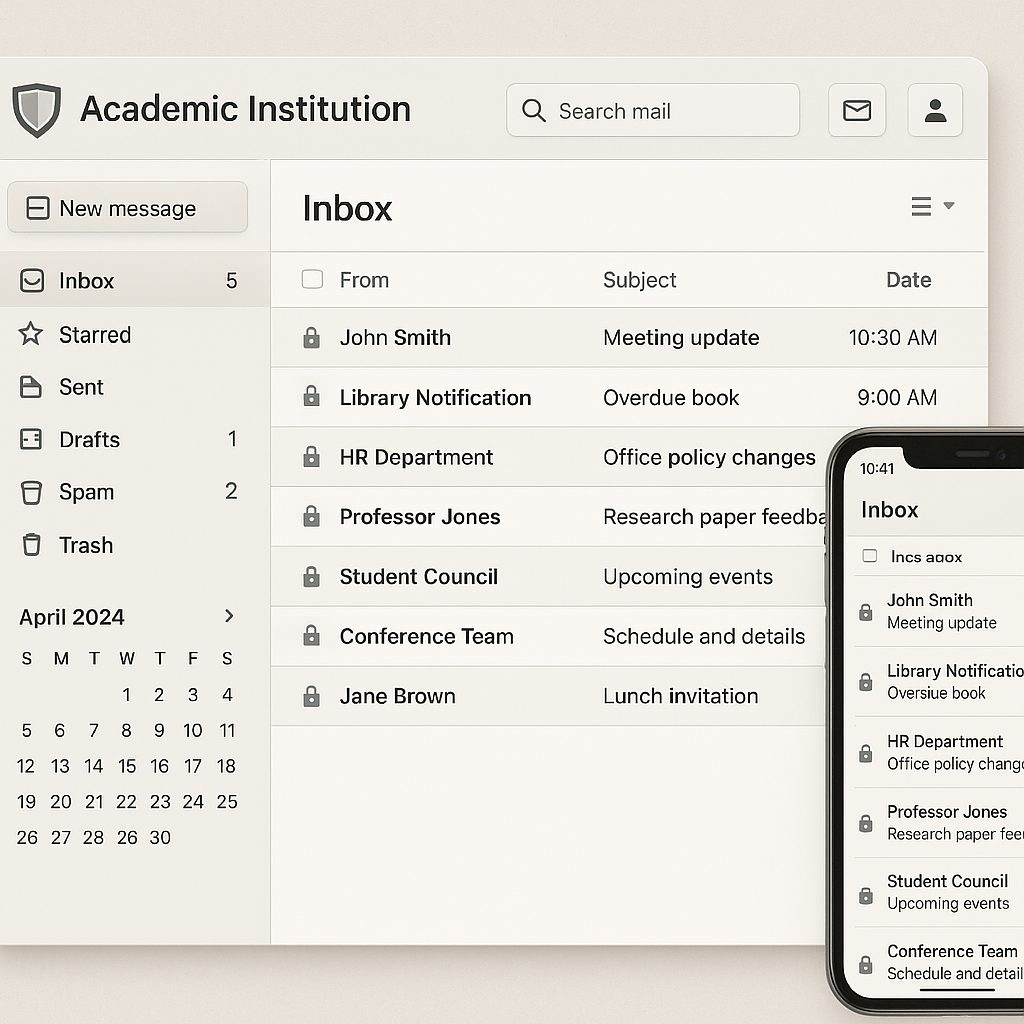
The Webmail AC Normandie offers a streamlined interface, designed for quick handling. The mailboxes are structured around classic folders (Inbox, Sent, Drafts) and include search and filter functions.
In practice, some teachers find the interface less modern than consumer solutions: limited customization, basic email templates, and sometimes cumbersome signature management. However, for daily administrative use, the whole remains perfectly functional and reliable.
Mobile compatibility is adequate, especially through the use of IMAP applications or redirections to mail clients: this facilitates quick responses to urgent messages, even away from the office.
Administration and Maintenance
The academic IT department centrally manages accounts, quotas, and retention rules. Routine operations (account creation, address modification) are quite standardized, which limits human errors and speeds up commissioning.
Operationally, the IT department offers mail restoration procedures in case of accidental deletion and a continuity plan in case of a major incident. This organization strengthens the trust of institutions relying on the service for their official communications.
| Aspect | Webmail AC Normandie | Consumer solution (e.g. Gmail) |
|---|---|---|
| Data control | Academic hosting / public contract | Commercial hosting |
| Customization | Moderate | High |
| ENT integration | Native | Via API |
| Support | Academic IT department | Vendor support |
Concrete Cases and User Feedback
In several institutions, the Webmail AC Normandie is used both for official summons, sending reports, and coordinating teaching teams. School principals emphasize the value of having a channel dedicated to institutional exchanges, separate from personal messaging.
For parent-teacher exchanges, the academic messaging guarantees traceability and preservation of official elements, which is valuable during administrative procedures. The management staff also appreciate the centralization of accounts for access rights management.
“Having an institutional messaging system clearly separates official communication from private content, and this simplifies internal audits.”
Internal report from a Normandy middle school – Communication department, 2023
Practical Tips for Users
Here are simple actions to make the most of Webmail AC Normandie while staying protected:
- Local backup: periodically export important folders.
- Filtering: learn to create rules to automatically sort messages.
- Attachments: prefer academic hosting services for large files.
- Two-factor authentication: enable it as soon as possible.
- Updates: ensure your mail clients support recent TLS.
- Reporting: use the academic procedure for any suspicious message.
Support, common issues and resolution
The most frequent issues concern forgotten passwords, exceeded quotas, and configuration difficulties on mobile devices. The standard procedure is to contact the IT support via a ticket, provide the user ID, and, if necessary, verify identity through the internal procedure.
In case of suspected compromise, it is crucial to change the password, inform the IT department, and activate the recent login verification procedure. This limits the scope of the attack and facilitates remediation.
Costs, governance and outlook
The service’s economic model relies on public budgets and maintenance contracts: this ensures a certain stability and predictability of costs. Governance remains under the responsibility of the academy, with shared management between the rectorate and local IT departments.
In the medium term, possible developments include improving ergonomics, enriching integrated collaborative tools, and strengthening real-time incident tracking. These developments should be driven by user feedback and educational priorities.
Conclusion and recommendation
Webmail AC Normandie is a robust solution adapted to institutional needs: security, traceability, and ENT integration make it a logical choice for institutions. For uses very focused on individual productivity or marketing, third-party solutions can complement the ecosystem, but for official management, nothing replaces the coherence of an academic service.
Recommendation: maintain the use of webmail for institutional communications, enable 2FA, and regularly train staff on phishing risks.
FAQ
How to access Webmail AC Normandie?
Access via the ENT or the URL provided by your institution, then authenticate with your academic credentials. In case of forgetting, follow the recovery procedure managed by your IT department.
What to do if my account is compromised?
Immediately change your password, report the incident to academic support, and follow the login verification procedure; remember to enable two-factor authentication.
Can I synchronize my email on my smartphone?
Yes, using IMAP/SMTP and the settings provided by the IT department; make sure to use a secure connection (TLS) and a password generated by a manager.
Does the webmail respect data confidentiality?
Yes: hosting and procedures comply with regulatory obligations (GDPR) and internal data retention policies.
How to increase my inbox if I exceed the quota?
Contact your institution’s IT department to request a quota review; meanwhile, archive locally or delete large items.
Are there anti-spam filters?
Yes, heuristic filters and blacklists reduce spam flow. Report any false positives to support to refine the rules.
Can calendars be shared via webmail?
Depending on local configuration, the service may offer CalDAV or basic sharing mechanisms; check the available options in your interface.
What to do in case of persistent technical error?
Gather screenshots and logs, open a ticket with the IT department detailing the context (browser, time, error message) to speed up resolution.