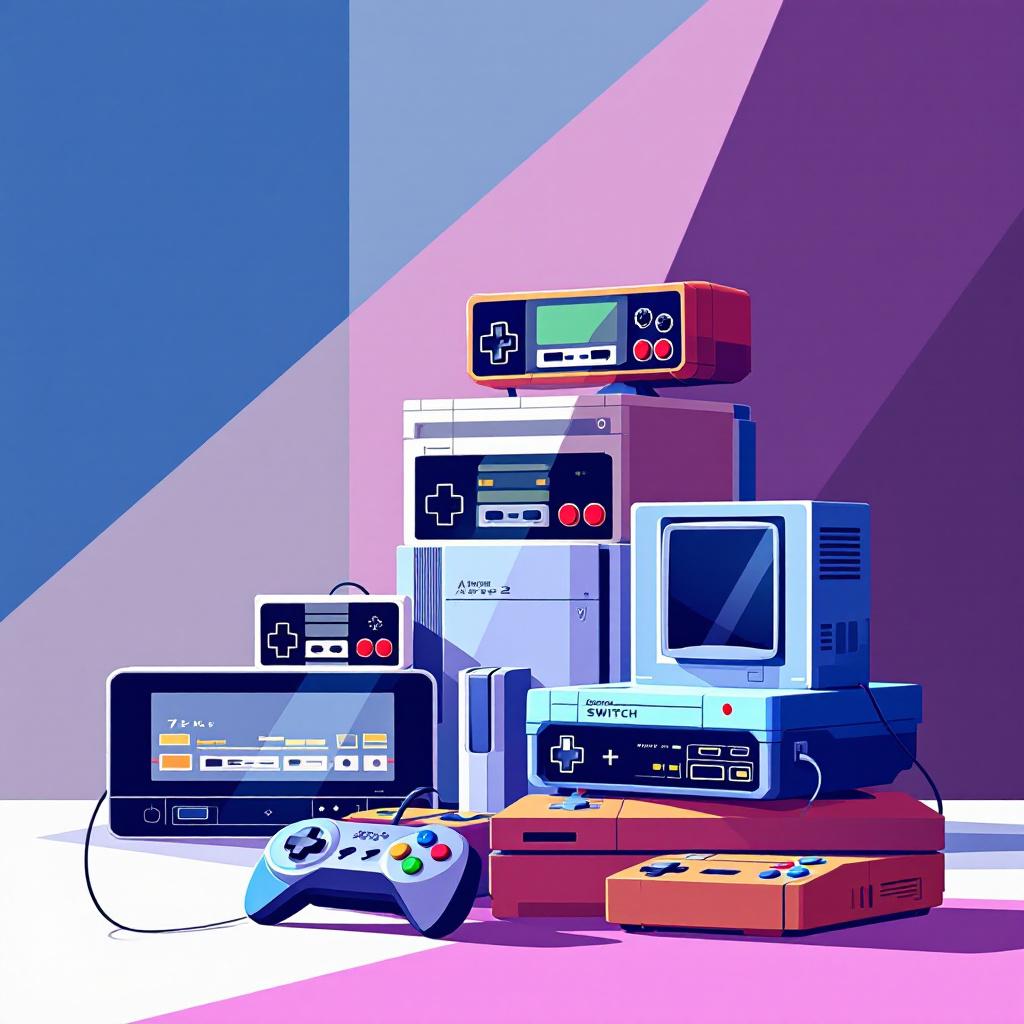
| Key Points | Details to Remember |
|---|---|
| 🎮 Genesis (1972) | Magnavox Odyssey invents the console concept with interchangeable games |
| 💥 Crash 1983 | Market crash followed by the Nintendo rebirth with the NES |
| 🔵🔴 16-bit Wars | Sega and Nintendo define gaming identity with Sonic and Mario |
| 📀 3D Revolution | CD-ROM and 3D processors change game production |
| 🌐 Connected Era | Xbox Live and PSN transform gaming into a social experience |
| 🔄 Hybridization | The Switch breaks the boundaries between home and portable |
The history of video game consoles reads like a technological novel. What began as white rectangles on a black screen has become a universe of interactive emotions. Each generation brought its breakthrough: from the first moving pixels to photorealistic open worlds, from one-button controllers to haptic feedback. Behind these plastic boxes lie fierce industrial battles, bold visionaries, and millions of players whose memories are written in pixels. Let’s dive into this saga where innovation meets pop culture.
Sommaire
Genesis (1972-1976): The Dawn of Home Video Gaming
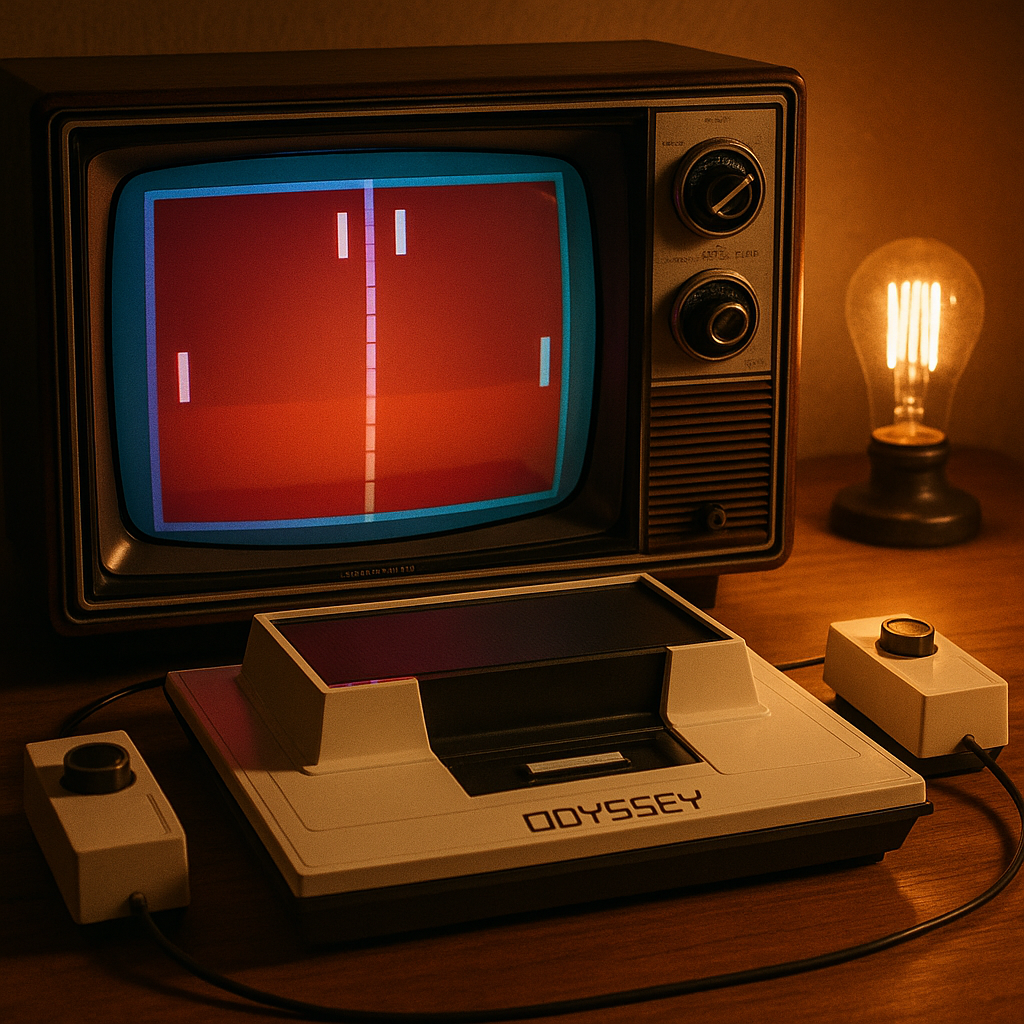
Ralph Baer, an unsung engineer, designed the Magnavox Odyssey in 1972. This beige box connected to the television offered 12 “games” via plastic overlays stuck on the screen. Without a processor or memory, its circuits generated three white squares and a vertical line. Yet, its modest success (350,000 sales) proved that you could play at home. In 1975, Atari popularized the concept with Pong, a simplified version of electronic table tennis. The cultural shock was immediate: bars equipped with arcade machines, households discovering electronic interactivity. The Fairchild Channel F introduced the interchangeable cartridge in 1976, freeing consoles from fixed games. This fundamental innovation allowed the Atari 2600 to dominate the market from 1977 with its home versions of Space Invaders and Pac-Man.
The 8-bit Era (1983-1989)
1983 marks the collapse of the North American market. Flooded with mediocre clones and untested games (including the infamous E.T.), the sector lost 97% of its value in two years. Paradoxically, this disaster paved the way for a complete overhaul.
Famicom/NES, Master System
The Nintendo Entertainment System (NES), released in Japan in 1983 and then in the USA in 1985, established a new model: strict quality control, royalties to publishers, and a charismatic mascot. Super Mario Bros. became the ideal pack-in, demonstrating the narrative possibilities of 8-bit. Facing this giant, the Sega Master System found its audience in Europe and Brazil thanks to clever partnerships with Master System. Its versions of Alex Kidd and Wonder Boy offered a colorful alternative to Nintendo’s hegemony.
Post-crash renaissance
What is Nintendo’s secret? A lockout system preventing unapproved publishers from releasing games on the NES. This control reassures distributors after the Atari debacle. At the same time, the handheld market emerges with the Game Boy in 1989. Its monochrome green screen and legendary battery life attract users despite technically superior competition from the Game Gear and the Lynx.
The 16-bit era (1989-1994)
The arrival of 16-bit transforms the Nintendo/Sega cold war into an open conflict. Bits become a marketing argument, TV ads clash fiercely, and players choose their side.
Mega Drive vs Super Nintendo
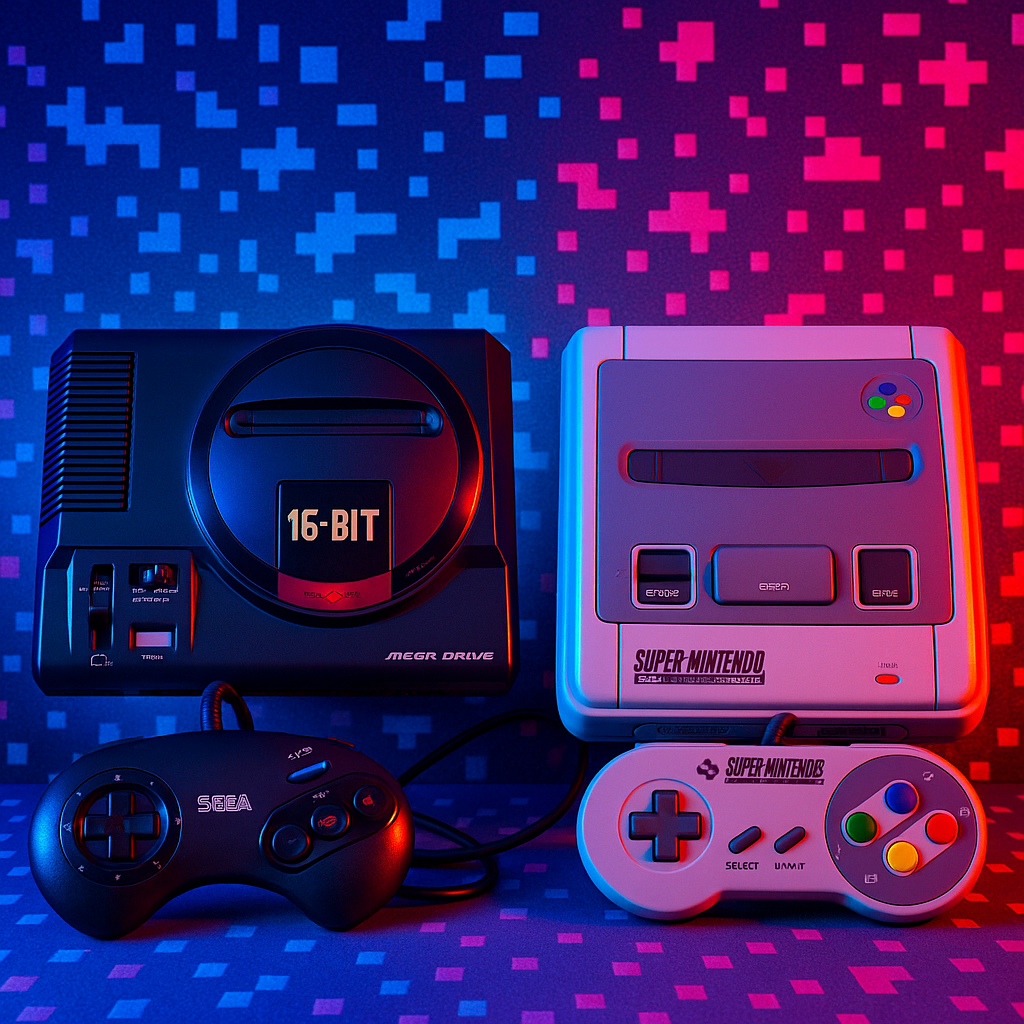
The Sega Mega Drive (Genesis in the USA) strikes first in 1989 with its slogan “Genesis does what Nintendon’t.” Sonic, the supersonic blue hedgehog, embodies this philosophy: speed, rebellious attitude, teenage target audience. Nintendo counterattacks in 1991 with the Super Nintendo (SNES) and its Mode 7 allowing 2.5D rotations. The technical duel peaks with Street Fighter II: the SNES version benefits from additional buttons, but the Mega Drive offers a more faithful arcade conversion via the 6-button controller.
Birth of iconic liches
This generation cements enduring franchises. Super Mario World (SNES) introduces Yoshi and gigantic levels. Sonic the Hedgehog (Mega Drive) popularizes loops and rings. On the RPG side, Secret of Mana and Phantasy Star IV lay the foundations of the genre. These titles finally exploit the color and sound capabilities of 16-bit, creating memorable atmospheres.
Transition to 3D (1994-2000)
The arrival of 3D processors and CD-ROM reshuffles the deck. Sony, an electronic outsider, shakes up the two historical giants with a disruptive approach.
PlayStation, Saturn, Nintendo 64
The Sony PlayStation (1994) appeals with its affordable price, CD player, and “adult” games like Resident Evil. Its lack of lockout attracts small studios. Sega responds with the Saturn, a complex machine with two processors, hampered by its cost and difficult development. Nintendo bets on cartridges with the Nintendo 64 (1996), offering sharper textures but limited capacity. However, the analog stick on its controller revolutionizes 3D control.
New paradigms
The CD-ROM allows orchestral soundtracks (Final Fantasy VII) and immersive cinematics. But it also introduces loading times, unknown in the cartridge era. The analog stick becomes essential for FPS games like GoldenEye 007. This period sees the birth of the first 3D open worlds with Super Mario 64 and The Legend of Zelda: Ocarina of Time, laying the foundations of modern game design.
Online & multimedia (2000-2006)
Internet transforms consoles into multimedia hubs. Microsoft enters the arena, while Sega leaves the hardware market after a final masterpiece.
The PlayStation 2 (2000) dominates thanks to its integrated DVD player and huge catalog. Its Emotion Engine processor enables feats like Shadow of the Colossus. Sega’s Dreamcast (1999), the first natively online console, creates cult classics with Shenmue and Jet Set Radio before disappearing in 2001. Microsoft arrives with the Xbox (2001) and its internal hard drive, propelling Halo into a cultural phenomenon. Nintendo surprises with the GameCube and its mini-DVDs, offering unique experiences like Super Smash Bros. Melee.
HD Consoles (2005-2013)
High definition divides strategies: race for power versus mass-market innovation.
Xbox 360 (2005) and PlayStation 3 (2006) engage in an expensive technical war, pushing HD and online (Xbox Live, PSN). Their multi-core architecture complicates development, leading to often inferior ports on PS3. Nintendo changes the game with the Wii (2006) and its Wiimote, attracting millions of non-gamers through Wii Sports. Its phenomenal success proves that user innovation can surpass raw power. On the portable side, the Nintendo DS popularizes the touch screen while Sony’s PSP focuses on UMD multimedia.
Generation 8 & 9 (2013-2025)
Technological convergence and hybridization redefine the console experience.
PlayStation 4 (2013) and Xbox One (2013) standardize PC architectures, facilitating multi-console development. Microsoft’s Game Pass revolutionizes game access via subscription. The Nintendo Switch (2017) merges portable and home console, becoming the third best-selling console in history. With the PS5 (2020) and Xbox Series X|S (2020), SSD eliminates loading times, optical drives enable denser worlds, and ray tracing simulates realistic lighting.
Current Trends and Perspectives
Material boundaries are fading: cloud gaming (xCloud, PS Now), backward compatibility, and cross-platform games become normal. Exclusives remain strategic weapons, but hybrid models (PS5 Digital Edition) and the service economy dominate. Manufacturers are now exploring VR, procedural AI, and persistent worlds. One constant remains: every technical innovation serves an age-old quest—to immerse the player in ever more captivating universes.
FAQ: History of Video Game Consoles
Which console initiated the first console war?
The Nintendo/Sega conflict in the 1990s was the first publicized “war,” with the Mega Drive against the Super Nintendo. Their rivalry defined aggressive marketing in video games.
Why did the Dreamcast become cult despite its commercial failure?
Its early death in 2001 crystallized its status as a visionary machine: first integrated modem, innovative games like Shenmue, and controllers with screens. It heralded the online era while remaining accessible.
How did the Switch revolutionize the market?
By merging portable and home console without major technical compromise, it created a new segment. Its flexibility meets modern lifestyles, proving that modest power can suffice with optimized games.
