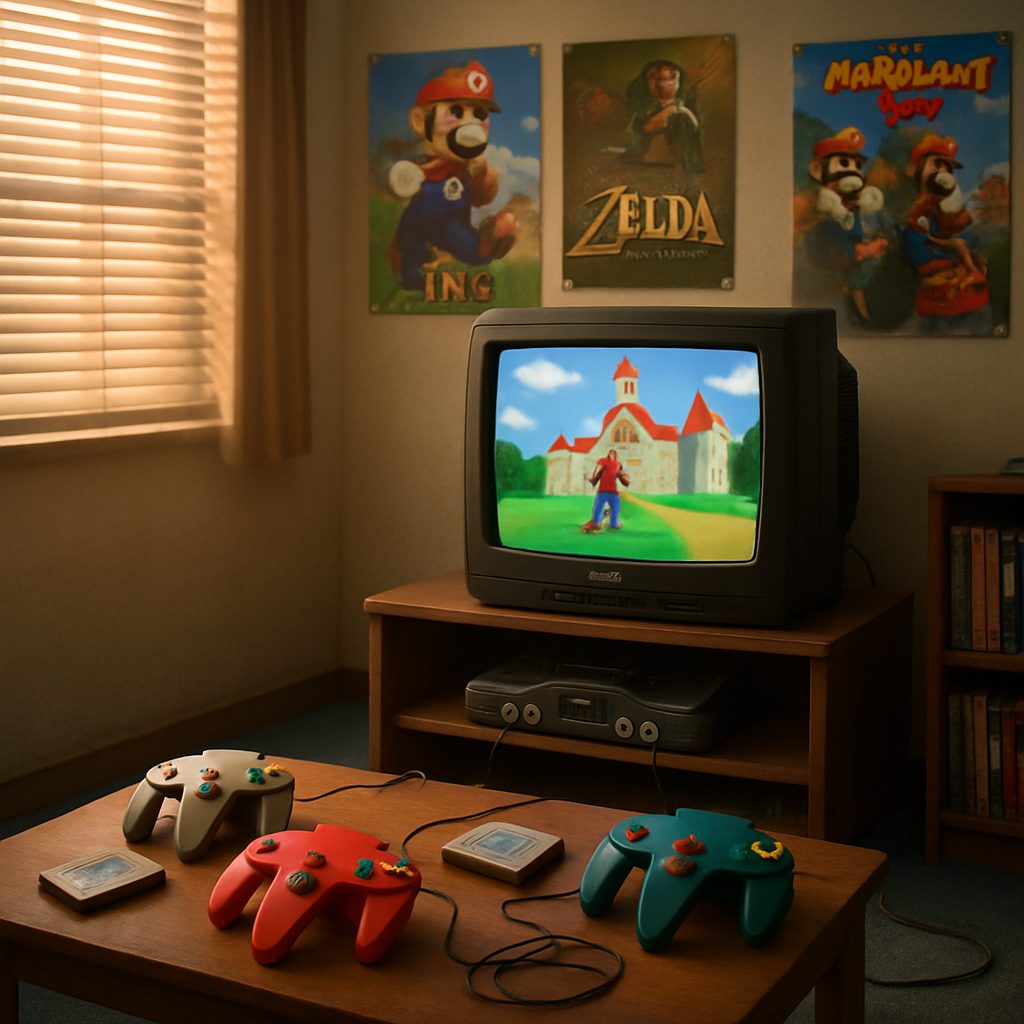
When Nintendo unveiled 64 bits in 1996, it was a bit like opening a door to a three-dimensional universe until then confined to professional arcade halls. With the Nintendo 64, the general public discovered the power of polygons, refined handling, and games that redefine their genre. From the Silicon Graphics-designed architecture to the cultural impact of legendary titles, this console marks a clear break. In short, it is not just a technological leap, but a true gaming revolution that still shapes our vision of video games today.
🎯 Launch in June 1996 in Japan (September 1997 in Europe) positioned the N64 as the first consumer 64-bit console.
⚙️ R4300i Architecture and Reality Coprocessor designed by Silicon Graphics offered unprecedented 3D graphics, still impressive on some games.
🎮 A rich library of classics (Super Mario 64, Ocarina of Time) redefined the standards of each genre.
💾 Unlike its CD rivals, the choice of cartridge favored lightning-fast loading times and increased durability, at the cost of limited capacity.
Sommaire
Context and genesis of the project
In the mid-90s, 3D games remained the domain of arcade machines or powerful PCs. Nintendo, buoyed by the success of its Super NES and the revival operated by the post-crash revival of consoles, decided to push three-dimensional exploration further. Joking aside, by collaborating with Silicon Graphics, the Japanese company laid the foundations for a dedicated processor and coprocessor, capable of rendering thousands of polygons on screen without flinching. This alliance was surprising at a time when one would expect Nintendo to turn less towards an external solution.
Technical innovations
CPU and 64-bit architecture
At the heart of the N64, the R4300i processor clocked at 93.75 MHz is based on a 64-bit architecture, a first for a home console. It communicates with 4 MB of RAM, expandable to 8 MB via the Expansion Pak. Decoding this choice, one understands that it is not just about numbers: increased precision in calculations improves texture rendering and animation fluidity. In other words, it is a real technological boost that propels virtual worlds into a new dimension.
3D polygon graphics
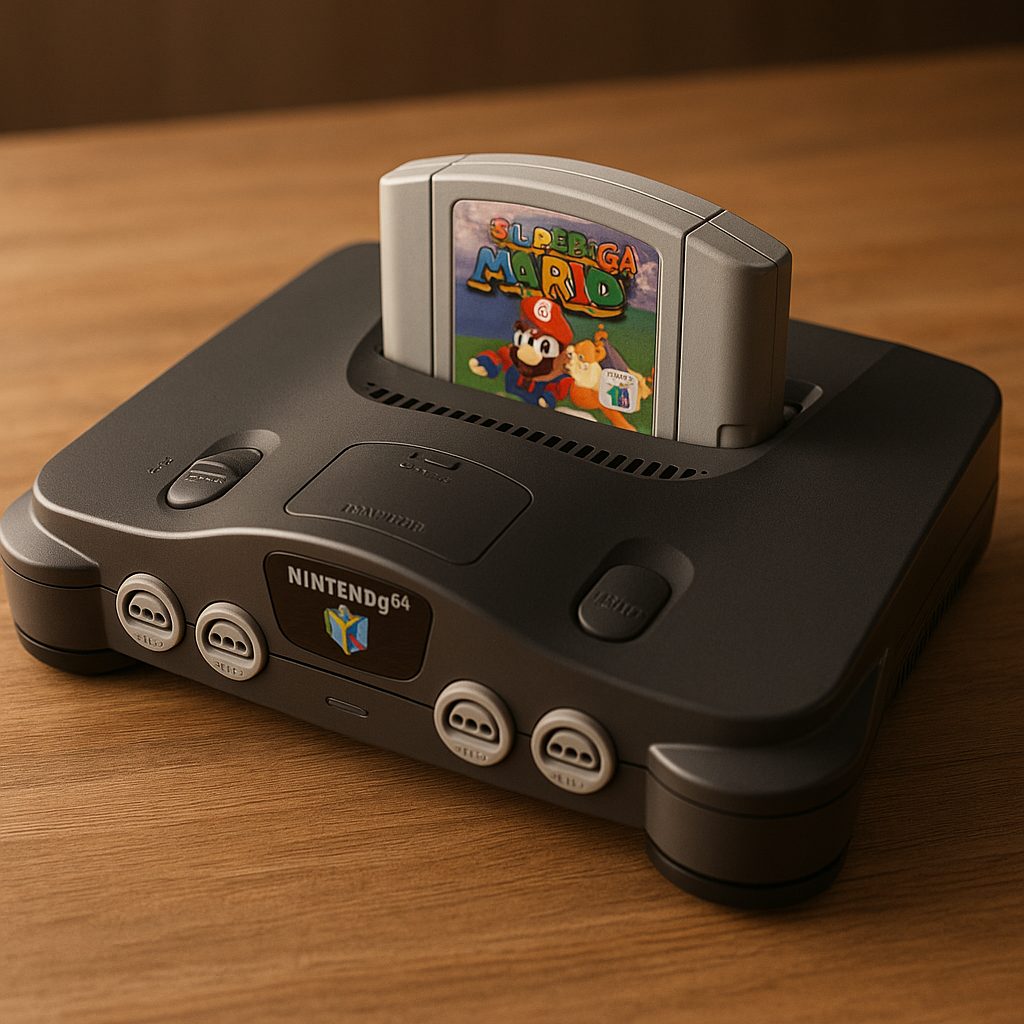
The famous Reality Coprocessor manages everything related to geometry and pixel shading. With it, Nintendo democratizes polygon 3D on a large scale, previously confined to professional productions. Developers, suddenly freed from certain constraints, dared vast panoramas and unprecedented camera movements. This is how Super Mario 64 imposed its revolution, becoming the undisputed showcase of this three-dimensional era.
A revolutionary game library
The strength of the N64 is not just in its components: it is measured above all by its games. Super Mario 64 creates a new gameplay language, Ocarina of Time breathes an epic dimension into adventure gaming, and GoldenEye 007 paves the way for competitive multiplayer. The icing on the cake is the intuitive handling of the analog stick, allowing for more organic movements, while the expansion pak proves essential for Majora’s Mask and Donkey Kong 64.
Before this 3D leap, Nintendo was already betting on portability: the original Game Boy and the chromatic evolution of the Game Boy Color had already proven that Nintendo never runs out of ideas.
Technical specifications
| Element | Characteristics |
|---|---|
| Processor | MIPS R4300i 64-bit at 93.75 MHz |
| RAM | 4 MB (expandable to 8 MB via Expansion Pak) |
| Graphics | Reality Coprocessor (SGI GPU) |
| Media | Proprietary cartridge (4 to 64 MB) |
| Notable accessories | Rumble Pak, Expansion Pak |
| Release | June 1996 (JP), Sept. 1997 (EU), Nov. 1996 (US) |
Competition and market impact
While Sony offers its PlayStation and Sega launches the Saturn, the Nintendo 64 plays the card of power and responsiveness. The choice of cartridge directly opposes the console to CD-based titles, which are larger but slower to load. On PC, Windows 95 enables stunning 3D games, but at prices out of reach for the general public. Ultimately, the N64 finds its audience by betting on controller ergonomics, the absence of downtime, and a selection of exclusive hits. For those studying the evolution of consoles from 1972 to today, this technological clash remains a key episode.
A legacy still alive
Beyond sales (32.9 million units), the Nintendo 64 imposed a new visual and gameplay language. Today, emulators and official compilations on Switch remind us that we remain fascinated by these angular textures. Speedrunners continue to push the limits of Super Mario 64, proof that the inventiveness of the original developers remains intact. The console may no longer be in production, but its footprint still shapes video game creation.
FAQ
Why did Nintendo choose the cartridge rather than the CD?
The cartridge ensures almost zero loading times and better protection against piracy, at the cost of reduced memory capacity (up to 64 MB). This decision favored in-game responsiveness and durability.
What was the best-selling game on the N64?
Super Mario 64 leads sales with over 11 million copies. Its innovative level design and pioneering controls make it indisputably an intergenerational classic.
Is the N64 backward compatible with the Super NES?
No, the Nintendo 64 does not read Super NES cartridges. To discover its library, you must go through compilations or authorized emulators.
