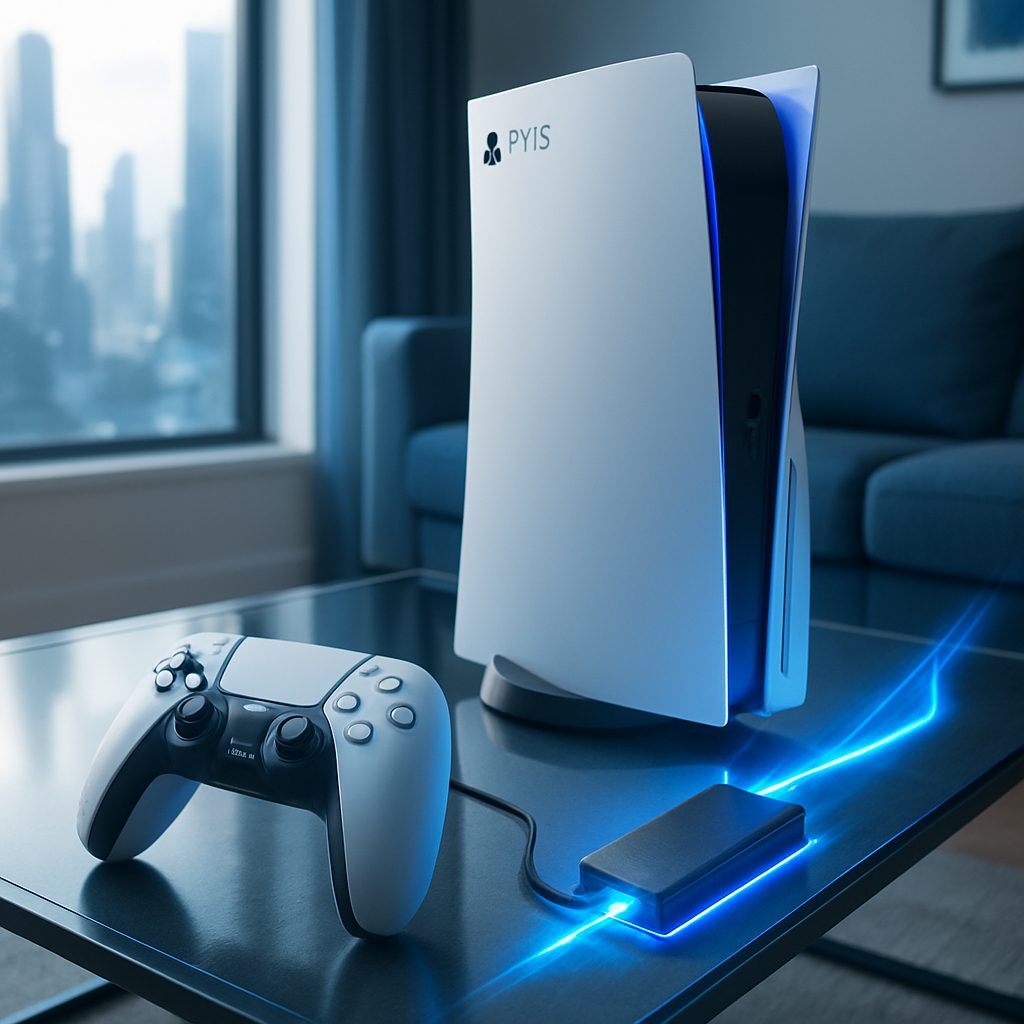
The PlayStation 5 disrupts benchmarks by combining instant storage, 4K graphics at 120 Hz, and the DualSense controller with unprecedented responsiveness. More than just a console, it represents a turning point in the hardware and sensory design of video games.
😀 825 GB SSD at 5.5 GB/s: levels flow seamlessly, promising near-instant immersion.
⚡ 4K/120 Hz and HDMI 2.1: high framerate, ultra-detailed image, and VRR support for stable rendering in all circumstances.
🎮 DualSense: adaptive triggers and haptic vibrations redefine the feel of every action, from braking in a race to the tension of a bow.
🔧 Complete technical sheet, comparison with high-end PCs, and overview of Xbox Series X rivals to position the PS5 in the technology race.
Sommaire
Ultra-fast SSD: the comeback of storage
In a world where textures multiply and open worlds reach colossal proportions, the PS5’s SSD is not just an accessory: it relies on a custom NVMe chip delivering up to 5.5 GB/s in raw read speed. By comparison, many high-end gaming PCs peak around 3 GB/s on standard NVMe SSDs. This feat drastically reduces loading times and enables unprecedented game design concepts, such as on-the-fly asset streaming.
Architecture and embedded technologies
The key to this speed lies in the combination of a proprietary controller, GDDR6 memory, and an optimized input-output system. A hardware decompression engine named Kraken (inspired by Radeon’s) works in parallel to extract compressed data without overloading the CPU. Result: even cinematic sequences launch in the blink of an eye.
« Loading an open world in under two seconds redefines the promise of immersion. »
4K/120 Hz visuals: a new standard
The PS5 is based on a customized AMD RDNA2 graphics chip, capable of pushing up to 10.28 TFLOPS. Coupled with support for ray tracing and dynamic HDR, it takes 4K resolution at 120 Hz to the next level. To enjoy this, a screen or TV compatible with HDMI 2.1 is necessary, along with a suitable cable.
Compatibility and best practices
To fully exploit this bandwidth, opt for an HDMI 2.1 cable certified “48 Gbps”. The VRR and ALLM (Auto Low Latency Mode) options are configured directly in the console menus and guarantee smooth rendering, without screen tearing or annoying latency.
DualSense: tactile sensations and immersion
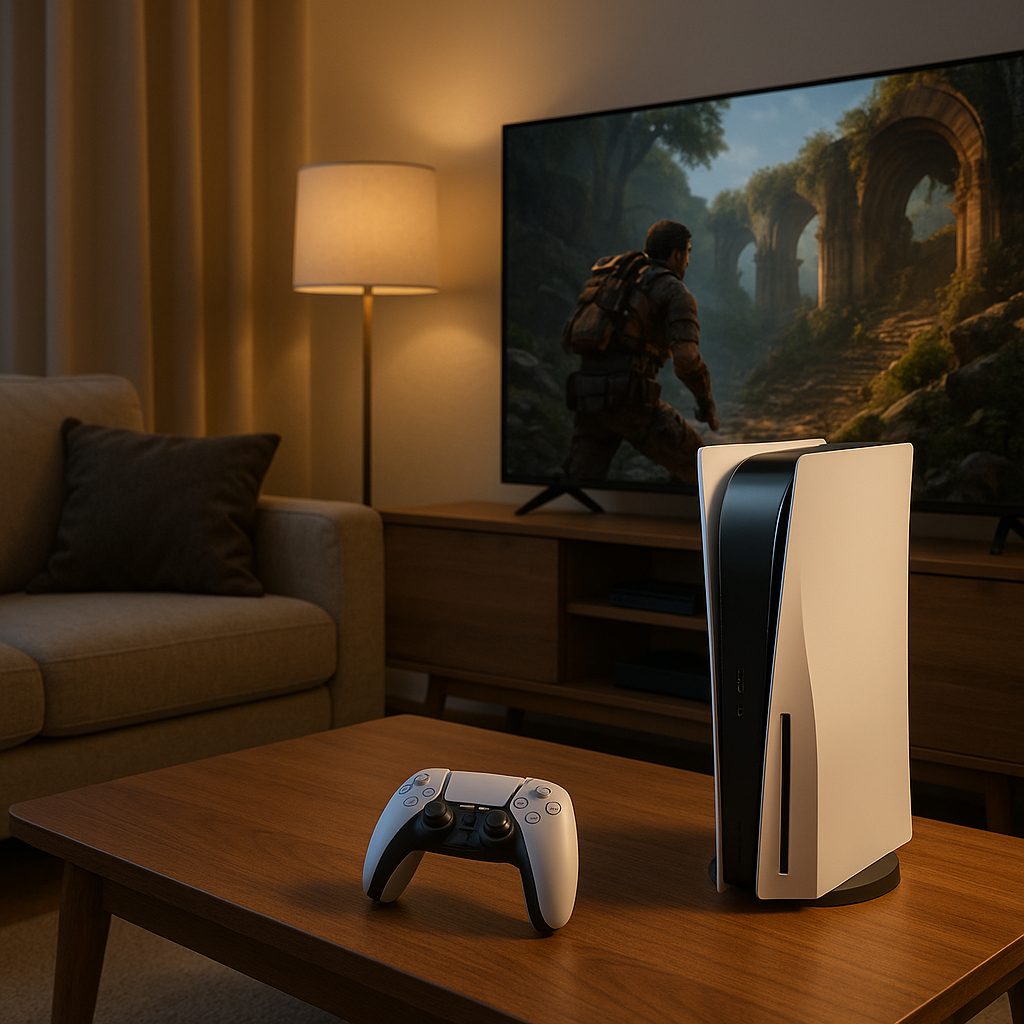
The DualSense controller shakes up habits with two major innovations: adaptive triggers that modulate according to applied pressure and an ultra-responsive haptic vibration system. More than simple feedback, each game sequence is accompanied by a nuance of resistance or texture feedback, whether it’s the crackle of an engine or the snap of a guitar string.
Comparison with competing controllers
- Xbox Series X/S: powerful vibrations, but no adaptive triggers.
- Nintendo Switch Pro: comfortable ergonomics, but more basic haptic feedback.
- Third-party PC controllers: often modular, but rarely integrated into game engines.
Technical Sheet
| Component | Specifications |
|---|---|
| CPU | AMD Zen 2, 8 cores at 3.5 GHz |
| GPU | AMD RDNA2, 10.28 TFLOPS |
| RAM | 16 GB GDDR6/256-bit |
| Internal Storage | NVMe SSD 825 GB, 5.5 GB/s |
| SSD Expansion | M.2 slot compatible with PCIe 4.0 |
| Optical Drive | 4K UHD Blu-ray |
| Ports | USB-C, USB-A, Ethernet, HDMI 2.1 |
| Connectivity | Wi-Fi 6, Bluetooth 5.1 |
Competition: High-End Gaming PC and Xbox Series X
Compared to a PC equipped with a GeForce RTX 3080 or a Radeon RX 6800 XT, the PS5 plays the card of price/performance ratio and simplicity. The cost of a comparable rig, including motherboard, high-performance CPU, cooling, and SSD, often exceeds that of a ready-to-use console. On the console side, the Xbox Series X offers similar power and some advantages with Game Pass, but it falls behind in SSD transfer rate and controller ergonomics.
To place the PS5 in the long history of home devices, one can draw benchmarks from the evolution of video game consoles, from the Atari 2600 to recent models, and measure the scale of this technological leap.
FAQ
How is the PS5’s SSD different from a PC SSD?
The console integrates a custom controller and a hardware decompression algorithm (“Kraken”) that smooth data access and limit CPU load, offering loading times impossible to achieve with a standard PC SSD.
Which cables and screens should be chosen for 4K/120 Hz?
Favor a TV or monitor certified HDMI 2.1 and a 48 Gbps cable. Some manufacturers explicitly mention support for VRR and ALLM for optimal display.
Does the DualSense work on PC?
Yes, via USB or Bluetooth. Some PC games perfectly handle haptic vibrations and adaptive triggers, provided they are optimized.
