
When the Xbox 360 arrived at the end of 2005, it not only inaugurated Microsoft’s second generation of consoles: it sparked a true revolution in network gaming and high-definition rendering. While its competitors were still navigating between physical media and fledgling online services, the Redmond company bet on a robust service and a noticeable extra pixel to unite players and developers around new video game practices.
Sommaire
In brief
🕹️ Thanks to its **triple-core processor** and a GPU designed for HD, the Xbox 360 offered an unprecedented graphical experience, bringing **1080p** into gamers’ living rooms.
🌐 The **Xbox Live** standardized paid online matches: before it, multiplayer often required a PC or third-party services. This one-stop shop disrupted the console ecosystem.
📺 Between consoles, PC, and streaming services, the Xbox 360 laid the foundations of connected gaming, influencing digital distribution and the frantic competition in a universe seeking more pixels.
Genesis and market positioning
Against the backdrop of the first Xbox’s mixed success, Microsoft designed the 360 to address two challenges: catch up with the thunderous launch of the PlayStation 3 while riding the casual wave of the Wii. From its earliest sketches, the idea germinated to place **online gaming** at the heart of the project, even if it meant making domestic bandwidth the new playground. This strategy fits into an evolution of consoles where each generation redefines both the image and the technology of interactive entertainment.
The targeted audience oscillates between the hardcore gamer seeking finer graphics and the casual player attracted by an intuitive service. Alliances forged with publishers for exclusives (Gears of War, Halo 3) solidified a catalog appealing against the competition. Paradoxically, it is in the ability to bring together these two axes that the Xbox 360 found its place.
Democratization of Xbox Live
An unprecedented infrastructure
At the time, establishing a paid network on console was a risky bet. Yet, Microsoft deployed redundant servers and encryption protocols to guarantee the stability and security of exchanges. Live Arcade allowed independent studios to shine without physical media, fostering creativity often absent on DVD support. It is this robust architecture that made Xbox Live a model followed by the competition.
Communities and digital content
Each Xbox Live profile became a showcase: avatar, gamer score, achievements… These elements introduced a visible sense of progression and emulation between friends and strangers. Over the years, the online store welcomed movies, series, and DLC, transforming the console into a multimedia gateway. Without falling into an overly closed ecosystem, this openness fueled both addiction and the need to offer ever more value-added services.
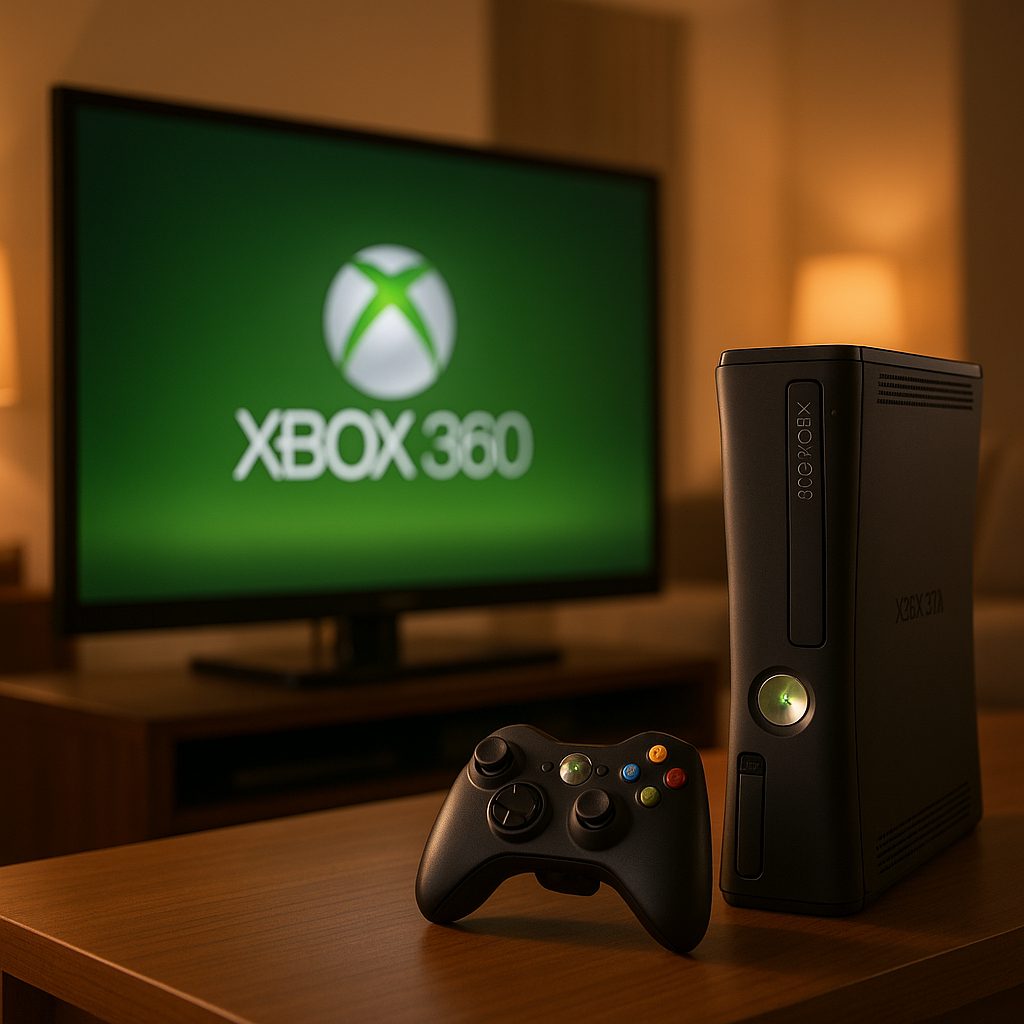
The rise of HD gaming
Exploiting High Definition
The transition from standard resolution to 720p, then to 1080p, redefined developers’ priorities: more detailed textures, wider fields of view, enhanced visual effects. Studios had to optimize their production pipeline to take advantage of the 512 MB of GDDR3 RAM, while juggling real-time shader generation. Players, for their part, discovered how much immersion depended on image clarity and smoothness.
Impact on Developers and Players
Behind the pixels, there was a upheaval in working methods. Several teams invested in more powerful workstations, calibrated to simulate HD rendering even before the console entered homes. Players, on their side, invested in compatible TVs, redefining the criteria for choosing a living room television. Bundles with HD screens multiplied, contributing to the penetration of high definition in European and American households.
Technical Specifications
| Component | Specification |
|---|---|
| CPU | Triple-core IBM PowerPC at 3.2 GHz |
| GPU | ATI Xenos at 500 MHz with 10 MB eDRAM |
| RAM | 512 MB unified GDDR3 |
| Storage | Removable hard drives (20 to 500 GB), 256 MB flash memory |
| Media | DVD ± R drive, HD-USB port, HD-DVD compatibility (optional module) |
Competition from PCs and Other Platforms
While the Xbox 360 shifted the console landscape, the PC remained a playground where HD and online gaming were already established. Modders offered free content, higher resolutions, and often higher framerates. Yet, the simplicity of Xbox Live—interface, standardized controller, absence of complex network settings—made it a springboard to online gaming for millions of households. As for the Wii, it drew on accessibility without chasing pixel counts, demonstrating that innovation could take other forms.
Legacy and Influence
Beyond its sales figures, the Xbox 360 has left a lasting mark on the video game landscape. It instilled the idea that a console is judged as much by its catalog as by its online services. Subscriptions, the concept of achievements, community ranking… these principles remain at the heart of current ecosystems. Even the latest generation of Xbox and PlayStation rests on foundations laid by this hybrid model between hardware and service.
FAQ
What is the key to Xbox Live’s success?
Its strength lies in the robustness of the infrastructure, ease of use, and a game catalog designed to encourage multiplayer. The paid subscription also financed server expansion, ensuring a stable service.
Was the Xbox 360 really more powerful than its contemporaries?
On paper, it rivaled the PlayStation 3, sometimes falling behind on certain floating-point calculations. In practice, developers often preferred targeting the 360 to streamline development and guarantee a more consistent experience.
What has HD gaming brought to gameplay?
Beyond simple sharpness, HD allowed for wider fields of view, refined interfaces, and improved readability of on-screen information, thus enriching the tactical and immersive dimension.
Can you still play online on an Xbox 360 today?
Microsoft still maintains some of the servers, but certain ancillary services (VoD, DLC purchases) have been gradually shut down. The Equipment mode of hundreds of titles often remains accessible in local and online multiplayer for the most determined.
