
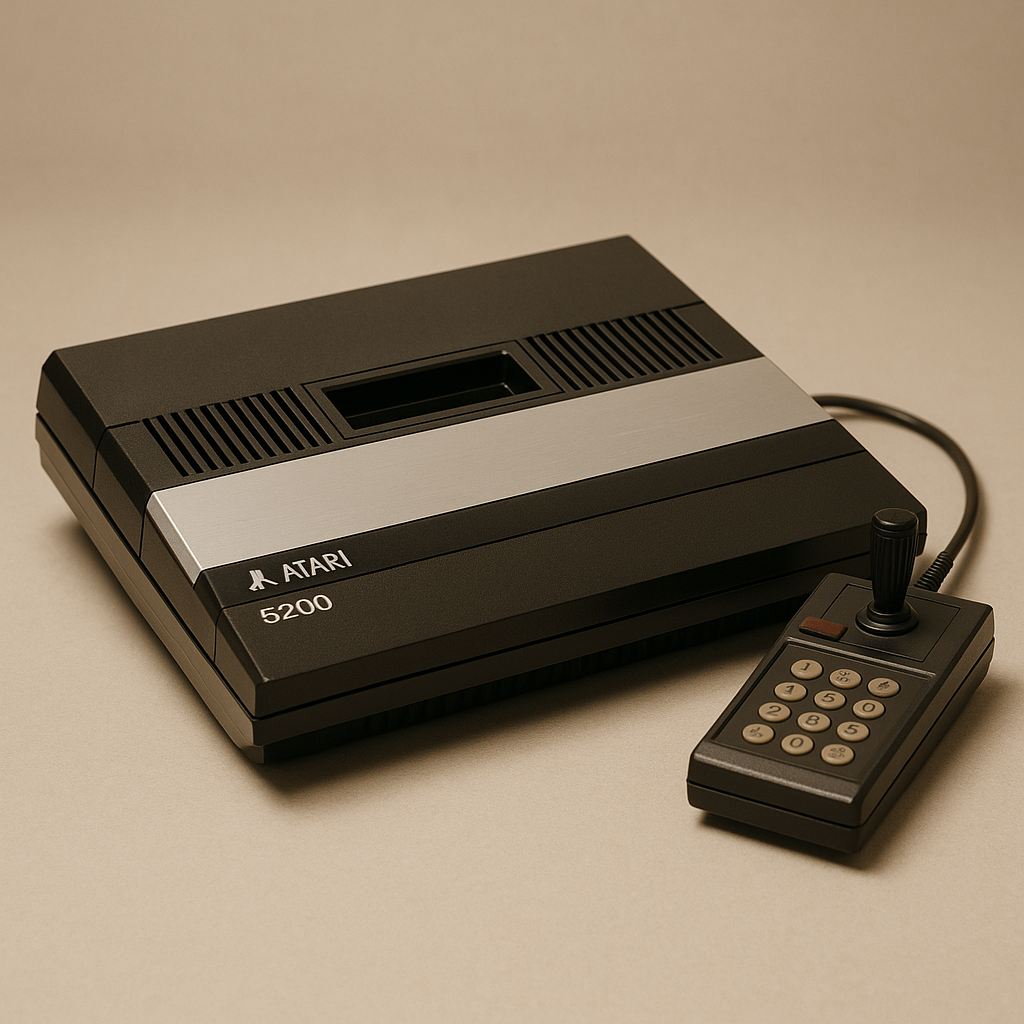
When the 2600 established itself in living rooms at the end of the 1970s, Atari was already considering a successor that would meet video game expectations. Released in 1982, the 5200 embodied this ambition, supported by upgraded hardware and flattering graphics. However, several technical decisions and a fierce competitive context turned the promised home computer into a resounding failure, despite its undeniable contribution to the evolution of consoles.
📌 Historical context: released in 1982, the Atari 5200 aimed to surpass the performance of the 2600, but suffered delays and awkward design choices.
⚡️ Key specifications: Custom MOS 6502C processor, 16 KB of RAM, proprietary cartridges, sliding joystick controllers considered unreliable.
🎯 Severe competition: between the Mattel Intellivision and the rise of home microcomputers, the 5200 faced a “graphics war” and an increasingly demanding clientele.
💡 Paradoxical legacy: despite its commercial failure, the 5200 foreshadowed the shift to more powerful consoles, while highlighting the importance of ergonomics and game compatibility.
Sommaire
The origins and design of the 5200
Second generation ambitions
Atari struggled to maintain its dominance after the dazzling success of the 2600. Internal teams then dreamed of a machine capable of competing with the graphic buckets of microcomputers and outpacing the Intellivision. The goal: to offer finer images, more colors, richer sound, and compatibility with a new cartridge standard. Relying on internal technological building blocks, Atari based the 5200’s architecture on a revised chipset, derived from the abandoned personal computer project.
Technical comparison with the 2600
On paper, the 5200 outclasses the older console: MOS 6502C processor clocked at 1.79 MHz (versus 1.19 MHz), ANTIC graphics chip capable of displaying up to 256 colors, and flagship memory of 16 KB compared to 128 bytes on the 2600. However, this additional power comes with a complex interface and a shaky BIOS that slow down game development. Creators reproached Atari for incomplete documentation and a cartridge incompatible with the 2600, breaking the much-anticipated backward compatibility for players.
Technical specifications
| Element | Detail |
|---|---|
| Processor | MOS 6502C at 1.79 MHz |
| RAM | 16 KB |
| Graphics | ANTIC chipset with 256 color palette |
| Audio | POKEY (4 channels) |
| Storage | Proprietary cartridges (not compatible with 2600) |
| Controllers | Sliding analog joystick |
Graphic Innovation and Ergonomic Obstacles
Cutting-edge visuals… for the time
The ANTIC chipset of the 5200 rivals the best chips seen on microcomputers. The backgrounds gain in detail, the sprites are more numerous, and the colors more nuanced. Some titles fully exploit these capabilities, giving the illusion of a generational leap. However, incomplete technical documentation pushes developers to bypass the chips or improvise routines, which results in the uneven quality of the catalog.
Controllers: creativity or headache?
Atari designed a sliding analog joystick, intended to offer more precision. In reality, the slider gets dirty, the contacts wear out, and the haptic feedback lacks responsiveness. An irony when trying to enhance gameplay. Many players end up replacing their official controllers with third-party models. This frustrating experience contributes, often unnoticed, to the decline in sales.
A hostile market and fierce competition
Mattel Intellivision and the battle of rendering
As the 5200 hits the shelves, Mattel’s Intellivision already boasts smoother graphics and more responsive numeric controllers. In this “first graphics war,” Atari struggles to assert its technical lead, especially since the Intellivision’s software support is more stable, better documented, and benefits from agreements with third-party publishers.
Personal computers: an unexpected rival
At the same time, the rise of home microcomputers (Apple II, TRS-80, Commodore 64) attracts households. The taste for versatile machines shakes the idea of a simple “cartridge player” and blurs the line between console and computer. The selling price of the 5200 places it in direct competition with these machines capable of word processing and programming.
The reasons for a failure and its impact
Key factors of the commercial setback
- High complexity and production cost compared to simpler consoles
- Durability issues with controllers harming the user experience
- Limited game catalog, delayed by incomplete technical documentation
- Competition from Intellivision and versatile microcomputers
A paradoxical assessment
The end of the 5200 marks one of Atari’s most instructive turning points. Engineers learned the importance of a single standard for consumables (cartridges, controllers) and the necessity of a complete SDK. Subsequent consoles, and later the 7800, benefited from these lessons to offer more reliable backward compatibility and smoother game development.
FAQ
Why wasn’t the 5200 cartridge compatible with the 2600?
Atari redesigned the pinout and electronic connection to fully exploit the new graphics and sound chips, making a format overhaul inevitable but penalizing the installed base.
What were the differences with Mattel’s Intellivision?
Beyond the color palette, the Intellivision relied on numeric keypad controllers, clear documentation, and solid partnerships, whereas the 5200 suffered from delays in its software support.
Which titles showcased the power of the 5200?
Some games like Super Breakout and Ms. Pac-Man illustrate the visual potential, even if the majority of the catalog did not exploit the advanced capabilities of the ANTIC chipset.
Did the failure of the 5200 influence the creation of the 7800?
Absolutely: the 7800 incorporates from its design backward compatibility, a complete SDK, and redesigned controllers, benefiting from the lessons of the previous generation.
