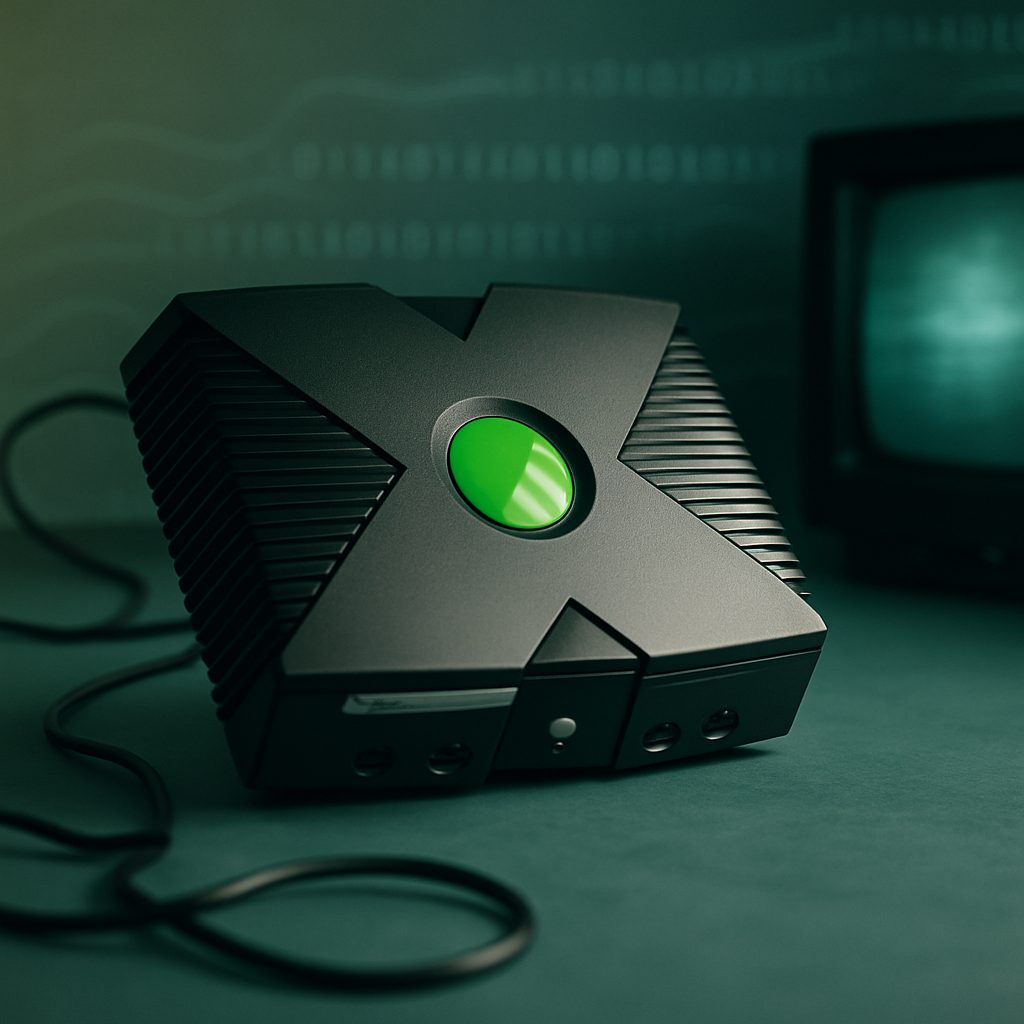
November 2001. While the video game world is living to the rhythm of the PlayStation 2 and the GameCube, a new player breaks into the market with an unlikely product: a software giant enters the treacherous console field. Microsoft’s Xbox, born from a meeting between Bill Gates’ boundless ambition and the fear of missing the digital revolution, will upset the balance of power. This machine, designed as a disguised PC, sold at a loss in an aggressive strategy, did not have the game won in advance against Sony, Nintendo, and Sega.
🚀 A crazy technological bet: The Xbox features an Intel Pentium III 733 MHz processor and an integrated hard drive – a first on a console – openly challenging the technically inferior PS2. Its NVIDIA GPU revolutionizes textures with unprecedented bump mapping effects.
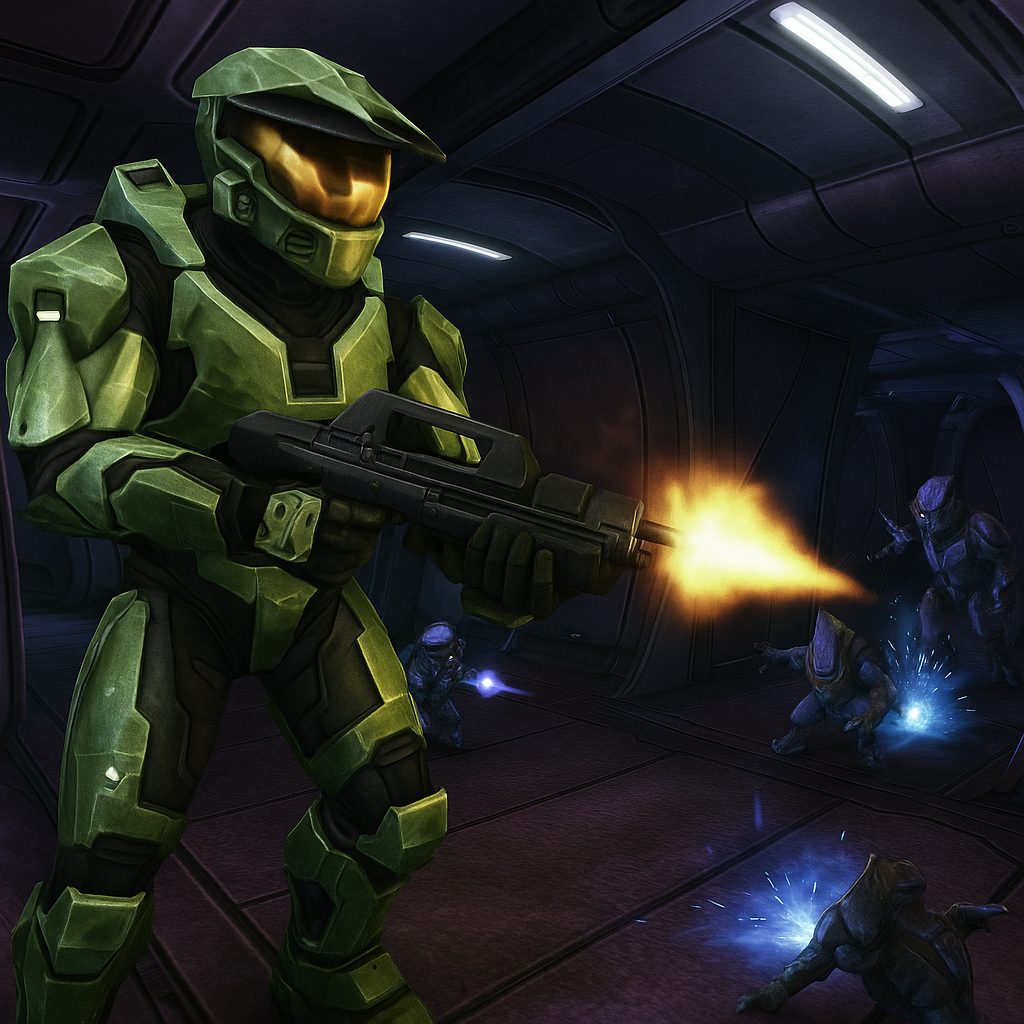
🎮 Halo, the ultimate weapon: Bungie’s FPS, specially acquired by Microsoft, becomes the console’s best-selling game (5 million copies) and invents online shooting games on console via the nascent Xbox Live.
💸 Kamikaze strategy: Sold for $299 (i.e., $100 less than its production cost), Microsoft absorbs colossal losses – nearly 4 billion dollars – to establish itself sustainably against Sony.
Sommaire
The explosive context: Microsoft in the lion’s den
In 1999, the console market looks like a post-apocalyptic battlefield. Sony dominates with its PlayStation, Sega is dying with the Dreamcast, and Nintendo is preparing its GameCube. Bill Gates, meanwhile, sees a greater danger: the convergence between PC and living room. The PlayStation 2, with its integrated DVD player, threatens to become the digital hub of homes – a territory Microsoft considers its own. As an internal leaked report points out: “Sony is enemy number 1. Their machine is a Trojan horse to invade our platforms.” The response? Build an in-house console, even if it means defying the economic laws of the sector.
A tense genesis: from the “Midway” project to the black beast
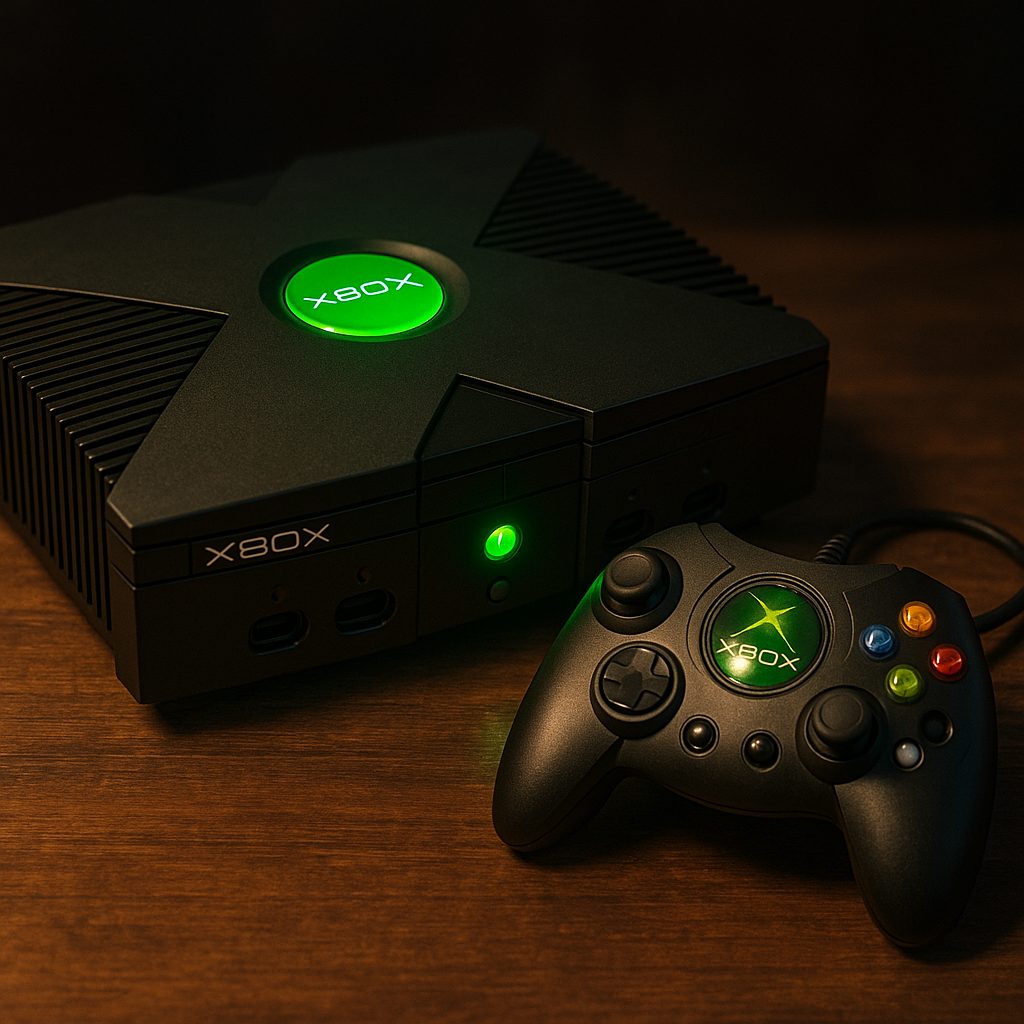
Development, named “Project Midway,” starts in utmost secrecy. The team, led by the eccentric Seamus Blackley (a physicist turned video game developer), opts for an iconoclastic approach: rather than custom hardware like its competitors, the Xbox recycles high-end PC components. A choice that facilitates game porting but increases costs. Engineers must solve unusual challenges: how to dissipate heat from an overclocked Pentium III? Why does the prototype explode during a surge test? And above all: how to convince third-party publishers, skeptical of this intruder from the Windows world?
Technical sheet: the PC that dreamed of being a console
| Component | Specifications | Advantage over the PS2 |
|---|---|---|
| CPU | Intel Pentium III 733 MHz | +40% raw power |
| GPU | NVIDIA NV2A 233 MHz | Superior lighting effects and textures |
| RAM | 64 MB DDR | Double the RAM |
| Storage | 8 GB hard drive | Saves and downloadable content |
| Media | DVD-ROM 5x | Same capacity but slower loading |
This configuration creates a cultural shock: where Sony and Nintendo optimize every transistor for gaming, Microsoft bets on the brute force. The hard drive, in particular, allows for radical innovations: unlimited saves, customizable soundtracks in sports games, and above all – the prefiguration of Xbox Live – downloadable additional content. A luxury unthinkable on memory cartridges.
The price trap: selling at a loss to conquer
The real stroke of genius (or madness) lies in the pricing strategy. Each Xbox costs $425 to produce… for a retail price set at $299. Microsoft thus assumes a loss of $125 per unit, compensated by royalties on games. An approach modeled on the razor and blades model, but on an unprecedented industrial scale. Peter Moore, then VP at Microsoft, sums it up: “We weren’t selling a console, we were buying market share with burning checks.” Result: 1.5 million units sold in 3 months, despite a failed launch in Japan where the bulky design is mocked.
The exclusivity war: Halo versus Gran Turismo
While the hardware impresses, the catalog initially pales in comparison. Only 20 titles accompany the launch, against 29 for the PS2. But Microsoft has a trump card: Halo: Combat Evolved. Bought from Apple for 30 million dollars, this FPS revolutionizes console gaming with:
- An automatic environment reloading system (no loading times)
- Enemy artificial intelligence never seen before
- A two-player split-screen cooperative mode
The title becomes the flagship of the Xbox, even overshadowing PS2 exclusives like Metal Gear Solid 2. Yet, other key titles struggle to convince: Project Gotham Racing suffers in comparison to Gran Turismo 3, and Oddworld: Munch’s Oddysee disappoints with its gameplay. Microsoft quickly understands: to survive, it must win over Japanese studios – a titanic challenge against Sony’s grip on the Japanese market.
The shadow of predecessors: lessons from historical failures
Microsoft carefully studies the failures of previous consoles to avoid their pitfalls. The Atari Jaguar and its so-called “64 bits” remind it that a complex architecture discourages developers. The Atari 5200 illustrates the dangers of incompatibility with previous games (unlike the Xbox, backward compatible via PC emulation). As for the Mattel Intellivision, pioneer of the “spec wars” against the Atari 2600, it proves that raw power is not enough without ergonomics – hence the urgent redesign of the “Duke” controller, deemed too bulky. These lessons nurture a pragmatic approach: rather than a break, Microsoft aims for gradual integration into the existing ecosystem.
Xbox Live: the time bomb
The real turning point came in 2002 with the launch of Xbox Live. For $50 per year, players gain access to:
- An integrated headset microphone
- A unique identifier (Gamertag)
- Dedicated servers for smooth gameplay
Unlike Sega’s Dreamcast, the paid model ensures premium service quality. Result: 500,000 subscribers in 6 months, and games like MechAssault or Tom Clancy’s Splinter Cell that turned multiplayer into a social phenomenon. This innovation sealed the console’s fate: even with “only” 24 million units sold (compared to 155 million for the PS2), the Xbox laid the foundations of an online empire whose success would explode with the Xbox 360.
The legacy: a springboard to domination
In hindsight, the original Xbox looks more like a bold prototype than a finished product. Its bulky design, noisy fans, and failure in Japan should have doomed it. Yet, it achieved the essentials:
- Establish Microsoft as a credible player against Sony and Nintendo
- Validate the “hardware sold at a loss” economic model
- Lay the groundwork for an integrated digital ecosystem
Its disappearance in 2006 paved the way for the Xbox 360, which corrected its flaws while capitalizing on its Live network. A winning strategy: today, gaming represents 15 billion dollars annually for Microsoft, proving that Gates’ bet – costly as it was – was visionary. As a former team member sums it up: “We didn’t sell a console in 2001. We planted a flag on an unknown planet.”
