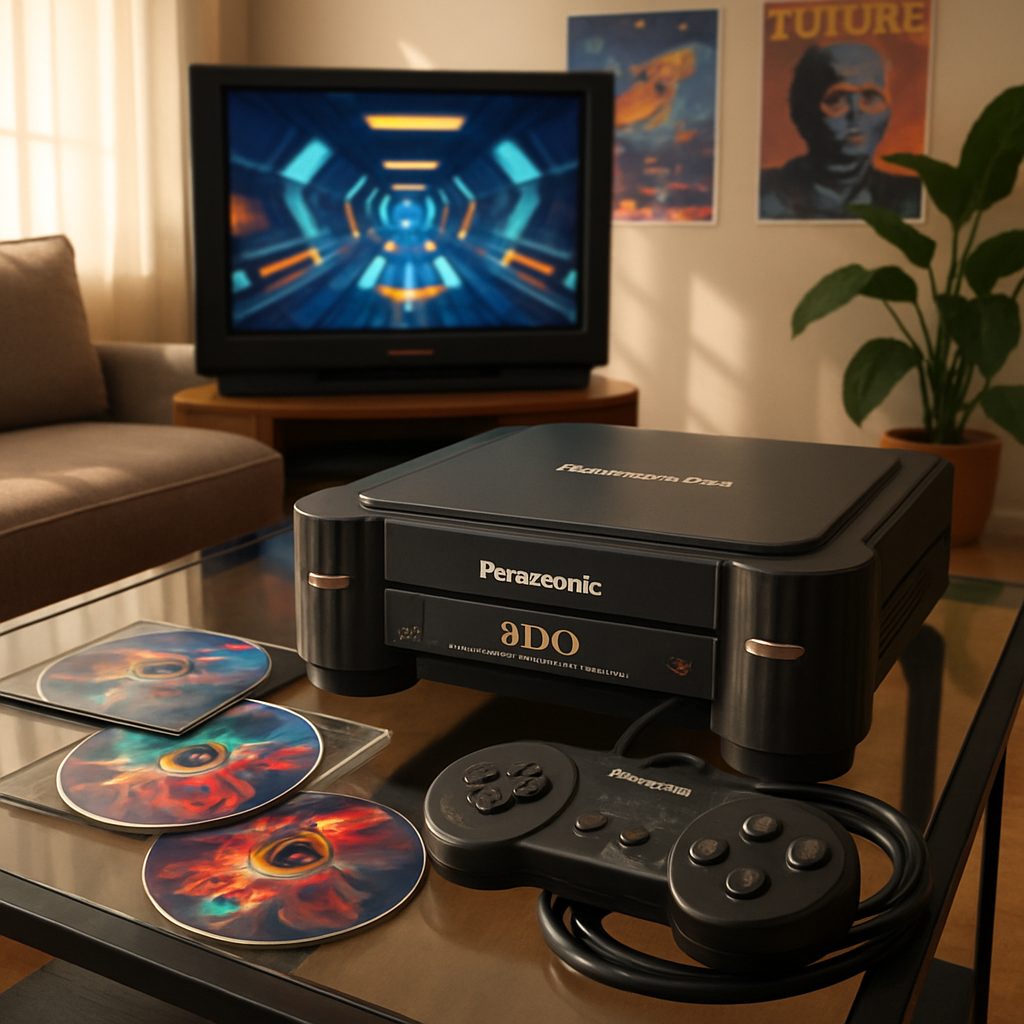
In 1993, the 3DO Interactive Multiplayer entered the market with a bold promise: to combine video games, music, and video on a single device. Designed by Ed Logg’s 3DO Company, this machine surprised with its unprecedented business model—a consortium of licensed manufacturers—and its dizzying price of $699. Behind its light gray casing and stylized logo, it featured an ambitious technical specification for the time, but it quickly faced the reality of development costs and the rise of multimedia PCs. Rich in innovations, it nonetheless could not escape the constraints of a market still in full mutation.
🎞️ First-generation CD-ROM: the 3DO bets everything on the optical disc to offer video and audio sequences of better quality than traditional cartridges.
💸 Launch price at $699: a premium positioning targeting enthusiasts ready to invest, but hindering mass adoption.
⚙️ Relative power: ARM60 CPU at 12.5 MHz, 2 MB of RAM, and a 1× CD-ROM drive—a solid configuration but quickly outpaced by competing PCs and consoles.
📂 Fierce competition: facing the Super Nintendo, Mega Drive, and emerging multimedia PCs, the 3DO struggles to find its place despite its “multimedia” ambition.
Sommaire
Project Genesis and Multimedia Ambition
The idea of the 3DO took shape in the early 1990s, when the CD-ROM began to establish itself in the computer sector. Ed Logg, an arcade veteran, brought together several manufacturers (Panasonic, GoldStar, Sanyo) around an open licensed architecture. By entrusting third parties with console manufacturing, the 3DO Company hoped to promote rapid diffusion of its format and multiply game releases. This model recalls the Windows strategy on PC rather than the closed scheme adopted by Nintendo or Sega. The bet: to offer a device capable of playing games, audio CDs, and video, and to become the multimedia hub of the living room. In practice, this pioneering vision coexisted with technical and logistical challenges, partly explaining the high price and consumer reluctance.
Design, Ergonomics, and Hardware
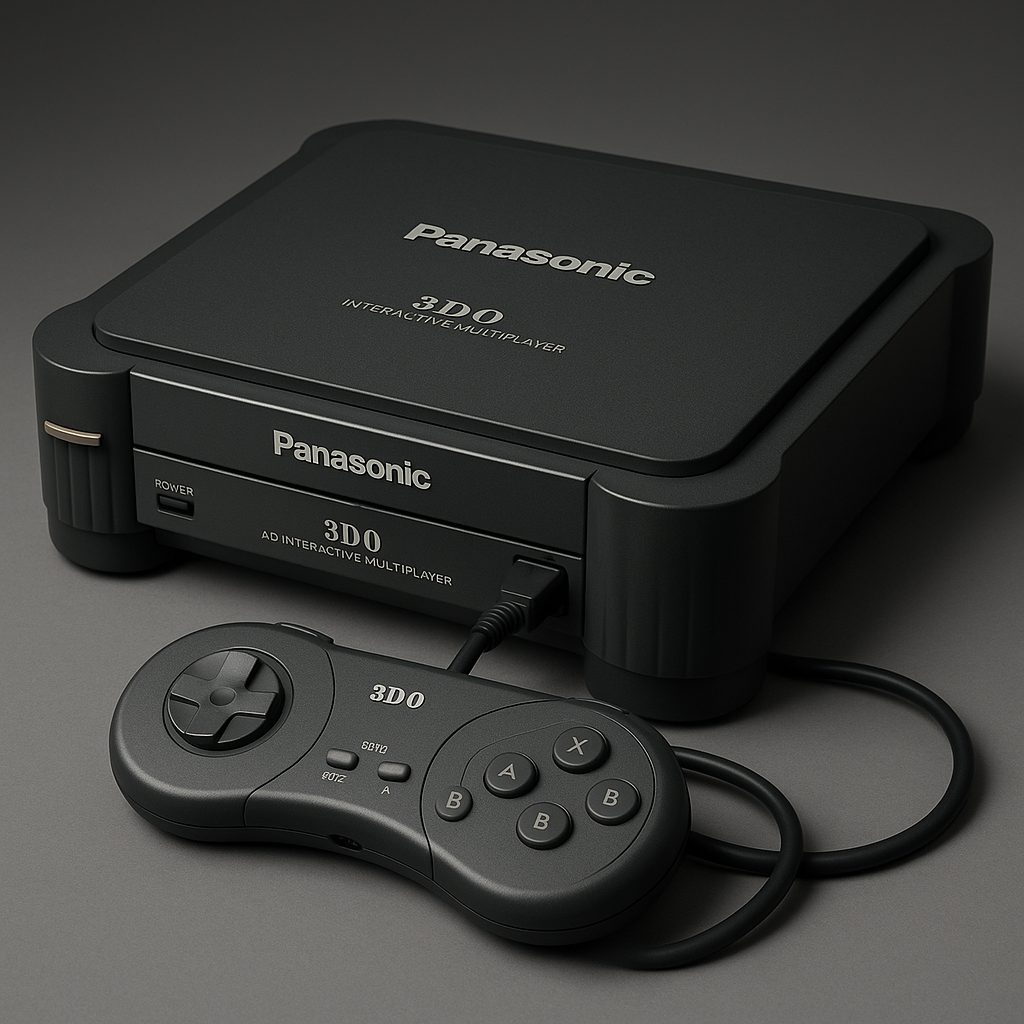
At first glance, the 3DO stands out with its compact case, edged with angular lines and a logo engraved on top. The controller, inspired by the Super NES model but thicker, integrates a precise directional pad and six front buttons. The handling is appreciated, even if the weight of the CD drive and the placement of the controls require some adaptation time. On the connectivity side, the console offers a composite AV output and an accessory port, while the internal fan remains relatively discreet. The whole gives an impression of robustness, typical of Panasonic products of the time.
Technical Specifications
| Processor | ARM60 at 12.5 MHz |
|---|---|
| Graphics | Custom GPU, 16-bit colors |
| RAM | 2 MB (DRAM) |
| Storage | 1× CD-ROM (650 MB) |
| Audio/Video Support | Audio CD, Vinyl Vision (FMV) |
| Launch Price | $699 / €699 |
Economic and Pricing Model
Instead of imposing a single manufacturer, the 3DO Company sells licenses and collects royalties on each console produced and each game distributed. This system, almost revolutionary, however increases the final cost. At $699, the console far exceeds the cost of the Super NES ($250) and Mega Drive ($200), and does not offer a sufficient competitive advantage in terms of raw performance. Traditional players are reluctant to invest such an amount without the guarantee of massive exclusive games or essential accessories. Distributors, meanwhile, struggle to support a machine whose life cycle depends entirely on studios willing to pay the 3DO license.
Comparison with Contemporary Computers and Consoles
In 1993, an entry-level Pentium PC with a 486 DX2-66 could already be equipped with a CD-ROM drive and Sound Blaster, rivaling the 3DO in multimedia. Meanwhile, the Super Nintendo and Mega Drive dominate the market with their well-established cartridge libraries and accessible prices. The 3DO finds itself in the middle: neither as powerful as a gaming PC, nor as affordable as a traditional console. This situation reflects the evolution of multimedia consoles of the time, where the CD-ROM becomes a marketing argument, sometimes even before being a relevant selection criterion for all players.
Game Library and Actual Performance
Jam-packed with FMV (Full Motion Video) titles, the 3DO offers games like “Gex”, “Return Fire” or “Crash ’n Burn” that push the visual limits of the era. Yet, the rendering varies depending on the developers: some fully exploit the 16-bit colors, while others limit themselves to lazy conversions. Loading times, inherent to the 1× CD-ROM, can quickly become frustrating compared to the almost instantaneous fluidity of cartridges. On the controller, precision remains correct, but the 3DO shines neither by its speed nor by its audio system, often calibrated for standard stereo rather than for the emerging home cinemas.
Commercial Failure and Legacy
After a promising launch, sales stagnated around 2 million units, far from expectations. Licensing costs discouraged publishers and competition tightened its grip. By the late 90s, the 3DO was abandoned, leaving behind a reputation of costly experimentation. However, some concepts—open model, CD-ROM format, multimedia orientation—were taken up and improved by subsequent consoles, such as the PlayStation and Sega Saturn. Thus, despite its controversial fate, the 3DO Interactive Multiplayer remains a fascinating milestone in the history of consoles.
FAQ
Why was the 3DO so expensive?
The high cost resulted from the licensing model: each manufacturer had to pay royalties to the 3DO Company, which increased the retail price for consumers.
Which publishers supported the console?
Studios like Crystal Dynamics, Panasonic, and Novagame developed notable titles, but the overall offering remained limited compared to competing consoles.
Can you play 3DO games today?
Several PC emulators and digital re-releases allow rediscovering the library, often considered vintage and interesting for collectors.
