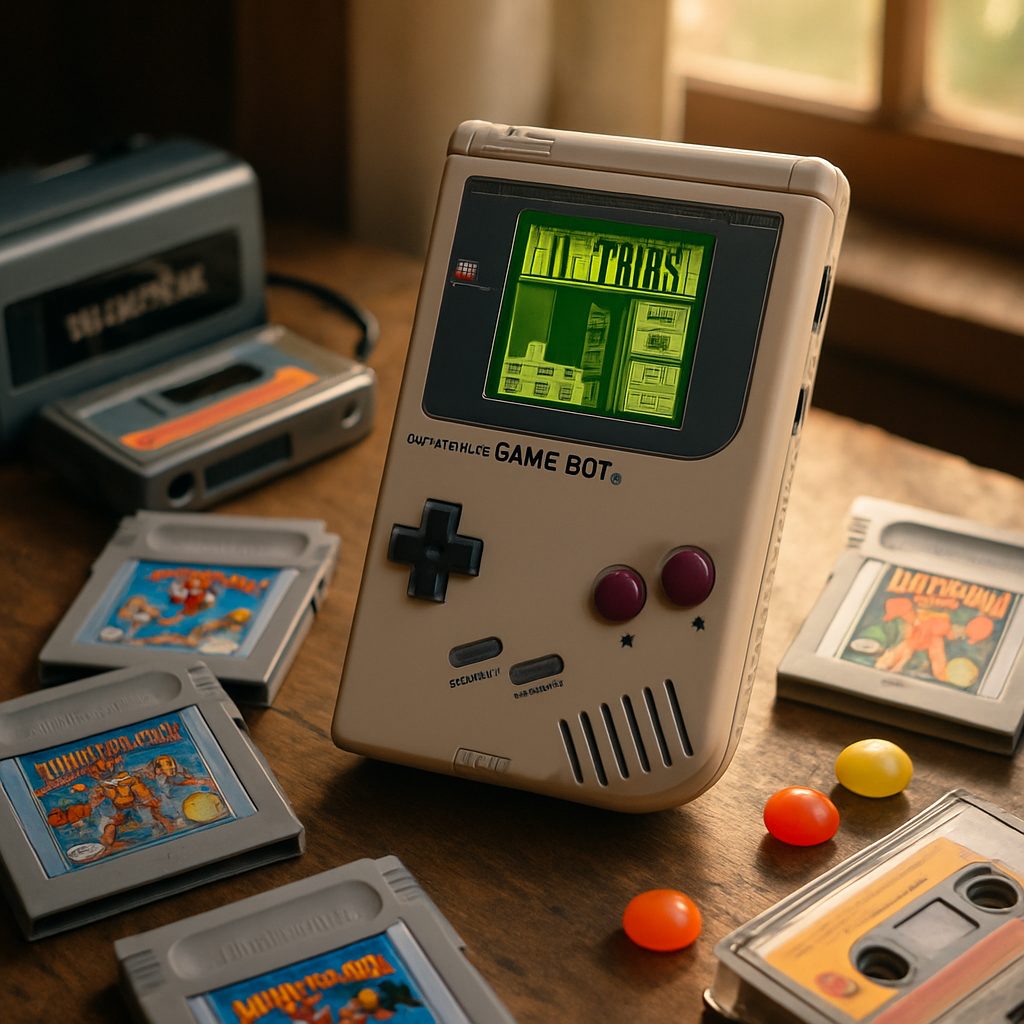
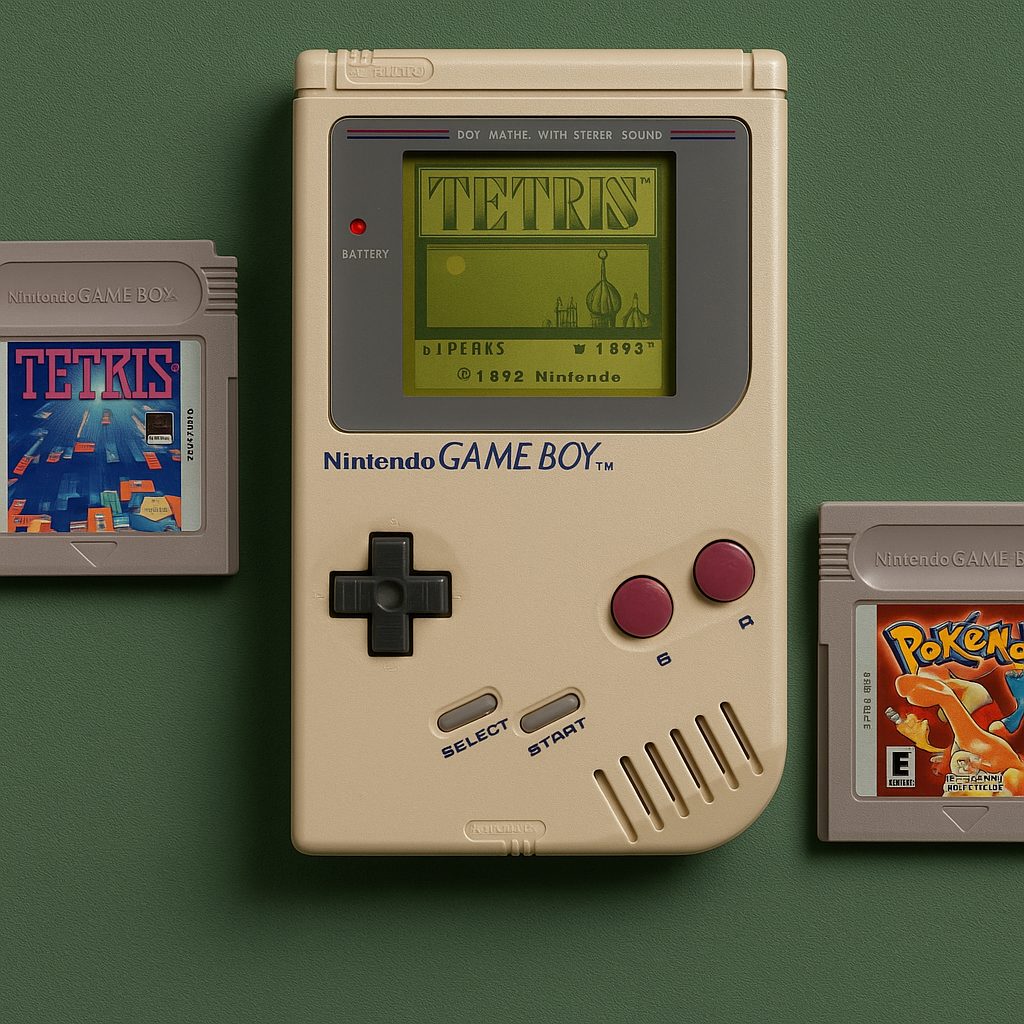
When the Game Boy arrived in 1989, the handheld gaming market was a wasteland. Previous attempts, like the Microvision or the Game & Watch, had shown technical limitations. Yet, this small gray rectangle achieved the impossible: creating a new market, surviving against technically superior competitors, and establishing itself for a decade of unrivaled dominance. How did a monochrome machine with an 8-bit processor crush 16-bit color devices? The answer lies in a mix of industrial genius, bold choices, and a legendary game library.
🚀 Portable revolution: Launched in Japan on April 21, 1989, Nintendo’s Game Boy crushed the market with 118.69 million units sold, a historic record at the time.
🎮 Winning duo: Bundled with Tetris (35 million sales), it became a phenomenon thanks to Pokémon Red/Blue (45 million), creating two enduring franchises.
⚙️ Strategic simplicity: Despite a green monochrome screen and an 8-bit processor (4.19 MHz), it outperformed competitors thanks to 15 hours of battery life and an unbeatable price ($89 at launch).
🛡️ Born survivor: It withstood assaults from the Atari Lynx (color screen) and the Sega Game Gear, proving that raw power isn’t everything.
Sommaire
The genesis of a portable revolution
Behind this global success is Gunpei Yokoi, a visionary engineer at Nintendo. His mantra? “Lateral Thinking of Withered Technology”: reusing proven technologies rather than chasing innovation at all costs. While Sega and Atari bet on power-hungry color screens, Yokoi chose a high-contrast monochrome LCD screen, visible in bright sunlight. A choice that allowed the use of 4 AA batteries for 15 hours of gameplay, compared to 3 hours for the Game Gear. The gray ergonomic shell fits all hands, survives drops, and became iconic. But the stroke of genius was the bundle: including Tetris, an addictive puzzle game perfect for short sessions. Alexey Pajitnov, its creator, said: “Nintendo understood that portable gaming had to be social – we traded our Game Boys like a deck of cards.”
Technical sheet: effective sobriety
| Component | Specifications | Advantage |
|---|---|---|
| Processor | Custom 8-bit Sharp LR35902 (4.19 MHz) | Low power consumption |
| Screen | Monochrome LCD 160×144 pixels | Outdoor readability |
| Sound | 4 channels (2 PSG + 2 wave) | Iconic game themes |
| RAM | 8 KB | Reduced manufacturing cost |
| Media | ROM cartridges max 8 MB | Instant loading |
| Power | 4 AA batteries | 15h battery life |
These radical technical choices allowed a launch price of $89 – half the price of the Atari Lynx. The battery became a major selling point: where Game Gear players lugged spare batteries, Game Boy owners played for days. Paradoxically, the limited resolution stimulated developers’ creativity, as Pokémon would prove with its sprites recognizable from a thousand.
The Game Library That Defeated the Titans
The Game Boy owes its triumph to two phenomenal titles. First, Tetris, for which Nintendo acquired the rights for 10 million dollars – a madness at the time. The game was sold with 35% of the consoles, creating a virtuous circle. In 1996, the bombshell arrived: Pokémon Red and Blue. Satoshi Tajiri drew on his childhood memories (insect collecting) to create a portable RPG with a trading mechanic via link cable. An ingenious system that turned every recess into a social arena. Other pillars:
- The Legend of Zelda: Link’s Awakening – proved that a true RPG fits in a cartridge
- Super Mario Land – sold 18 million copies
- Kirby’s Dream Land – introduced the cult character
In 1998, the arrival of the Game Boy Color gave a new lease on life without breaking compatibility – all original cartridges remained playable. This total backward compatibility would become a pillar of Nintendo’s strategy.
David versus Goliath: The War of Portables
In 1990, the Atari Lynx counterattacked with a backlit color screen and 16-bit graphics. Sega followed in 1991 with the Game Gear. Technically superior, they nevertheless failed against the Game Boy. Why? Three fatal errors:
- Ridiculous battery life (3-4 hours)
- Prohibitive price ($149 for the Game Gear)
- Absence of a “killer game” like Tetris
The Game Gear suffered from another flaw: its screen required constant backlighting, making it unreadable in broad daylight. A user testifies: “We played hidden under a blanket like spies!” Nintendo exploited these weaknesses with a clever campaign: TV spots showing teens playing in the park, at the beach, everywhere competitors failed. This battle illustrates a turning point in the evolution of consoles: pure technology yields to the overall user experience.
The Legacy: A Still-Living DNA
The Game Boy officially ended in 2003, but its influence persists. The Nintendo DS took up its “booklet” format and the concept of social gaming via local connection. Pokémon became a multi-billion dollar franchise, with remakes on Switch. More fundamentally, it established principles still current today:
- Portability takes precedence over raw power
- Backward compatibility is sacred (Switch still plays Game Boy games via emulation)
- A good game > a beautiful game (cf. success of the Nintendo Switch Lite)
In 2020, the Game Boy appeared in the film “Tetris” as a cultural symbol. Artists even create albums exploiting its sound capabilities – proof that this little gray box remains a timeless icon.
FAQ: Your Questions About the Game Boy
Why was the screen green?
To improve contrast and readability in natural light. Standard monochrome LCD screens had a grayish background, but the green tint reduced eye strain.
How many games were released on Game Boy?
Nearly 1,046 official titles, including 496 in Japan, 372 in North America, and 178 in Europe. The last official game was “Harry Potter: Goblet of Fire” in 2005.
Did the Game Boy have special editions?
Yes! Nintendo released limited editions: Game Boy Light (backlight, Japan only), Game Boy Pocket (30% smaller), and transparent versions or ones featuring Pokémon.
How did the link cable work?
A serial cable allowing two Game Boys to exchange data at 512 kbit/s. Vital for Pokémon battles or 4-player games on Tetris. Ancestor of modern local wireless.
