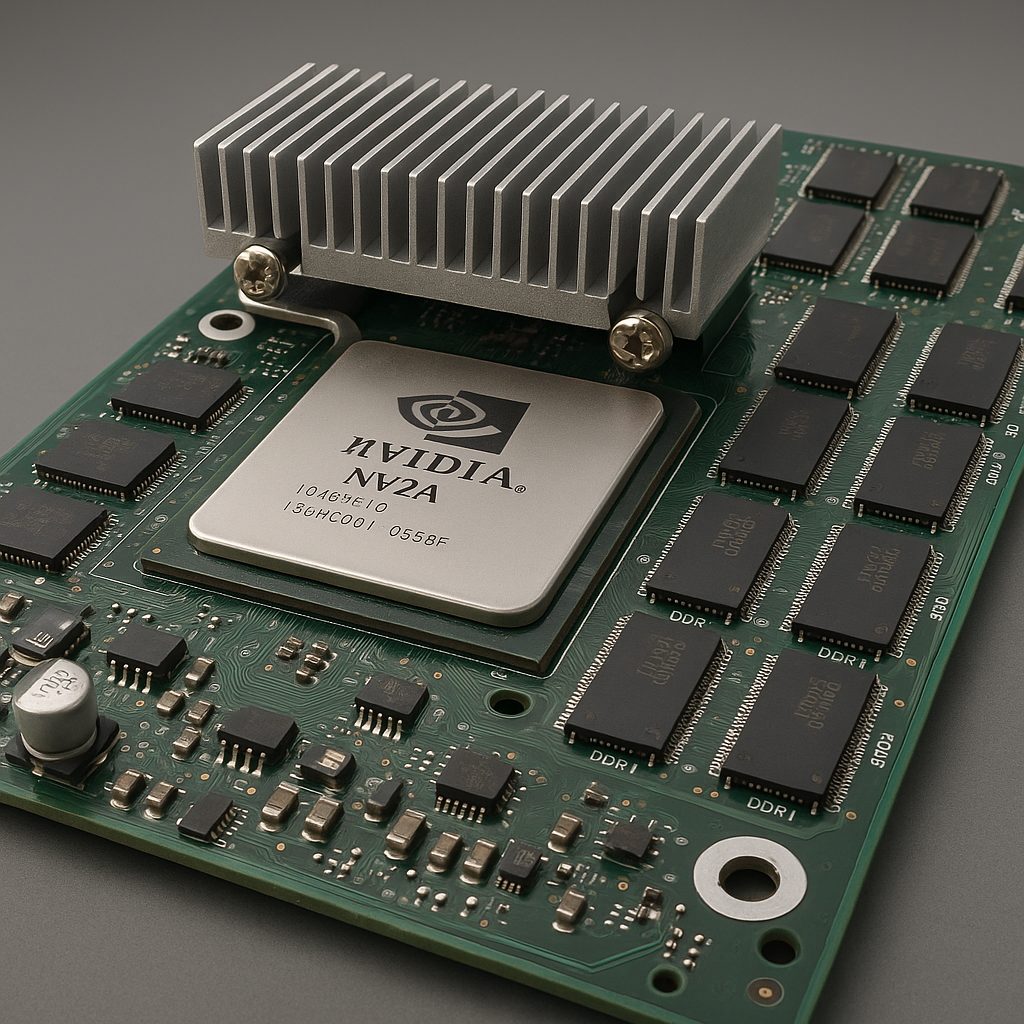
At the heart of the first Xbox, released at the end of 2001, beat a graphics processor still little known to enthusiasts: the Nvidia NV2A. Behind this acronym hides a chip designed to redefine the visual standards of the time, capable of running iconic titles with a quality until then reserved for high-end PCs. Here we explore the design, technical choices, and lasting impact of this pioneering GPU.
🕹️ NV2A establishes the Xbox as an ambitious console: this GPU, born from a close collaboration between Microsoft and Nvidia, combines Direct3D and custom pipelines.
⚙️ Equipped with programmable vertex and pixel shaders, it surpasses the previous generation in terms of flexibility for developers.
📊 With a peak power estimated at 125 MFLOPS and 64 MB of DDR memory, it competes with some early 2000s desktop PCs.
🔄 Its legacy is found in the evolution of home console GPUs and the early maturity of graphics APIs.
Sommaire
Genesis of a marriage between console and PC GPU
When in 1999 Microsoft decided to enter the home console market, the priority was clear: to outpace Sony and Sega in graphical quality. Nvidia, already recognized for its GeForce 2 on PC, was tasked with adapting a chip suitable for the compact format of the Xbox. This choice was not trivial: it was about offering developers a familiar Direct3D environment while optimizing thermal and cost constraints.
An unprecedented collaboration
Instead of hiring a console-specialized designer, Microsoft and Nvidia created a hybrid design. The NV2A chip takes the backbone of the GeForce 3 (NV20) and simplifies it: some advanced calculation units were removed to reduce power consumption and die size. In fact, one might think it is just a discounted clone, but the technical challenge goes beyond this simple shortcut.
Detailed architecture of the NV2A
The heart of the NV2A consists of two programmable rendering pipelines, each configured to process vertices and pixels in parallel. This dual-stream structure guarantees remarkable flexibility for the time.
Vertex and pixel shader pipelines
Unlike the previous generation, where vertex transformations and pixel calculations were rigid, the NV2A introduces programmable shaders. Vertex shaders orchestrate the transformation of vertices (rotation, projection…), while pixel shaders apply textures and lighting effects. Games like Halo: Combat Evolved fully exploit this freedom, resulting in more believable environments and unprecedented water or light effects on console.
Memory and memory bus
Surrounded by 64 MB of DDR-200 clocked at 200 MHz, the NV2A benefits from a 128-bit bus capable of reaching 6.4 GB/s bandwidth. This configuration, calibrated for a standard cathode ray tube screen in 480i/p, struggles to fully saturate the GPU, but proves sufficient to handle higher resolutions in interlaced mode.
Key Specifications Table
| Feature | Detail |
|---|---|
| Manufacturing Process | 150 nm |
| Frequency | 233 MHz |
| Rendering Pipelines | 2 programmable pipelines |
| Memory | 64 MB DDR-200 (128 bits) |
| Memory Bandwidth | 6.4 GB/s |
| API Support | Direct3D 8.0 |
Performance and Comparisons
In terms of theoretical power, the NV2A delivers about 125 MFLOPS in vertex and pixel shading, placing it a notch above competing consoles. When compared to PC cards of the same era, it sits between the GeForce 2 GTS and the GeForce 3 Ti 200, which was far from insignificant at the end of 2001.
- Smoother rendering thanks to parallel pipelines.
- Fewer limitations related to fixed shaders, allowing dynamic effects.
- Filtering quality and texture management close to that of PCs.
Impact on the Video Game Scene
The NV2A unlocked new possibilities for studios: complex particle effects, dynamic shadows, and more detailed terrains. Observing its contribution, one understands why the Xbox made a strong impression from its launch. For those interested in the evolution of consoles, an overview of the hardware innovations that marked video games illustrates competing projects and their strategies.
Limits and Adaptations
However, not all games fully exploited programmable shaders: some proprietary engines remained confined to more traditional techniques, due to development time constraints or lack of mastery of the technology. Yet, the gain was noticeable as soon as a studio explored the potential of the NV2A.
Legacy and Posterity
Although Microsoft and Nvidia later parted ways, the NV2A laid the foundation for modern home console GPUs. Later architectures of the Xbox 360 and PlayStation 3 adopted the idea of a GPU close to that of a PC to facilitate porting of 3D productions. In this sense, the NV2A can be considered a decisive milestone towards console/PC convergence.
FAQ
What differentiates the NV2A from a typical PC GPU of the time?
The NV2A is an optimized version of the GeForce 3, streamlined to reduce power consumption, but enhanced with native Direct3D 8.0 support and adjusted to console constraints (temperature, cost, form factor).
How did developers take advantage of programmable shaders?
They were able to create specific effects such as dynamic reflections, complex vertex animations, and smoother texture transitions, which gave Xbox games a noticeably superior visual rendering compared to competitors.
Is the NV2A still relevant for collectors or retro enthusiasts?
Absolutely. Beyond its historical value, it remains a concrete example of the transition to programmable GPUs in consoles. Collectors appreciate it for its pioneering role.