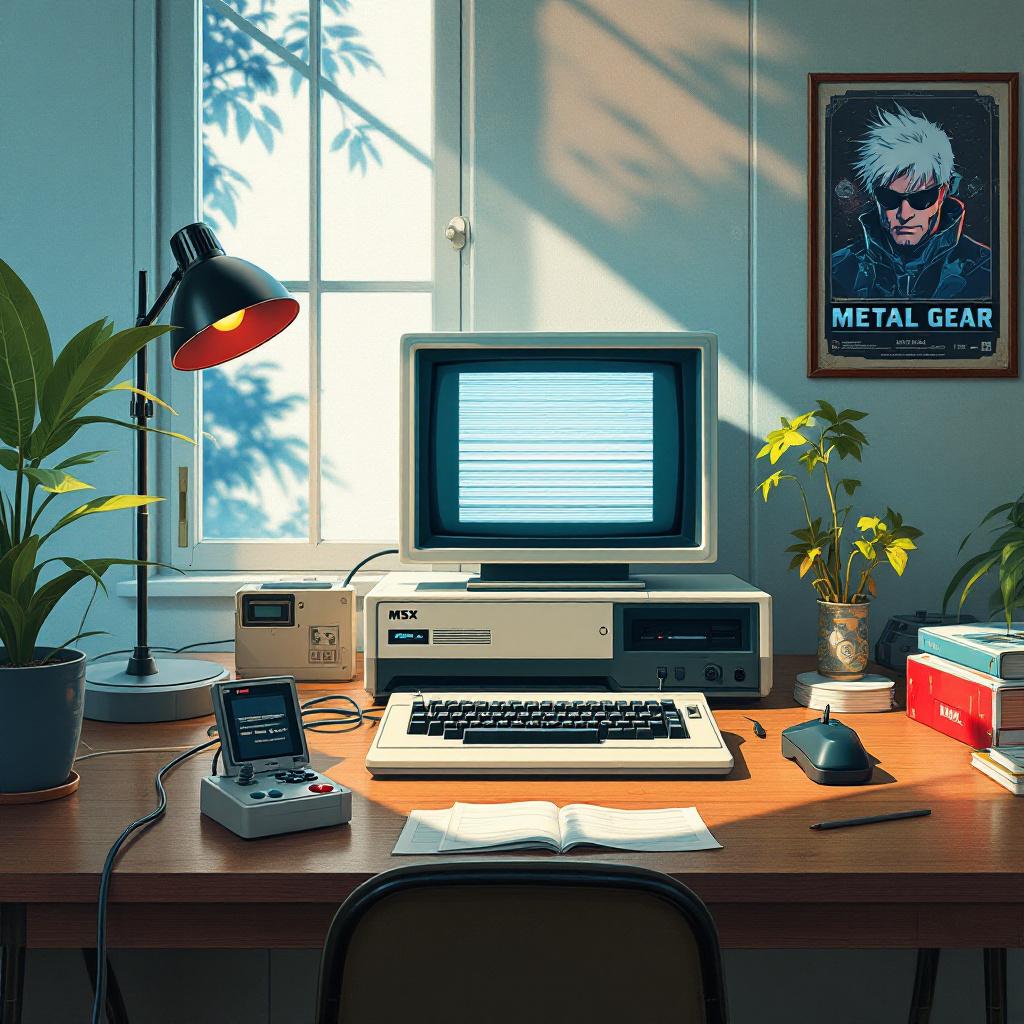
In the early 1980s, Japan witnessed a proliferation of proprietary microcomputers. Faced with this fragmentation, a consortium formed by ASCII and Microsoft decided to impose an open standard: the MSX. Quickly, this platform became Konami’s favorite playground, giving birth to a revolutionary title, Metal Gear, and leaving a lasting mark on video game history.
🚀 MSX was born in 1983 to unify the Japanese microcomputer market, thanks to an accessible and modular architecture.
🎮 With its Z80 processor clocked at 3.58 MHz and 64 KB of RAM, the MSX offered a common development ground that quickly attracted publishers, from Konami to Hudson Soft.
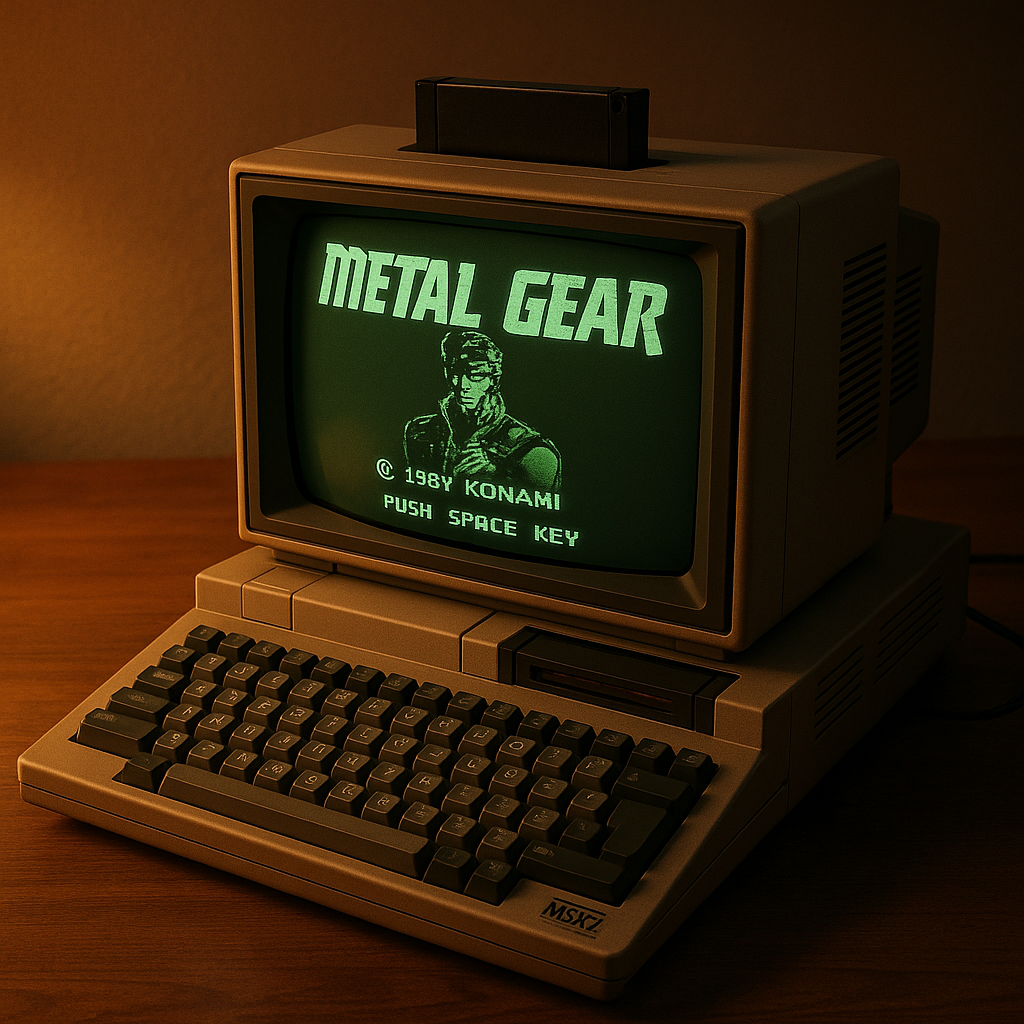
💡 It was on an MSX2 that Hideo Kojima created Metal Gear in 1987: an innovative concept blending deep storytelling and stealth, born from the machine’s graphical and sound potential.
⚙️ Today, the MSX remains an emblem for collectors and the homebrew scene: emulators, game reprints, and open-source projects perpetuate its legacy.
Sommaire
Genesis of a Japanese standard
Origins and ambitions
In early 1980s Japan, each manufacturer offered its own microcomputer, with its share of languages, floppy disk formats, and cartridges. ASCII, a publishing house specialized in computing, had a simple idea: to define a common specification, under an open license, to bring together manufacturers and developers around the same hardware. Microsoft, eager to conquer the Japanese market, provided its software expertise by supplying a standardized BASIC. Together, they launched the MSX, a contraction of “Machines with Software eXchangeability,” hoping to stimulate a wide software offering without locking in the user.
Architecture and technical characteristics
At the heart of this machine, a Zilog Z80 clocked at 3.58 MHz, supported by a Texas Instruments TMS9918 graphics coprocessor, capable of displaying up to 32 sprites simultaneously. The extension slot, a hallmark of the MSX, allowed adding memory, game cartridges, or modems. In RAM, 64 KB standard — a remarkable feat for the time — with the possibility to reach 128 KB on the MSX2. As for sound, a three-channel AY-3-8910 offered richer melodies than many competing platforms.
| Model | Year | RAM | Graphics | Sound |
|---|---|---|---|---|
| MSX | 1983 | 64 KB | Mode 2 (256×192, 16 colors) | 3 channels |
| MSX2 | 1985 | 64–128 KB | Mode 5 (512×212, 256 colors) | 3 channels |
| MSX2+ | 1988 | 128 KB | Mode 8 (512×212, 4096 colors) | 6 channels (PSG + FM) |
A catalyst for the video game industry
The rise of Japanese studios
The uniformity of the MSX greatly facilitated game production. Konami, commonly with 30 developers behind the flagship titles of the time, quickly adopted the platform for its arcade MSX machine fleet. Hudson Soft, Xanadu, and other publishers followed, reducing costs and development times. The result: a dense catalog, ranging from hypnotic puzzles to frenetic shoot ’em ups, which laid the foundations of a flourishing national video game industry.
Metal Gear: Birth of an Icon
In 1987, Hideo Kojima, then a young designer at Konami, took advantage of the increased memory and graphical capabilities of the MSX2 to transpose a concept inspired by his espionage readings: the player does not confront enemies head-on but observes, plans, and infiltrates. Metal Gear revolutionized the gaming approach: no more direct confrontation, but constant tension, amplified by an anxiety-inducing soundtrack. The result is a narrative and technical tour de force — detailed sprites, shadow management, basic but effective AI — relying on the strengths of the MSX2.
Legacy and Influences
Beyond the MSX: Towards New Horizons
The success of the MSX inspired other modular standards, and many technical concepts migrated to consoles and PCs of the late 1980s. Scrolling routines, sprite data compression, and intensive use of graphic modes pushed teams to optimize their tools. Thus, in the evolution of Sega and Nintendo architectures, refined techniques from the MSX can be found.
Community and Reissues
Nearly forty years later, the MSX community remains alive. OpenMSX or blueMSX emulators, physical flash cartridges, homebrews, and remakes continue to flourish. The icing on the cake: several official compilations gather iconic titles, and independent developers even design new games for this retro standard. To trace the evolution of machines from these pioneers to ultra-refined configurations, one can consult a chronology of gaming computers that places the MSX in a fascinating historical continuum.
FAQ
What is the MSX standard?
The MSX is a hardware and software specification launched in 1983 by ASCII and Microsoft to unify the Japanese microcomputer market, simplify development, and offer cross-manufacturer compatibility.
Why is Metal Gear linked to the MSX?
Hideo Kojima designed Metal Gear by exploiting the capabilities of the MSX2: increased memory, 256-color graphics, and enhanced sound allowed the development of gameplay based on stealth and advanced storytelling.
How many versions of MSX existed?
There are three major iterations: the basic MSX (1983), the MSX2 (1985), and the MSX2+ (1988), each bringing more memory, colors, and sound capabilities.
Does the MSX still have relevance today?
For retro-gaming enthusiasts, the MSX remains a privileged playground: emulation, flash cartridges, homebrews, and official reissues allow (re)discovery of its rich catalog and historical influence.
