
An exceptional engineer, Gunpei Yokoi carved out a unique path at Nintendo, where he transformed “toys” into a video game revolution. From his beginnings on the assembly lines to the creation of the Game Boy, his pragmatic and unconventional approach, lateral thinking, redefined the codes of innovation. Let’s dive into the journey of a creative mind whose impact still resonates in every handheld console.
🎯 Key career moments: starting in maintenance, Yokoi climbed the ranks to lead Nintendo’s R&D, signing the success of the Game & Watch and Game Boy.
💡 Lateral thinking: his method focuses on cleverness rather than complexity, favoring simplicity and surprise.
🕹️ Game Boy: launched in 1989, a sturdy and autonomous handheld, it popularized portable video gaming among millions of players.
🌟 Legacy: his vision still shapes modern consoles and inspires designers to think outside the box.
Sommaire
The unique journey of Gunpei Yokoi
Unlike most engineers of his time, Yokoi was neither a graduate of a prestigious school nor passionate about printed circuits from a young age. Recruited in 1965 to repair slot machines in after-sales service, he learned to listen to operators’ needs and optimize each component with small touches of ingenuity. This practice of “less, but better” propelled him toward creating Nintendo’s simplest yet most iconic device: the Game & Watch.
From slot machines to the Game & Watch
At the time, Nintendo was looking to diversify its income. Yokoi, equipped with a small budget and endless curiosity, designed an electronic game with a monochrome LCD screen packed in a compact case. The result, surprisingly attractive and easy to produce, sold several million units from 1980 to 1991. Behind this success was his method: repurposing an industrial component – the LCD screen – for a new playful purpose.
The philosophy of lateral thinking
More than just a buzzword, Yokoi’s lateral thinking is built around two pillars: exploiting existing technologies for new purposes and constantly seeking immediate playability. Rather than chasing technical performance, he favored “innovation through simplicity,” where the distinctive element emerges from the interface rather than the chip.
Origins and inspirations
His approach was inspired by visual puzzles and the concept of “useful error”: a feedback loop where the unexpected turns into a welcome surprise. Yokoi considered every constraint – budget, space, autonomy – as fertile ground for imagining novel mechanics. This is how he was able to reuse standard AA batteries to offer thirty hours of autonomy for the Game Boy.
Impact on the design of the Game Boy
In 1989, he unveiled a gray case, a 2.6-inch screen, and simple controls. Behind this apparent austerity was a well-honed tactic: a reassuring, accessible product with a varied library of titles. This convenience strategy ensured a spectacular launch, from Japan to America, far outpacing more powerful but less portable home consoles.
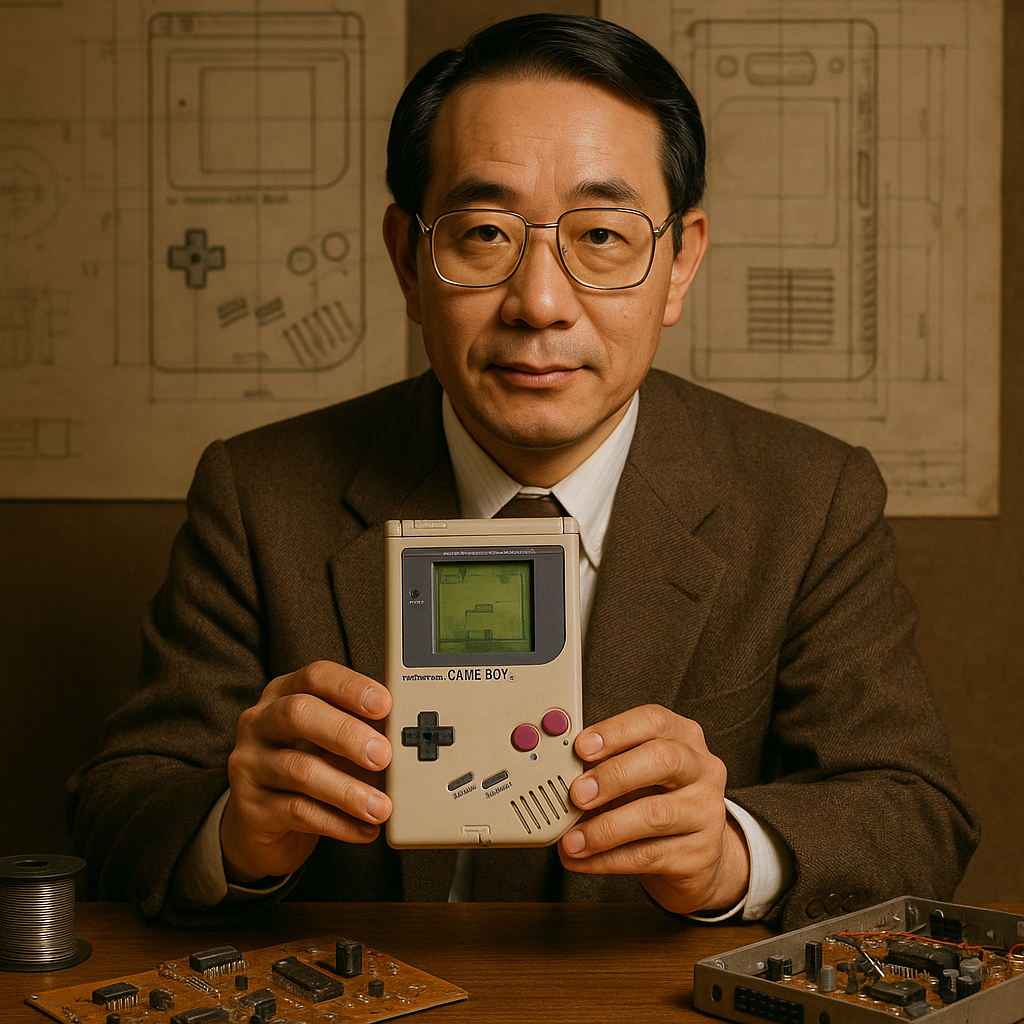
“It is because I am outside the technical hierarchy that I am able to bring a fresh perspective.” – Gunpei Yokoi
Yokoi’s Legacy at Nintendo and Beyond
While the commercial success of the Game Boy cemented his reputation, it is above all the transmission of his mindset that endures. From the Game Boy Advance to the Nintendo Switch, one finds this taste for clever compromise and these streamlined interfaces. To grasp the importance of these pioneers, one can consult our profiles of the pioneers of video games, where Yokoi holds a prominent place.
From R&D to Succession
After leaving Nintendo in 1996, he founded Koto Laboratory and developed the Virtual Boy. Despite its commercial failure, the idea of offering a portable 3D experience reveals his spirit always in search of new horizons. Contemporary designers see it as an act of bravery, proof that gradual improvement is better than unreachable perfection.
Comparison Table: Major Innovations of Gunpei Yokoi
| Product | Year | Key Feature | Impact |
|---|---|---|---|
| Game & Watch | 1980 | Repurposed LCD screen | First successful handheld console |
| Game Boy | 1989 | Portability + varied library | Worldwide spread of mobile gaming |
| Virtual Boy | 1995 | Stereoscopic 3D experience | Lesson on timing and usability |
FAQ
What is “lateral thinking” in Gunpei Yokoi’s approach?
It is a design method that relies on the clever reuse of existing technologies to create maximum impact with minimal resources.
Why did the Game Boy achieve worldwide success?
Its streamlined design, varied game catalog, and battery life of over 20 hours met a mobility need long neglected by home consoles.
How does the Virtual Boy reflect Yokoi’s spirit?
Although commercially limited, the Virtual Boy illustrates his willingness to explore new experiences, even at the risk of failure, to push the boundaries of what is possible.
