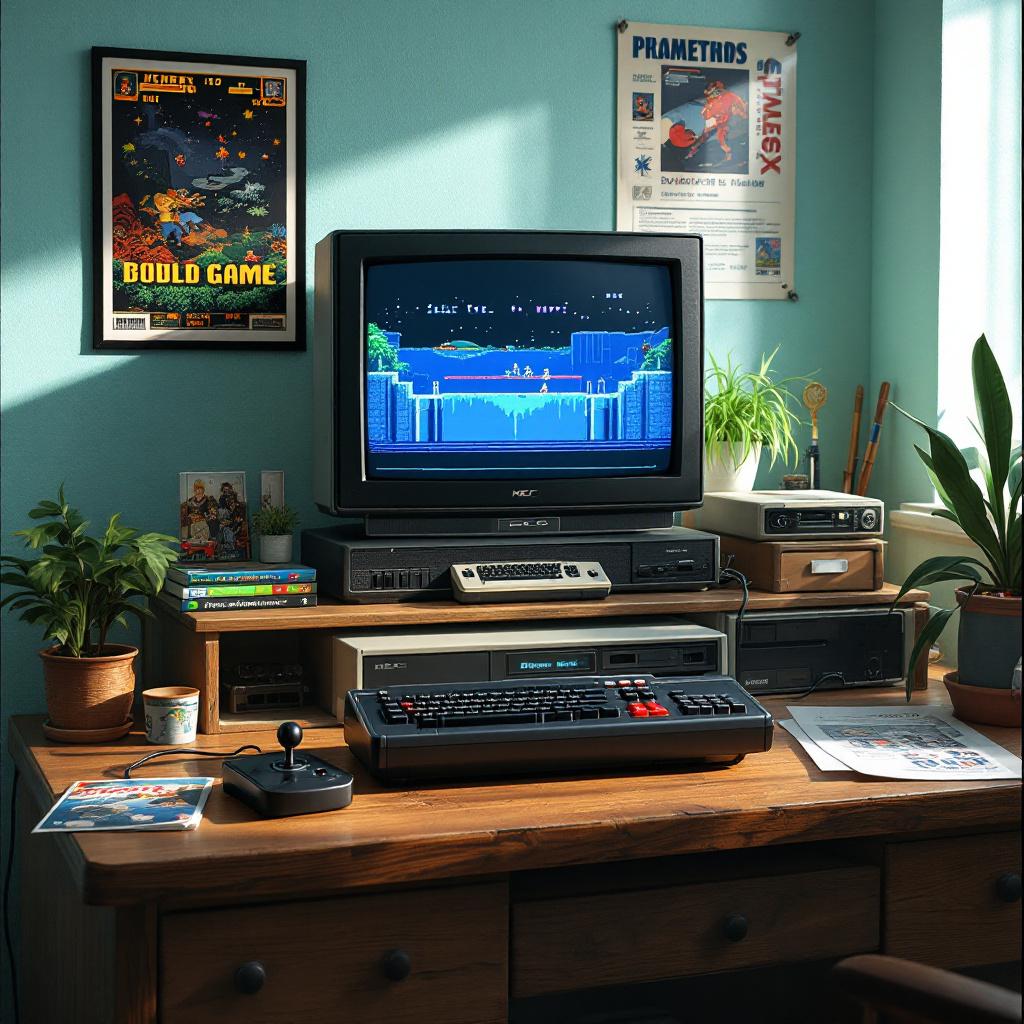
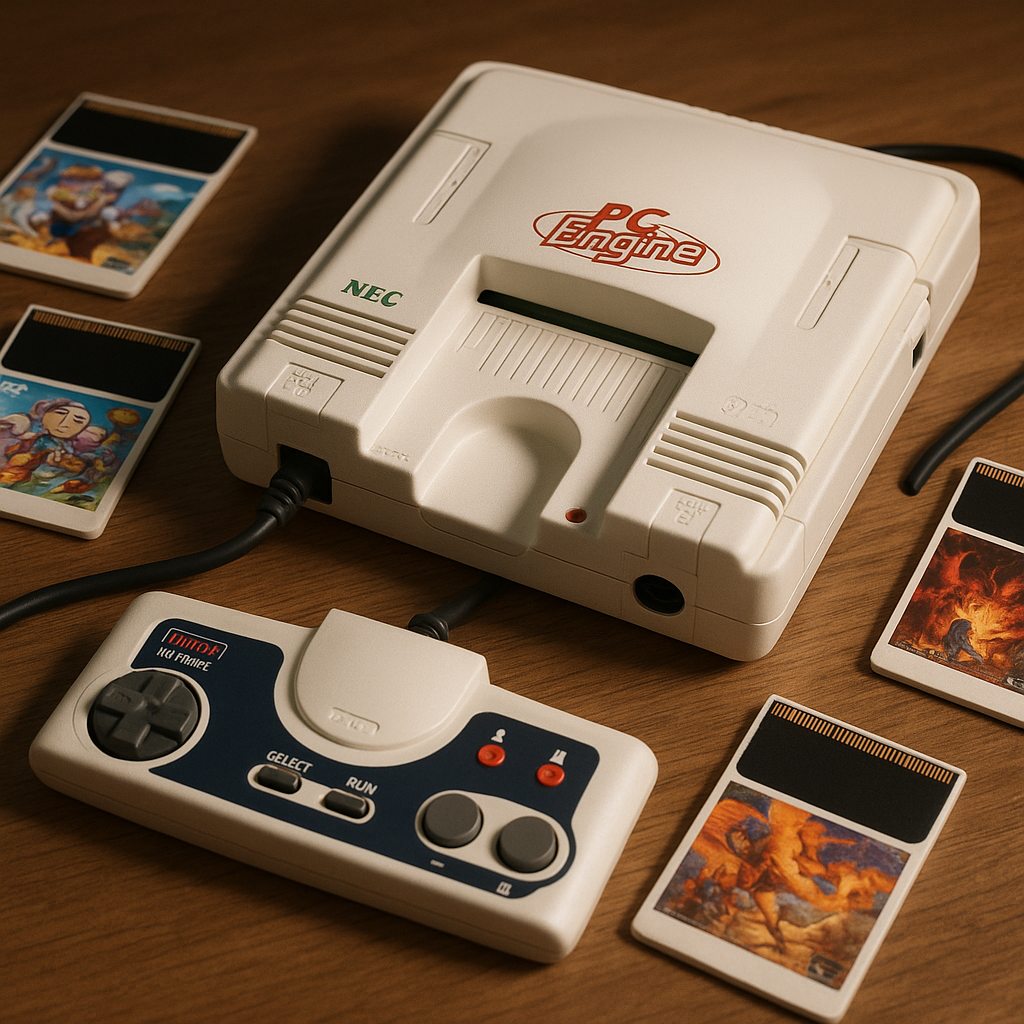
In 1987, NEC and Hudson Soft unveiled the PC-Engine, a compact machine that combines an 8-bit processor and a 16-bit graphics chip. A few months later, renamed TurboGrafx-16 in the United States, it rose to become a credible competitor against Nintendo’s NES and Sega’s Master System. Behind its minimalist design lies an unprecedented visual capability, which would redefine the standards of home consoles at the turn of the 1980s and 1990s.
🎯 Launch 1987 in Japan then 1989 in the United States, with a bold strategy to compete with Nintendo and Sega.
⚙️ Hybrid architecture: Hudson HuC6280 8-bit CPU paired with a 16-bit graphics chip capable of displaying 482 simultaneous colors.
💾 Various formats: HuCards ultra-thin for games and optional TurboGrafx-CD, for an emerging exploration of the CD-ROM medium.
🎨 Notable visual impact, pushing competitors to enhance graphical power. A milestone in the evolution of video game consoles.
Sommaire
History and Launch
Japanese Origins
Amid the booming Japanese market, NEC partnered with Hudson Soft to offer a console halfway between a microcomputer and a dedicated gaming platform. The PC-Engine focused on the sleekness of its design – the controller almost fits entirely inside the case – but above all on the power of its graphics subsystem, inspired by the architecture of professional computers. At a time when the Famicom reigned supreme, this technological gamble sparked as much admiration as surprise: the console displayed more detailed sprites, richer backgrounds, while remaining faithful to the 8-bit core that guaranteed software compatibility and controlled production costs.
American Ambitions
For its launch across the Atlantic in 1989, NEC renamed the device TurboGrafx-16, playing on the direct comparison with emerging 16-bit systems. The marketing positioning emphasized “next-gen” graphics and a lineup including notably Bonk’s Adventure, a mascot as colorful as unexpected. Despite an aggressive pricing strategy and solid after-sales service, the console struggled to break through against Nintendo’s supremacy and the early blows of the Sega Mega Drive. Nevertheless, it created a loyal fan base, attracted by the ergonomics of its HuCard cartridges and the possibility to add a CD player to enrich the experience.
Architecture and Technical Specificities
The key to the concept lies in the separation between the core processor and the video chip. The Hudson HuC6280, clocked at 7.16 MHz, manages logic, controller inputs, and memory reading. Alongside it, the video chip capable of processing 16-bit data ensures finer rendering and a larger color palette than a classic 8-bit console. This combination offers smoothness and richness of backgrounds rarely seen at the time: multiple scrolling, partial transparency, and management of over 50 sprites on screen without sacrificing speed.
Technical Sheet
| Element | Characteristic |
|---|---|
| Main Processor | Hudson HuC6280 (8 bits, 7.16 MHz) |
| RAM | 8 KB video, 64 KB for the program |
| Graphics | 16-bit chip, 482 simultaneous colors, hardware sprites |
| Game Media | HuCards (max 2 MB), TurboGrafx-CD module |
| Audio | 6 PSG channels + 2 ADPCM channels |
Graphics and Visual Innovations
While a classic 8-bit console caps at 256 theoretical colors, the PC-Engine uses a 16-bit video bus to display up to 482 colors simultaneously. This richness results in more nuanced backgrounds, transparency effects, and more detailed animations, as seen in landmark titles such as Ys Book I & II. The addition of the TurboGrafx-CD module further enhances these capabilities, introducing animated cutscenes and digital soundtracks, a playground later explored by many fifth-generation consoles.
Competition and Market Position
In the race for gaming salons, the PC-Engine first faces Nintendo’s NES and the Sega Master System in Europe, each with its own strengths. Later, it must also indirectly compete with machines like the Bally Astrocade or the Mattel Intellivision, which bet everything on graphical performance. Conversely, the Coleco Adam attempts the console-to-computer conversion, never quite achieving the same coherence. The PC-Engine stands out for its balance between manufacturing cost, maneuverability, and visual innovations.
Legacy and Influence
Beyond sales figures more modest than those of the Japanese giants, the PC-Engine inspires the evolutions of the next generation, where consoles systematically integrate chips dedicated to graphical effects. In the 2000s, re-releases via Nintendo’s Virtual Console or the TurboGrafx-16 Classics compilations on modern consoles recall its historical importance. Enthusiasts continue to develop homebrews and mini-editions, proof that the 8-bit–16-bit mechanics remain fertile ground for independent developers and collectors.
