
The TRS-80 Color Computer, launched in 1980 by Tandy/RadioShack, revolutionized access to home microcomputers thanks to its simple architecture and color screen. By combining a Motorola 6809 processor with a varied software offering, it became a pioneer capable of competing with the giants of the time and inspiring a whole generation of enthusiasts and developers.
Sommaire
Origins and Context
At the turn of the 1980s, Tandy sought to expand its RadioShack empire beyond calculators and consoles. The original TRS-80, monochrome and bulky, mainly met professional needs. In response to the growing demand for more affordable and versatile personal computers, the Color Computer was born from the collaboration between Tandy and Motorola.
The choice of the Motorola 6809 processor was imposed for its computing power and flexibility. Unlike the 6502s from Commodore or Apple, the 6809 offered richer instructions, facilitating the writing of educational and entertainment software. This unique collaboration allowed for an attractive price, while integrating color and a built-in BASIC language.
Technical Specifications
| Component | Details |
|---|---|
| CPU | Motorola 6809E clocked at 0.895 MHz or 1.79 MHz |
| RAM | 4 to 64 KB depending on the model and options |
| Graphics | Color mode up to 256 × 192 pixels in 4 colors |
| Audio | 1 channel via an internal generator |
| Storage | Cassette or external floppy disk drive |
First Evolutions
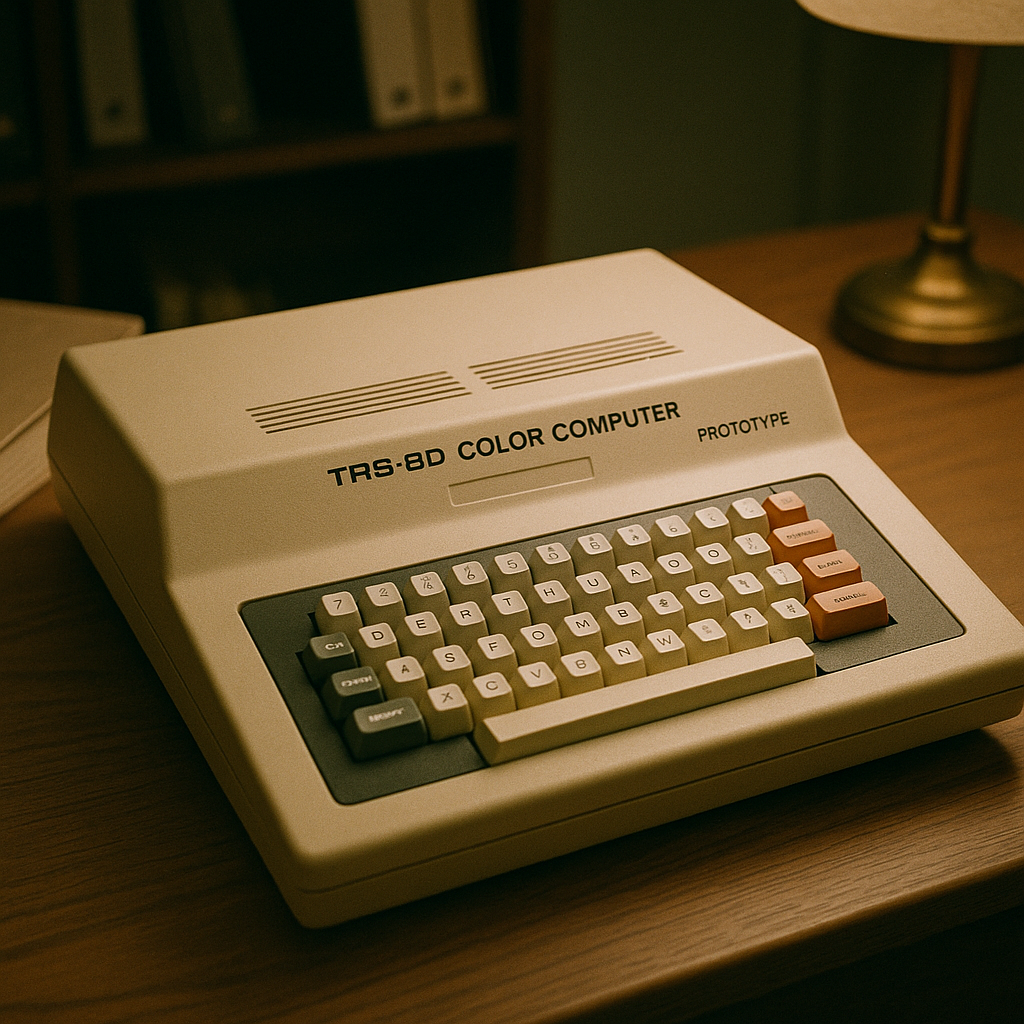
Launched under the name CoCo (for Color Computer), the first model quickly won over users with its complete BASIC and the quality of its display. But the era was evolving quickly: the transition to the CoCo 2 in 1983 improved memory and simplified the case, responding to criticisms of the original design.
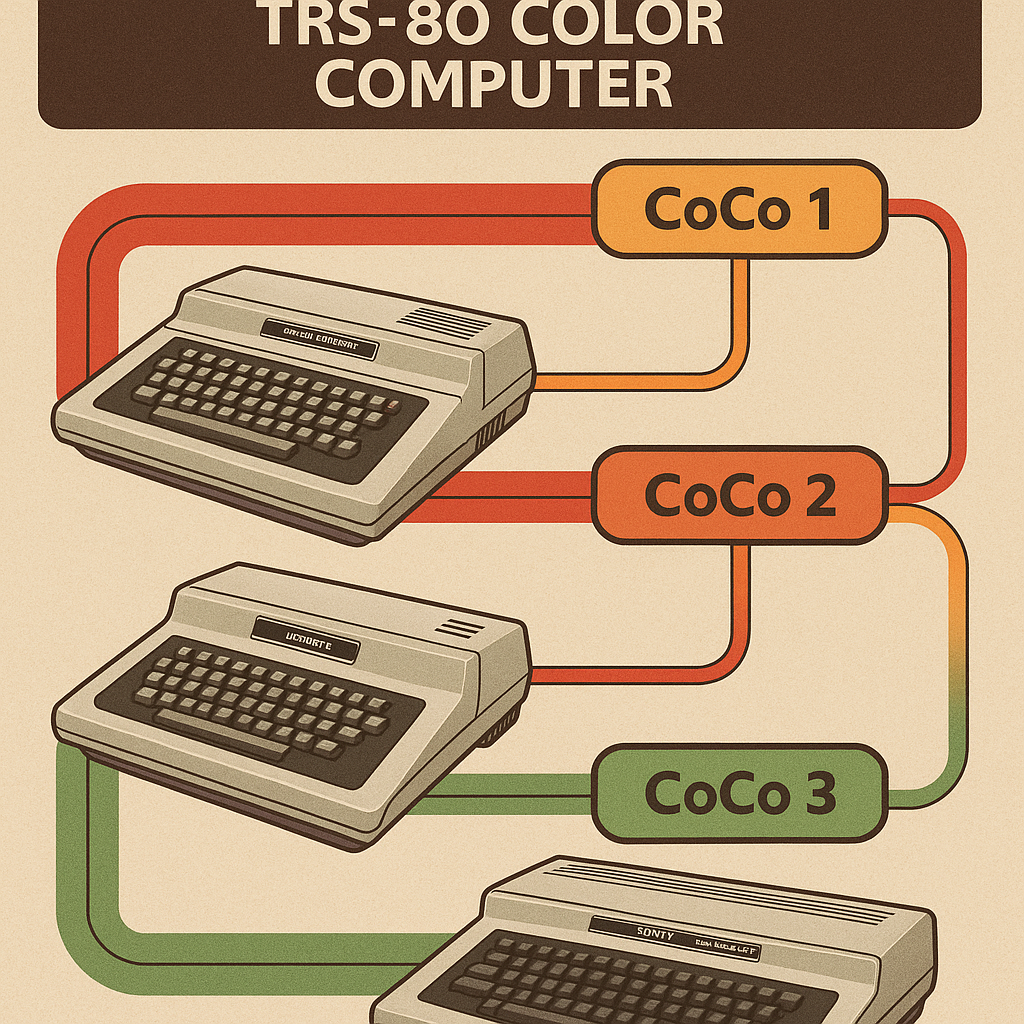
CoCo 1 vs CoCo 2
- CoCo 1: beige case, full keyboard, 4 KB of base RAM.
- CoCo 2: more compact shell, 16 KB to 64 KB of RAM, improved BASIC, modular connectors.
This transition strengthened the Color Computer’s appeal for education and leisure, notably thanks to better peripheral support and a broader software palette.
The Arrival of the CoCo 3
In 1986, the CoCo 3 symbolized the peak of the range. Memory jumped to 128 KB and the MC 6883 video chip included an 80-column text mode, a real plus for office work. Many enthusiasts discovered advanced graphic programming on this model, long after its production ended.
Competitors and Comparison
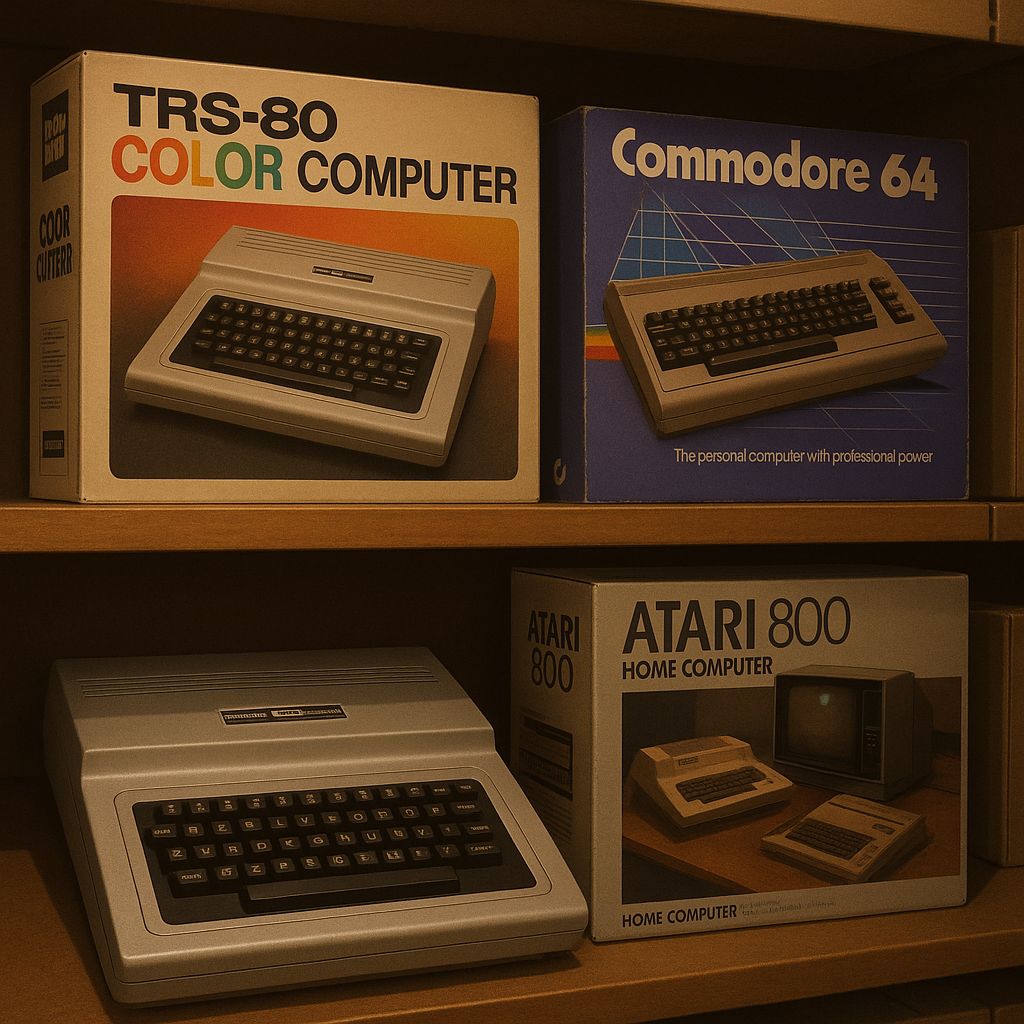
In the home segment, the CoCo faced several challengers:
- Commodore 64: great popularity, its legendary SID and 64 KB of RAM.
- Atari 800: advanced graphics, POKEY sound chipset, advanced video gaming.
- Apple II: dominant in educational and professional environments, modular expansion.
By comparison, the CoCo relied on a price/performance balance, a color-oriented BASIC, and more flexible programming possibilities. Fans praised the simplicity of the expansion bus and the active community that shared magazines and homemade development kits.
Market Impact and Legacy
The TRS-80 Color Computer democratized access to programming and game creation. Its technical features, far from revolutionary on paper, served as a springboard for an ecosystem of passionate amateurs who produced educational software, utilities, and very innovative entertainment titles.
“The CoCo was more than a machine: it was a community. Every month, magazines published BASIC listings, tips for hacking video registers, and even expansion card prototypes.”
Although the microcomputer war eventually favored Commodore and then Nintendo, the Color Computer remained a curiosity model for collectors and computer historians. Its influence is still felt today in the way educational kits and microcontrollers dedicated to learning code are designed.
Key Takeaways
- The TRS-80 Color Computer, or CoCo, was launched in 1980 with a Motorola 6809 processor.
- Three successive generations: CoCo 1, CoCo 2, and CoCo 3, up to 128 KB of RAM.
- Positioned against the Commodore 64, Atari 800, and Apple II, it relied on a rich BASIC and accessible architecture.
- Active community, publication of listings, and DIY projects strengthened its success.
- The CoCo’s legacy endures in educational kits and the appeal of retro computing.
FAQ
- What distinguishes the CoCo from the Commodore 64?
- The CoCo stood out by using the Motorola 6809 processor, a more powerful built-in BASIC, and a simpler expansion bus, while the C64 shone with its SID sound chipset and 64 KB of RAM.
- How to expand the memory of a CoCo 2?
- A memory expansion card was added in the side port, increasing from 16 KB to 64 KB, sometimes up to 128 KB with unofficial modules.
- Which software was popular on the CoCo?
- Educational programs (Tycom), drawing tools (Color Demo), and games like Robot Hunt or Galactic Patrol were popular for their creativity.
- Was the CoCo 3 compatible with older programs?
- Yes, most BASIC listings from CoCo 1 and 2 ran without modification, thanks to a hardware emulation mode in the CoCo 3.
- Where can you find a TRS-80 Color Computer today?
- Collectors, flea markets, and online retro computing groups remain the best sources to find a CoCo in good condition.
- Why was the 6809 appreciated?
- Its complex instruction set offered more powerful routines in limited memory, facilitating programming in assembly language.
