
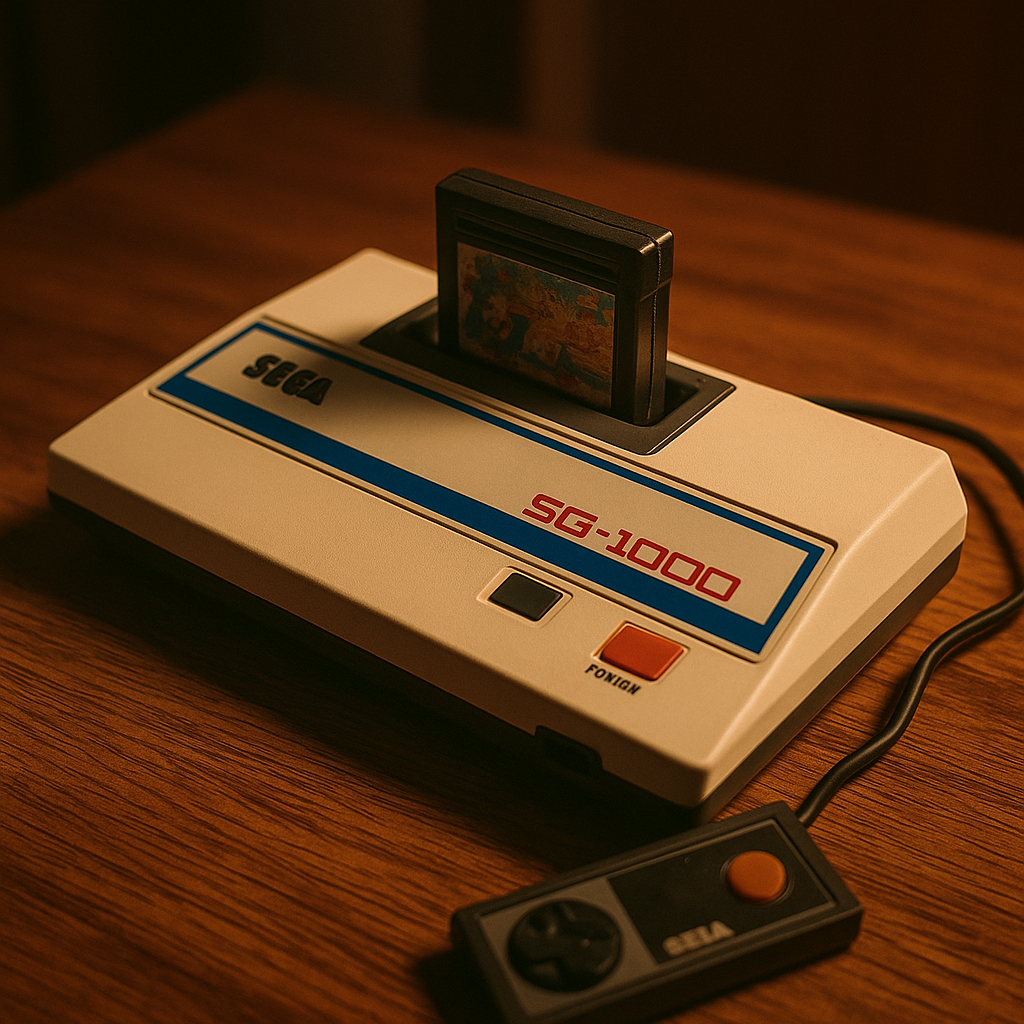
At the turn of the 1980s, Sega launched its very first gaming systems: the SG-1000 and its evolution, the Mark III. Long before the Master System, these experimental machines were already laying the foundations for an ambitious approach, both technically and in gameplay. They embody an era where competition was fierce, video standards were emerging, and audiences were yet to be conquered. A look back at these often forgotten but crucial consoles to understand Sega’s destiny.
Sommaire
In brief
🎧 SG-1000 (1983): Sega’s first foray into the home market, equipped with a Z80 chipset and a game library derived from arcade halls.
🚀 Mark III (1985): improved version with black casing, dockable controllers, and exclusive games, precursor to the Western Master System.
⚔️ Rivals: Nintendo Famicom, MSX, and personal computers already offered competing experiences, forcing Sega to innovate.
Origins and release context
Genesis of the SG-1000
In the early 1980s, Sega found itself marginalized after the arcade game crisis. Under the leadership of Hayao Nakayama, the company decided to diversify its offering by entering the home market. The SG-1000, unveiled on July 15, 1983 in Japan, borrowed heavily from the hardware architecture of the ColecoVision. Its core was based on a Zilog Z80 processor clocked at 3.58 MHz and a video chip capable of displaying 16 colors simultaneously. The first titles, including adaptations of Flicky and Galaga, demonstrated Sega’s intention to capitalize on its arcade expertise while remaining competitive against an already announced Famicom.
Launch and reception of the Mark III
Two years later, Sega refined its strategy with the Mark III. The facade darkened, the controllers gained a base to limit tangled wires, and the overall ergonomics were improved. This technical revision also allowed the introduction of more ambitious titles, such as Fantasy Zone or an embryonic version of Phantasy Star. Early feedback praised a more stable and powerful console, but its late arrival compared to the already firmly established Famicom slowed its adoption. Nevertheless, the Mark III played a decisive role: it laid the hardware and commercial groundwork for the future Master System.
Technical specifications
In this box, we outline the technical specifications of these pioneering consoles. The figures reflect Sega’s ambitions, which sought to offer a visual and sound experience worthy of its arcade machines, while controlling costs.
| Element | SG-1000 | Mark III |
|---|---|---|
| CPU | Zilog Z80 at 3.58 MHz | Zilog Z80 at 3.58 MHz |
| RAM | 1 KB internal + 16 KB video | 1 KB internal + 16 KB video |
| Graphics | 16 colors, resolution 256×192 | same + hardware sprites |
| Sound | Texas Instruments PSG | same |
| Media | Cartridges | Cartridges + Card Passthrough |
| Video output | RF TV | RF TV + modulated RF output |
| Launch price (Japan) | ¥15,000 | ¥16,800 |
Rivals and market positioning
At the time the SG-1000 arrived, Nintendo’s Famicom was already leading the way. At the same time, machines based on the MSX standard, as well as home computers like the Sharp X1 or the PC-Engine, targeted a broader audience, sometimes versatile (office + leisure). Consumers faced a multitude of choices:
- Famicom: strong licensed libraries and massive marketing support.
- MSX: open standard, many third-party publishers, software compatibility.
- ColecoVision system: arcade references and robust controllers.
To grasp the scale of these dynamics, one can examine the evolution of video game consoles over the decades, retracing the evolution of video game consoles and the strategies they deployed against the competition.
Contributions to the DNA of the Master System
Beyond the hardware, Sega learned valuable lessons. The modular controller concept, tested on the Mark III, would be found in the Master System with a dock for quick attachments. Taking into account player feedback on cable fragility and controller port layout led to design evolution. At the same time, Sega began forging partnerships with TecToy in Brazil, initiating the international distribution that would make the Master System famous outside Japan.
Gaming and community legacy
SG-1000 titles, often simple, have gained cult status among collectors. Some prototypes, like an experimental version of Zoom 909, are sought after for their rarity. Meanwhile, the Mark III already offers the beginnings of a more developed narrative universe, with save mechanics and larger levels. Several recent homebrews demonstrate the enduring enthusiasm, allowing independent developers to push the limits of these old circuits.
FAQ
- Why did Sega launch two such similar consoles?
- The SG-1000 aimed to test the market; the Mark III refined the design and corrected technical feedback to prepare the Master System.
- Is the SG-1000 compatible with Master System games?
- No, cartridge shapes and memory mapping differ. Only reissued titles can run after conversion.
- What are the emblematic games to own?
- Flicky, Space Hawk (SG-1000) and Fantasy Zone, Phantasy Star in prototype (Mark III) remain essentials.
