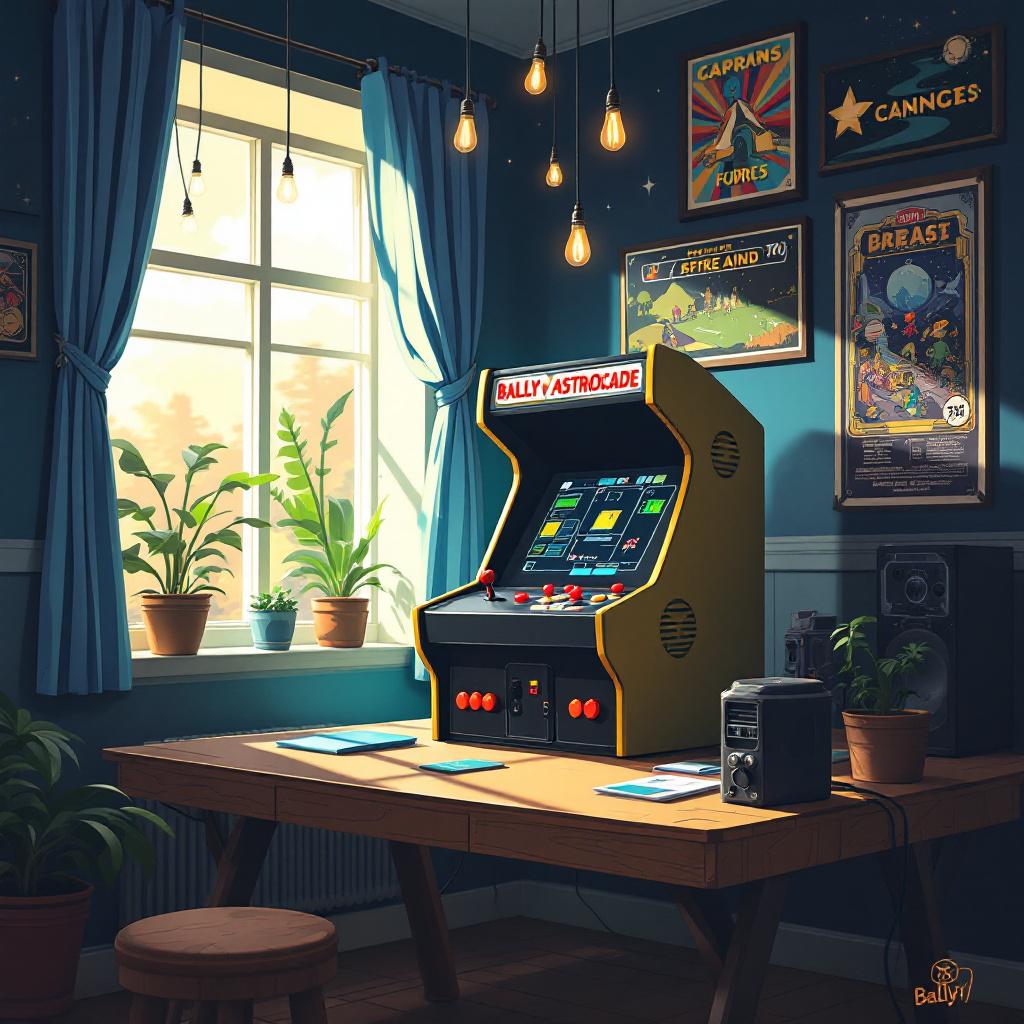
At the dawn of the video game revolution, while Atari and Intellivision dominated the landscape, a console from the United States disrupted the graphic standards of its time: the Bally Astrocade. Born under the aegis of a slot machine company, this ambitious system blends innovation and visual astonishment, while remaining little known to the general public. A look back at this remarkable underdog, which forged its legend between technical feats and a varied game catalog.
Sommaire
In brief
🚀 Launch in 1977: the Bally Astrocade entered the market with a Z80 processor clocked at 1.78 MHz, a hardware sprite set, and a rare color palette for the time.
🎮 Superior graphics: 320×204 resolution, 8 sprites per line, enhanced by a dedicated video chip, clearly surpassing the Atari 2600 and its competitors.
🕹️ Hybrid catalog: from first-person shooting to artistic creation thanks to its “Draw” mode, the Astrocade offers original titles and unexpected experiences.
🏆 Community legacy: long overlooked, it now sparks renewed interest through homebrews, retro conventions, and restoration projects.
Genesis and historical context
Origins at Bally Manufacturing
In the 70s, Bally Manufacturing ruled the slot machine and pinball industry. Among the engineers, the idea emerged to leverage the group’s graphic expertise to design a home gaming system. Initially named “Bally Professional Arcade,” the project was renamed Astrocade at the marketing department’s request, aiming to evoke a space universe in line with the era’s imagination.
Positioning against market giants
Despite limited distribution, the Astrocade capitalized on its technological depth to stand out. When the Atari 2600 displayed its eternal pixelated screens and the Intellivision boasted a limited palette, Bally’s baby played on a finer register. One might think such an advantage would be enough to capture the market, but in reality, logistics and the absence of massive marketing confined the machine to outsider status, appreciated more by technophiles than the general public.
Architecture and technical specifics
Examining the internal configuration closely, one understands why the Astrocade still surprises collectors and amateur developers today. Its components, modest on paper, are nevertheless centered around a sophisticated graphic chip for the time.
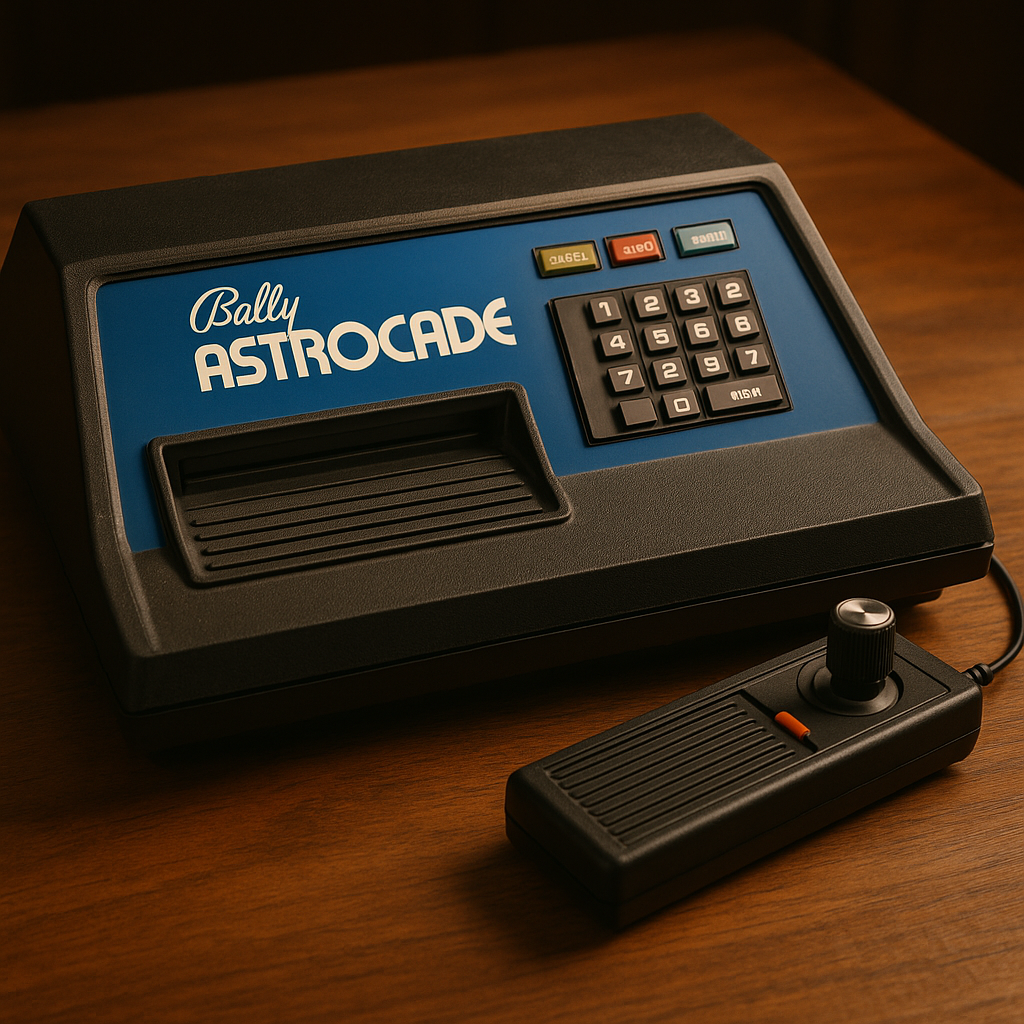
Technical specifications
| Element | Characteristic |
|---|---|
| Processor | Zilog Z80 @ 1.78 MHz |
| RAM | 4 KB |
| Video memory | 1 KB dedicated |
| Graphics | 320×204 px, 8 sprites/line, 4-color palette |
| Audio | Simple tone generator |
| Media | ROM cartridges & cassette tape (optional module) |
An Innovative Video Chip
While most machines rely on simple waveform generators, the Astrocade’s graphics circuit allows sprites and direct manipulation of the video buffer. This capability unknowingly foreshadows what some 8-bit consoles would later offer: scrolling effects, more detailed explosions, less pixelated avatars.
User Experience and Key Games
Controller Interface and Design
The Bally-designed pad stands out from the usual joysticks. Its cylindrical shape and dial selector offer a unique grip, even though it requires some time to get used to. The ergonomics prove all the more interesting when exploring the graphic input features via the “Draw” mode: a simple movement of the dial is enough to sketch shapes on the screen, inviting artistic creation.
Notable Titles and Game Variety
Among the 28 official cartridges, several titles stand out. Gunfight offers a top-down duel with smooth animations. Checkmate reinvents chess with an unprecedented graphic representation, while AstroBash introduces very fine particle effects to bombard enemy structures. In comparison, the Atari 2600 struggled to offer this level of detail, and the Bally cassette recorder even allowed loading small amateur programs, giving a preview of the homebrew scene that would flourish later.
Competitors and Comparison
To better understand the uniqueness of the Astrocade, it must be compared to its rivals:
- Atari 2600: the mainstream reference, but limited to 128 bytes of video RAM.
- Intellivision: more powerful processor, limited palette, strategy-oriented games.
- ColecoVision: similar graphics, but a very varied licensed library.
- Magnavox Odyssey²: few colors, but an integrated keyboard for edutainment.
Enriching one’s video game culture sometimes requires diving into cross-sectional analyses. To place the Astrocade in the évolution des consoles de jeux vidéo, one realizes it constitutes a discreet but essential milestone in the technical progression between the first and second generation of machines.
Legacy and Impact
Long forgotten, the Astrocade is now reborn thanks to enthusiasts. Unofficial cartridges regularly emerge, offering remakes or new experiences. Retro fairs and specialized forums dedicate entire sections to it, highlighting a renewed interest in this machine that was unloved during its lifetime. Beyond a simple collector’s item, it symbolizes the will to innovate in the face of commercial giants.
FAQ
What are the major differences with the Atari 2600?
The Astrocade offers a higher resolution (320×204 vs 160×192), more hardware sprites, and a unique drawing mode. The Atari, on the other hand, enjoys a larger catalog and a library of varied peripherals.
Can original games still be obtained?
Yes, on second-hand markets and from specialized resellers. Some developers also create cartridge reissues, but be cautious about the printed circuit compatibility.
How to connect the Astrocade to a modern TV?
The system outputs an RF signal, so an RF to SCART or HDMI adapter is needed. Several DIY boxes on the market process the composite signal to optimize it for LCD screens.
Is there an active homebrew scene?
Absolutely: new games, development utilities, and modern emulators keep the console alive by pushing its original limits.
