
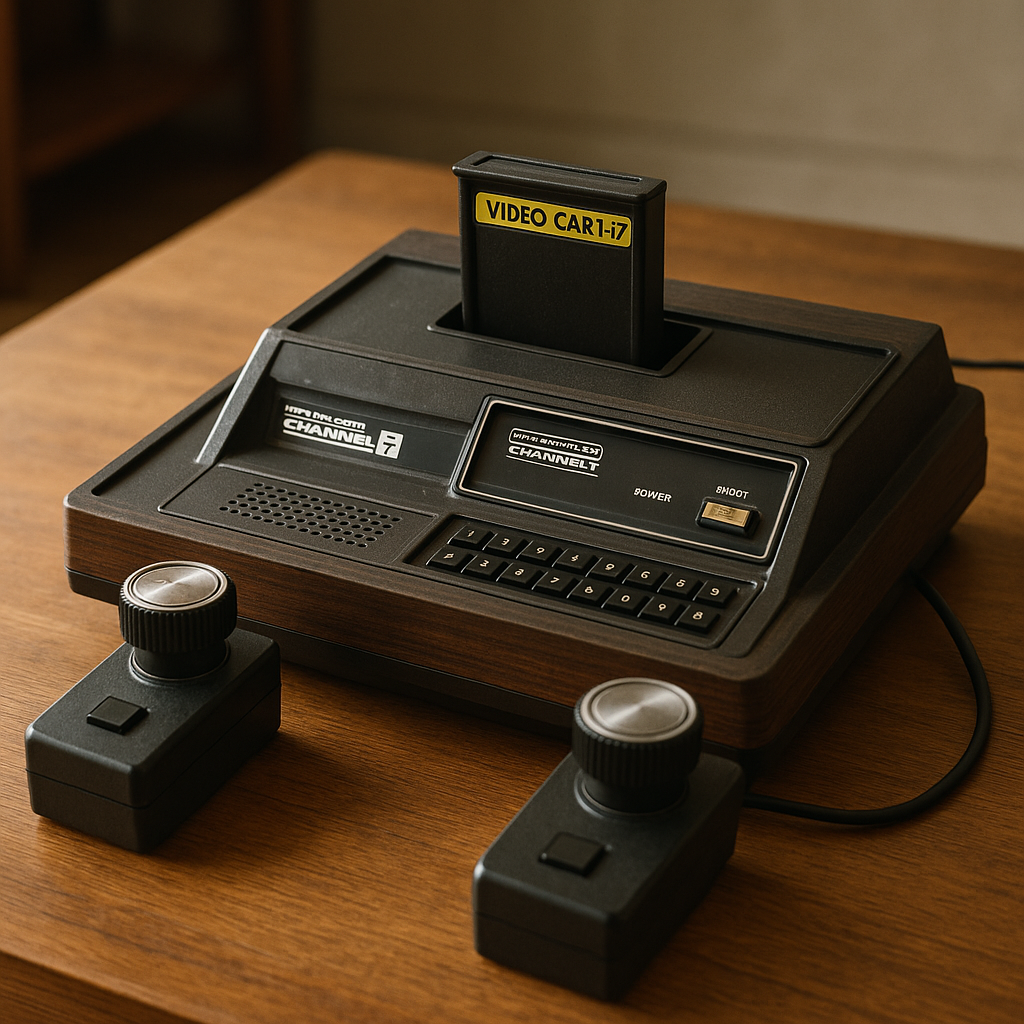
When Fairchild unveiled the Channel F in November 1976, the face of video gaming changed. Gone were the integrated printed circuits in the controllers; each cartridge became an independent world to plug in and then program. Behind this innovation, a visionary engineer, Jerry Lawson, imagined a modular system where the player controls their gaming experience rather than enduring a fixed choice. A look back at the revolution of this console that established the very concept of chip-based media, redefined the industry, and inspired a whole generation of machines.
🕹️ 1976 marks the arrival of the Channel F, the first console to offer programmable cartridges instead of fixed circuits.
⚙️ Under its casing lies a Fairchild F8 microprocessor clocked at 1.79 MHz, accompanied by 64 bytes of RAM and a modest but innovative video chipset.
📊 A direct competitor to the Atari 2600 and Mattel Intellivision, it laid the foundations of the economic model based on the sale of separate accessories and games.
💡 Its legacy remains alive: without the Channel F, it is impossible to imagine the modular design of modern consoles or the diversification of the independent developer market.
Sommaire
Origins and Development
In the mid-1970s, Fairchild Semiconductor positioned itself as a key player in electronics. Jerry Lawson, chief engineer at Fairchild, proposed the innovative idea of a console based on a microprocessor and removable modules to multiply gaming possibilities. This vision diverged from the arcade cabinets and monolithic kits then dominant. Like a computer, the Channel F could load new game logic with each cartridge insertion: a concept that immediately changed the game.
Technical Architecture
Processor and Memory
At the heart of the Channel F beats a Fairchild F8, an 8-bit processor from the industrial world, running at 1.79 MHz. It controls 64 bytes of RAM dedicated to game variables and 2 KB of internal ROM for the BIOS, a luxury at the time. Additionally, each cartridge carries up to 4 KB of extra memory, allowing programmers to add new algorithms without touching the main circuit.
Game Media: The Birth of the Cartridge
Each cartridge contains a printed circuit and a ROM engraved with the game instructions. Unlike fixed circuits, this format offers unprecedented extensibility: no need to buy a new console, just change the cartridge to explore a new universe. This technical evolutivity created an economic model based on the sale of titles, the ancestor of online stores and digital distribution.
Graphics and Sound
The Channel F’s video chip generates a display in basic text and bitmap mode, with a limited palette of four colors. Sprites are limited, the resolution reaches 128×64 pixels, and the sound is limited to a single monotone channel. Yet, this constraining simplicity stimulated developers’ creativity, who invented clever gameplay mechanisms to compensate for the visual harshness.
Competition and Historical Context
In 1976, the home video game market was still in its infancy. The Atari 2600 (VCS), launched a year later, would in turn adopt the cartridge format, directly inspired by the Channel F. Mattel Intellivision followed in 1979, marking a major graphical turning point thanks to its more powerful processor (Mattel Intellivision).
The Pre-Cartridge Era
Before the Channel F, consoles integrated a limited set of games programmed into the main printed circuit and activated by a simple button. This practice confined the player to a fixed selection, with no possibility of expansion. The Channel F overturned this paradigm by delegating the bulk of the code to cartridges, a choice dictated by the rise in semiconductor power.
Rivals and Innovations
Compared to the Atari 2600, the Channel F seemed modest in graphical power, but its real strength lay in the flexibility of the format. Bolted in the shadow of big names, it nevertheless created strong enthusiasm among enthusiasts and pushed giants like Mattel and Atari to rethink their strategies. This technical and commercial confrontation accelerated the rise of a timeline of console evolution from the late 1970s onward.
Technical Specifications
| Feature | Detail |
|---|---|
| Release | November 1976 |
| Manufacturer | Fairchild Semiconductor |
| Processor | Fairchild F8 @ 1.79 MHz |
| RAM | 64 bytes |
| Internal ROM | 2 KB (BIOS) |
| Media | 4 KB to 8 KB cartridges |
| Graphics | 128×64 px, 4 colors |
| Sound | 1 channel mono |
| Launch price | 179 USD |
| Key games | Video Baseball, Spitfire Interceptor |
Impact and Legacy
Beyond the technical feat, the Channel F established the idea that a console is no longer a fixed device but an evolving platform. Cartridges, initially criticized for their higher production cost, became a viable economic standard: they created a secondary market, encouraged regular investment from players, and opened the way for external studios.
Programmability and Economic Model
The rise of cartridges favored the emergence of third-party developers, freed from hardware manufacturing constraints. Soon, independent publishers capable of exploiting the platform without Fairchild’s direct approval began to flourish. This model, now common on digital stores, has its roots in the revolution inaugurated by the Channel F.
Transmission to Future Generations
Although the console faded in the face of the massive success of the Atari 2600, it nevertheless passed on an immutable concept to its successors: offering the player the power to choose and change their experience. Without this foundation, there would be no NES, Sega Master System, or the emergence of game on demand. Its influence is felt even in current platforms and the diversity of physical or digital media.
FAQ
When was the Fairchild Channel F released?
It was marketed in the United States in November 1976, well before the Atari 2600 (1977) and the Mattel Intellivision (1979).
What is its major technical feature?
Its ability to accommodate programmable cartridges thanks to a Fairchild F8 microprocessor, marking the end of games integrated into fixed circuits.
Who were its main competitors?
Besides the Atari 2600, it faced the Mattel Intellivision and, to a lesser extent, the first hobbyist cartridge-based machines.
Why is its legacy essential?
It inaugurates the modularity of consoles and the economic model of external media, principles still at the heart of the video game industry.
