In 1983, the collapse of the video game market in the United States plunged the industry into an unprecedented slump. Yet, two years later, Nintendo arrived with the Nintendo Entertainment System, ready to revive a sector lacking ideas and confidence. Beyond a simple device, the NES embodied a finely orchestrated recovery strategy, merging sleek design, clever marketing, and a lineup of exclusive games. This article explores how the 8-bit console saved a video game world on the brink of collapse.
Sommaire
In brief
🎮 Thanks to ingenious rebranding and a disguised presentation (it looked more like a video player than a console), the NES dodged post-crash suspicion and won back the general public.
✨ Equipped with a Ricoh 2A03 8-bit processor, 2 KB of RAM, and a palette of 54 colors, it offered gaming power far superior to competing machines.
🚀 Flagship licenses (Super Mario Bros., The Legend of Zelda) crystallized enthusiasm, turning every new release into a true event.
🖥️ Facing rivals like the Commodore 64 or the Atari 7800, the NES stood out for its ease of use and exclusive catalog.
The context of the 1983 video game crash
In the early 80s, too many consoles and poor-quality games flooded the shelves. Consumers, overwhelmed, voiced their disillusionment: some barely playable cartridges could cost more than a movie ticket. When sales collapsed, several manufacturers went bankrupt, leaving a historic void. Nintendo, still confined to the Japanese market, watched the turmoil cautiously, refining its vision of a product capable of reassuring both families and retailers.
Nintendo’s strategy to revive the market
Ingenious repackaging and partnership with retailers
Instead of presenting the NES as “a game console” – a suspicious label in the eyes of retailers – Nintendo sold it as an “Entertainment System.” The kit included a light gun and quality-locked cartridges, eliminating compatibility issues. Distribution chains refusing traditional consoles were convinced by an approach that resembled more a VCR.
The power of in-house licenses
One might think the hardware was enough, but in reality, it was the arsenal of exclusive titles that swayed minds. With Super Mario Bros., Nintendo invented smooth and accessible gameplay. The Legend of Zelda offered a non-linear adventure, a rare feat on 8-bit. Each release was orchestrated as a media event, supported by televised advertising and demonstration stands in stores.
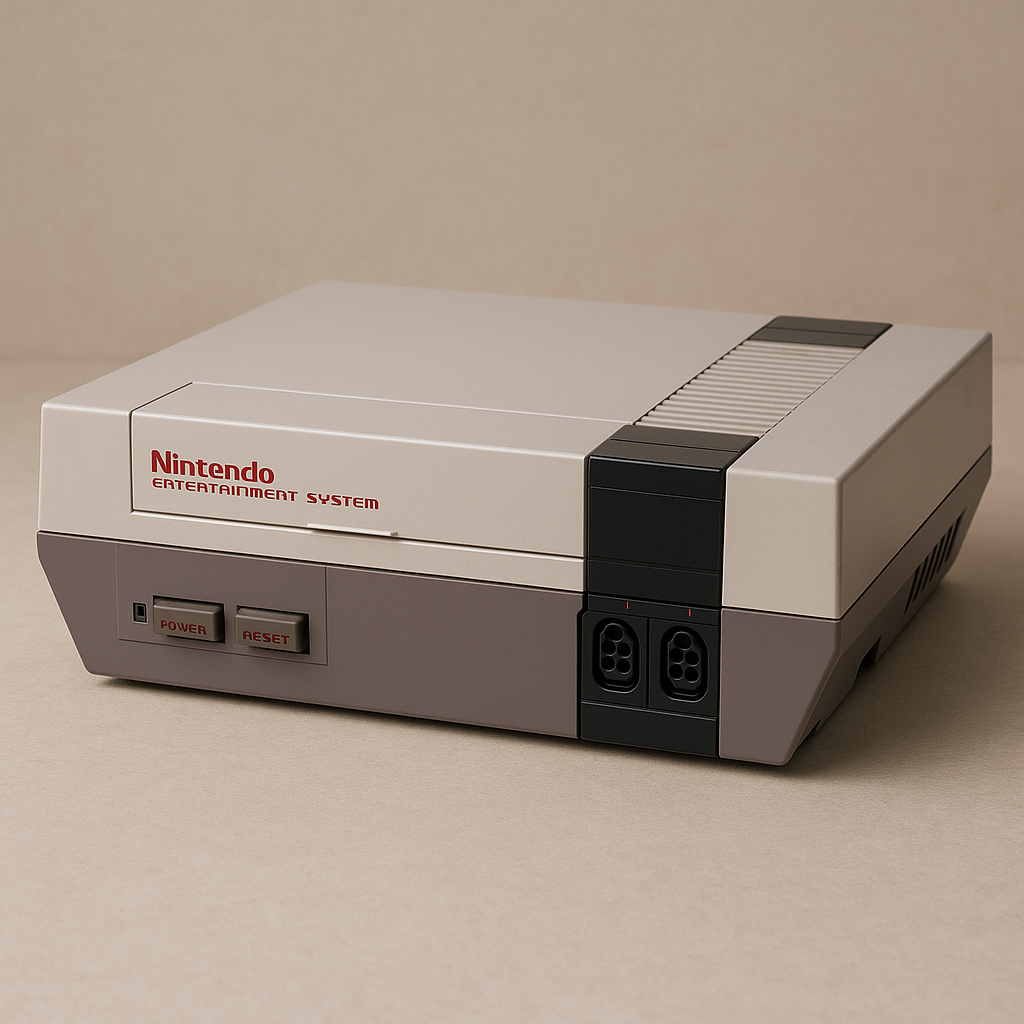
Technical Sheet
| Element | Characteristic |
|---|---|
| Processor | Ricoh 2A03 8-bit at 1.79 MHz |
| RAM | 2 KB + 2 KB VRAM |
| Graphics | 54-color palette, resolution 256×240 |
| Media | ROM cartridges (up to 1 MB with mappers) |
| Audio | 5 sound channels (2 square, 1 triangle, 1 noise, 1 DPCM) |
Market Competitors
In 1985, several machines coexisted in the player’s living room: personal computers, consoles nearing the end of their life, or still unfulfilled promises. Here is an overview:
- Commodore 64: king of the home computer, with an integrated keyboard and thousands of amateur games.
- Atari 7800: a late revival attempt, compatible with Atari 2600 cartridges, but suffering from a lack of strong titles.
- Sega Master System: as powerful or nearly as powerful as the NES, but less supported by in-house franchises.
- PC-Engine (in Japan): small but tough, it already offered faster microprocessors and 16-bit graphics.
To place the NES in a broader perspective, one can consult the history of video game consoles and measure how each machine release marks a stage in evolution.
A Lasting Legacy
Over the years, the NES laid the foundations of the current economic model: affordable hardware coupled with strong licenses. Remakes, compilations, and graphical enhancements still abound today, proof that its innovations have endured through the decades. By putting the user experience at the heart of its approach – ease of connection, ergonomic controllers, careful packaging – Nintendo taught the public to trust a home console again.
FAQ
Why is the NES so influential in video game history?
It managed to combine accessible technology with clever marketing and a catalog of original titles, creating a new momentum after the 1983 crash.
What is the difference between NES and Super Nintendo?
The SNES moves to 16-bit, offering more colors and sound power, while the NES remains a compact and iconic 8-bit system.
Can you still play original cartridges today?
Yes, thanks to second-hand consoles in good condition or modern adapters, you can experience the authentic gameplay of the era.
