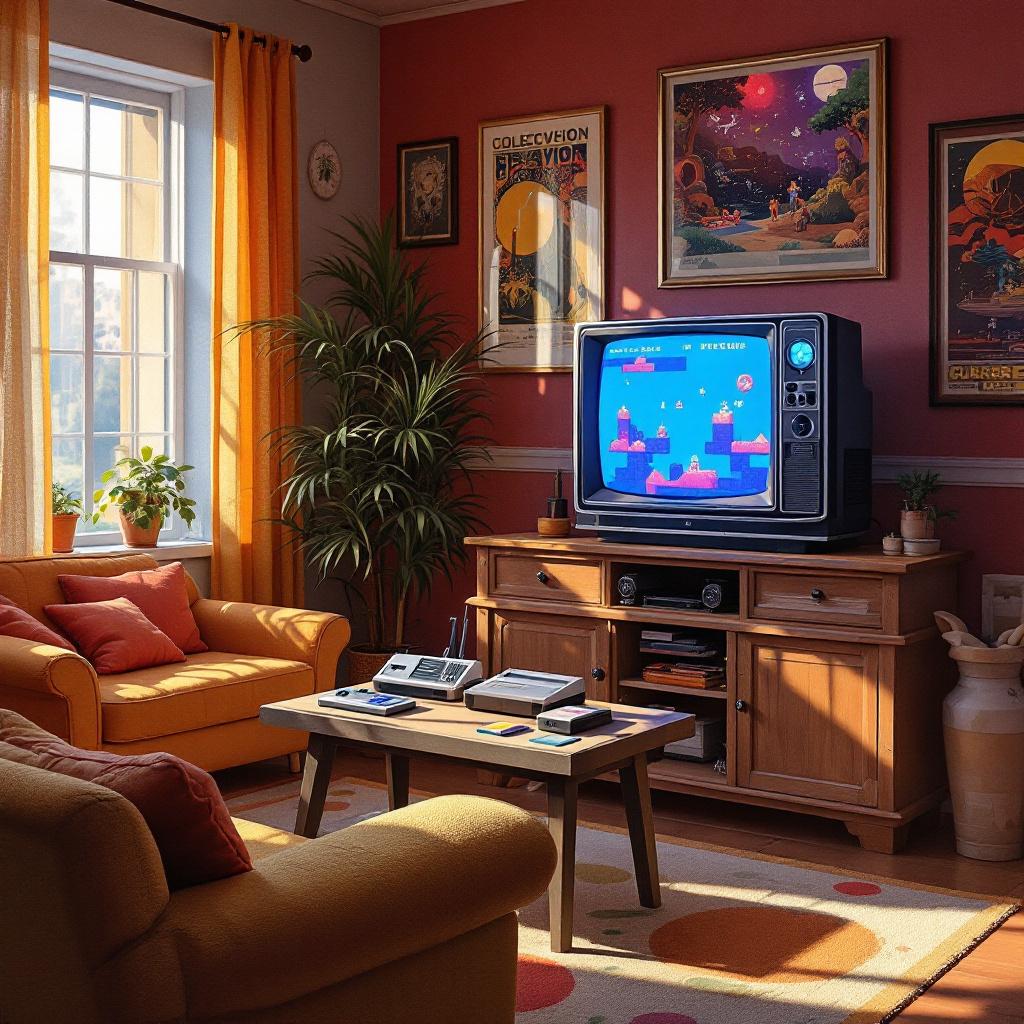
At the end of 1982, a small Coleco-licensed box took its place in American living rooms: the ColecoVision. With its promise to deliver sensations worthy of arcade machines, it redefined players’ expectations at home. Let’s dive behind the scenes of this cult console, from its architecture to its impact on a booming market.
🎮 Arcade power: equipped with a Z80 processor, the ColecoVision offered graphic and sound rendering far above its competitors, bringing the player closer to the arcade hall atmosphere.
📎 Varied catalogs: with more than 30 titles at launch, including the legendary Donkey Kong, it successfully combined Atari licenses and Coleco exclusives to build a loyal audience.
💾 Clear technical specs: 1 MHz frequency, 8 KB of RAM, and interchangeable cartridges, these are the essential ingredients of its configuration.
🏆 Market position: facing the Atari 2600, Intellivision, and some microcomputers (ZX Spectrum, VIC-20), it established itself thanks to its visual quality and arcade-like adaptations.
Sommaire
Genesis and ambitions
In 1982, Coleco—already famous for its Intellivision consoles—sought to position itself higher-end. The goal: to offer an authentic arcade experience at home. To do this, the company collaborated with Nintendo to include the hit Donkey Kong on cartridge and focused on a compact, almost plug-and-play design. The idea was simple: no complex wiring, just a dedicated input for the “joysticks + numeric keypad” controller, and you start the game directly.
Architecture and design
Processor and memory
At the heart of the ColecoVision beats a Zilog Z80 clocked at 3.58 MHz, supported by 8 KB of RAM and 16 KB of video ROM. This configuration seems modest in the era of microcomputers, but optimized for gaming, it delivers smooth and colorful rendering.
Media and cartridges
The games, inserted as cartridges, use a 16-bit bus for addressing, allowing for more complex titles than on the Atari 2600. Some cartridges even extend memory thanks to additional banks, paving the way for larger game worlds.
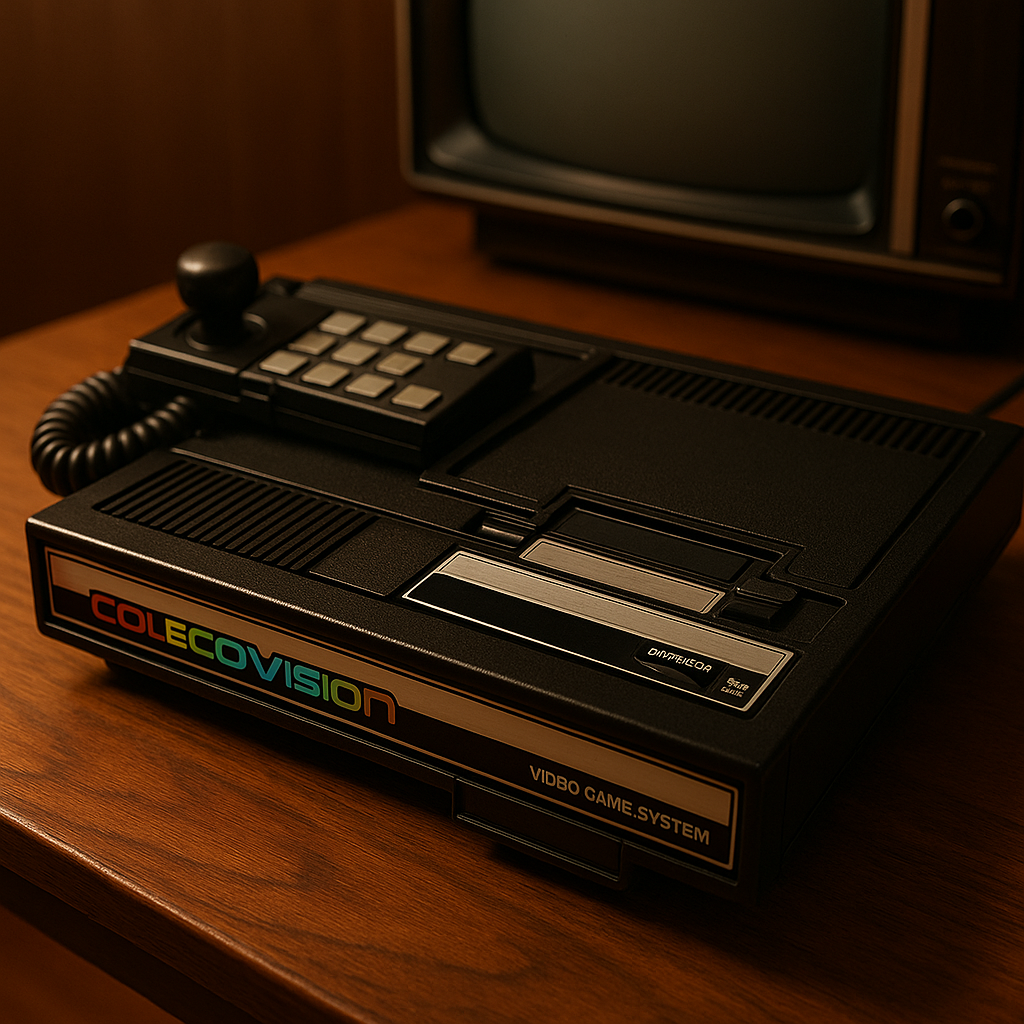
Technical specifications
| Element | Characteristic |
|---|---|
| Processor | Zilog Z80 @ 3.58 MHz |
| RAM | 8 KB |
| Graphics ROM | 16 KB |
| Sound | 3 PSG channels + 1 percussion |
| Media | 8-bit cartridges (with possible extensions) |
| Video output | RF + Composite |
Catalog and iconic titles
Few consoles can boast having launched a hit like Donkey Kong in a version almost identical to the arcade. Added to this are successful adaptations of Mouse Trap, Venture, and Smurf Paint ‘n’ Play. The publisher Coleco also diversified its offer with sports licenses and family hits, attracting a wider audience.
Competition and Market in 1982
At the time of its launch, the ColecoVision faced:
- Atari 2600: the reference, but already aging in terms of graphics.
- Mattel Intellivision: similar performance, but a less rich library in arcade licenses.
- ZX Spectrum & Commodore VIC-20: microcomputers that also appeal thanks to their programming capabilities.
To understand the impact of all these machines on the évolution des consoles de jeux vidéo, it is enough to compare the performance and marketing strategies of each player.
The Legacy of the ColecoVision
Despite its initial success, the ColecoVision gave way during the video game crash of 1983. However, its architecture inspired many later machines and remains a collector’s fantasy. Today, its rarity and iconic cartridges make it a retro treasure, a precious witness to the golden age of home arcade gaming.
FAQ
What distinguishes the ColecoVision from the Atari 2600?
Graphic and sound power: the ColecoVision approached arcade rendering, whereas the Atari 2600 remained limited.
How many games were released for the ColecoVision?
About 30 original cartridges, before the advent of memory expansions that increased this catalog.
Is the console compatible with other accessories?
Yes, notably a flight module for flight simulators and an adapter that allowed reading Atari 2600 cartridges.
