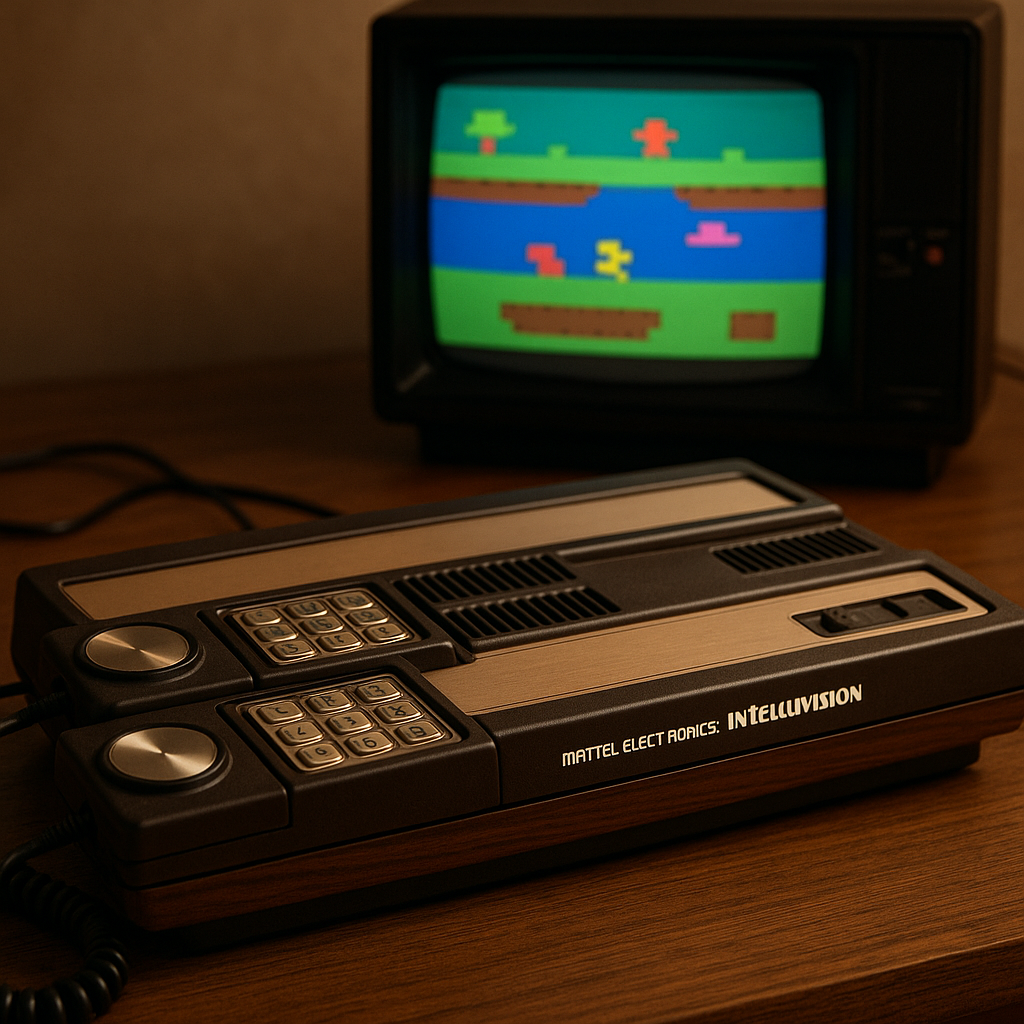
In the early 1980s, Mattel took on a major challenge: to surpass the iconic Atari 2600 in visuals. The Intellivision, launched at the end of 1979, played the card of graphic power and a more “computer-like” approach to attract an audience eager for novelty. Between oversized engineering and marketing strategies, this console laid the foundations for a true graphics war.
🎯 Intellivision relies on a 16-bit processor and a dedicated sound chip, offering a finer rendering than the Atari 2600.
⚔️ Facing it, the Atari 2600 uses its popularity and a dense catalog to maintain its commercial lead.
💡 The “graphics war” is based on more numerous sprites, extended color palettes, and stereo sound that hits the ear.
🚀 Legacy: Intellivision anticipates the rise of hybrid consoles and the importance of hardware for game designers.
Sommaire
Context and birth of the Intellivision
When Mattel, a toy giant, contemplates the explosion of the video game market, the idea of creating its own console becomes obvious. Rather than simply copying the Atari 2600, engineers opted for a hybrid architecture, close to that of a microcomputer. With a 16-bit CPU, a powerful graphics module, and a real sound chip, the Intellivision positioned itself as the console for demanding gamers.
The graphics war
Technical architecture and visual power
Behind its characteristic controllers, the Intellivision hides a CP1610 processor clocked at 894 kHz, accompanied by a TMS9918A for graphics and an AY-3-8914 sound chip. This configuration allows:
- 256×192 pixels full screen, compared to 160×192 for the Atari;
- up to 16 simultaneous colors on 16 palettes;
- a rendering with multiple sprites and smoother animations.
In comparison, the Atari 2600 remains limited in color and number of sprites. Mattel played the demonstration card: trade shows, advertisements, and audio jingles reinforced the idea of a spectacular visual leap.
An unprecedented audio-graphic approach
Beyond visuals, Mattel integrated stereo sound richer than the rival’s simple buzzer. Developers could play on three musical channels and one noise channel, paving the way for more immersive soundtracks. In games like Astrosmash or Shark! Shark!, the contrast is striking: more realistic explosions, catchier music, while Atari often limits itself to simple tones.
Technical specifications
| Feature | Description |
|---|---|
| CPU | General Instrument CP1610 (16 bits, 0.894 MHz) |
| GPU | TMS9918A (Sprites, 16 colors) |
| RAM | 1 KB internal + 72 KB additional via cartridges |
| Sound | AY-3-8914 (4 channels) |
| Media | ROM cartridges (programmed in machine language or C) |
Intellivision’s competitors
Atari 2600
The Atari 2600, released in 1977, dominated the market due to its ease of use and a vast game catalog. To counter its success, Mattel capitalized on technical performance. However, despite superior graphics, the Intellivision suffered from a less extensive library and a higher price.
Other Competitors and Computers
At the same time, microcomputers like the Commodore VIC-20 or the Apple II compete in the field of programming and modularity. These machines, more expensive, appeal to an audience oriented towards “computer hobbies.” They reinforce the idea that the boundary between consoles and computers is gradually fading.
Impact and Legacy
Although the Intellivision did not dethrone the Atari 2600 in volume, it established the notion of “graphic power” as a purchasing criterion. Its influence is seen in subsequent generations: larger cartridges, expansion chips, controllers with numeric keypads. To understand this evolution, read our retrospective of the history of consoles, which details these technical revolutions step by step.
FAQ
Why was the Intellivision considered more powerful than an Atari 2600?
Thanks to its 16-bit CPU, its graphics chip capable of handling more colors and sprites, as well as a stereo sound chip, the Intellivision offered a significantly superior audiovisual experience.
Which games showcased the Intellivision’s graphical superiority?
To highlight its capabilities, Mattel released titles like Astrosmash, Shark! Shark!, and sports adaptations with more realistic animations than on the 2600.
What lessons for the video game industry today?
The “graphics war” of the 1980s reminds us that hardware innovation can be a strong selling point, but that the catalog and price remain decisive factors for consumers.