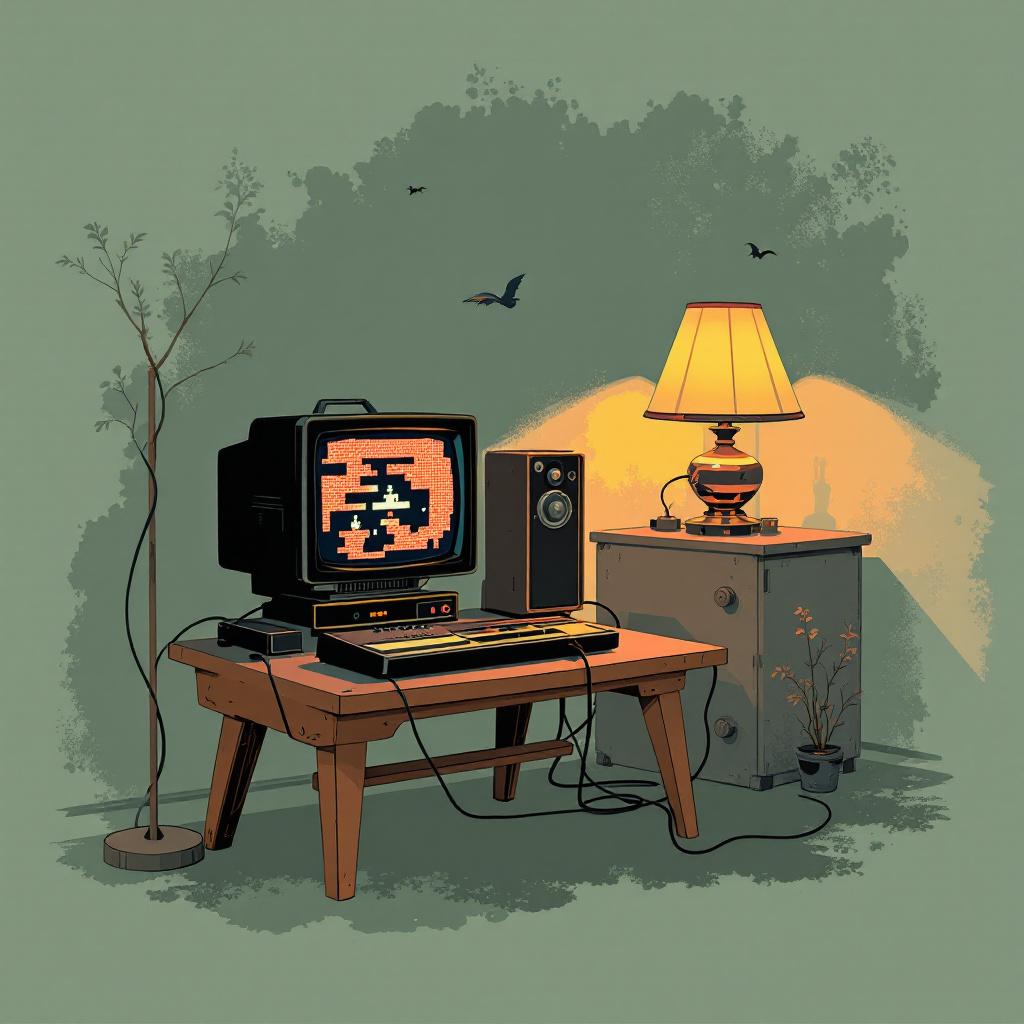
In 1977, the Atari 2600 did much more than launch a simple device: it established video gaming as a fully-fledged family entertainment. Thanks to its modular architecture, iconic design, and above all an unprecedented game catalog, this console became the gateway to a new pixelated world. Even today, its legacy resonates with developers and collectors as the symbol of an era where playing meant inventing your own pleasure, cartridge after cartridge.
Sommaire
In brief
🎮 1977 marks the advent of an accessible console: the Atari 2600 was installed in 70% of American households equipped with a television.
⚙️ A MOS 6507 core clocked at 1.19 MHz, only 128 bytes of RAM, and a cartridge system—simple but revolutionary.
🕹️ Eclectic catalog: from Pong to Adventure, many titles that laid the foundations of modern gameplay.
🌟 Facing competitors like Intellivision or the first microcomputers, the 2600 bet everything on user-friendliness and low price to conquer living rooms.
The origins of a video game revolution
Even before its launch, Atari was already experiencing tremendous success with arcade games. But bringing the living room experience closer to the arcade hall remained a challenge: how to offer hardware capable of reproducing the adrenaline of an arcade joystick on a simple television? The answer came from the team of Joe Decuir and Steve Mayer who, in 1976, sketched the prototype named Video Computer System (VCS).
Internally, the VCS was seen as a financial risk: inexpensive components but a bet on the future of “home gaming.” Commodore and Mattel were also evaluating microcomputers as future kings of the living room. Yet, Atari stumbled upon the idea of the interchangeable cartridge. While most systems were locked to a single game, the modular architecture of the 2600 allowed not only continuous renewal without repurchasing the console but also an economic model based on content.
Technical specifications
| Processor | MOS 6507 at 1.19 MHz |
|---|---|
| RAM | 128 bytes |
| Graphics | TIA chipset, 128 theoretical colors, 2 sprites |
| Sound | 2 simple channels (square waves) |
| Media | ROM cartridges (4 to 32 KB) |
| Video output | NTSC/SECAM/PAL |
| Dimensions | 29 × 17 × 5 cm |
Graphics and Gameplay: Constraints and Creativity
On closer inspection, the visual result seems almost minimal: two colored shapes on a solid background, sometimes a misaligned square that flickers. Yet, far from being a handicap, the forced simplicity stimulated the developers’ ingenuity. Carefully balanced color codes, interrupt-driven routines to draw faster: every pixel was a negotiation between memory and CPU.
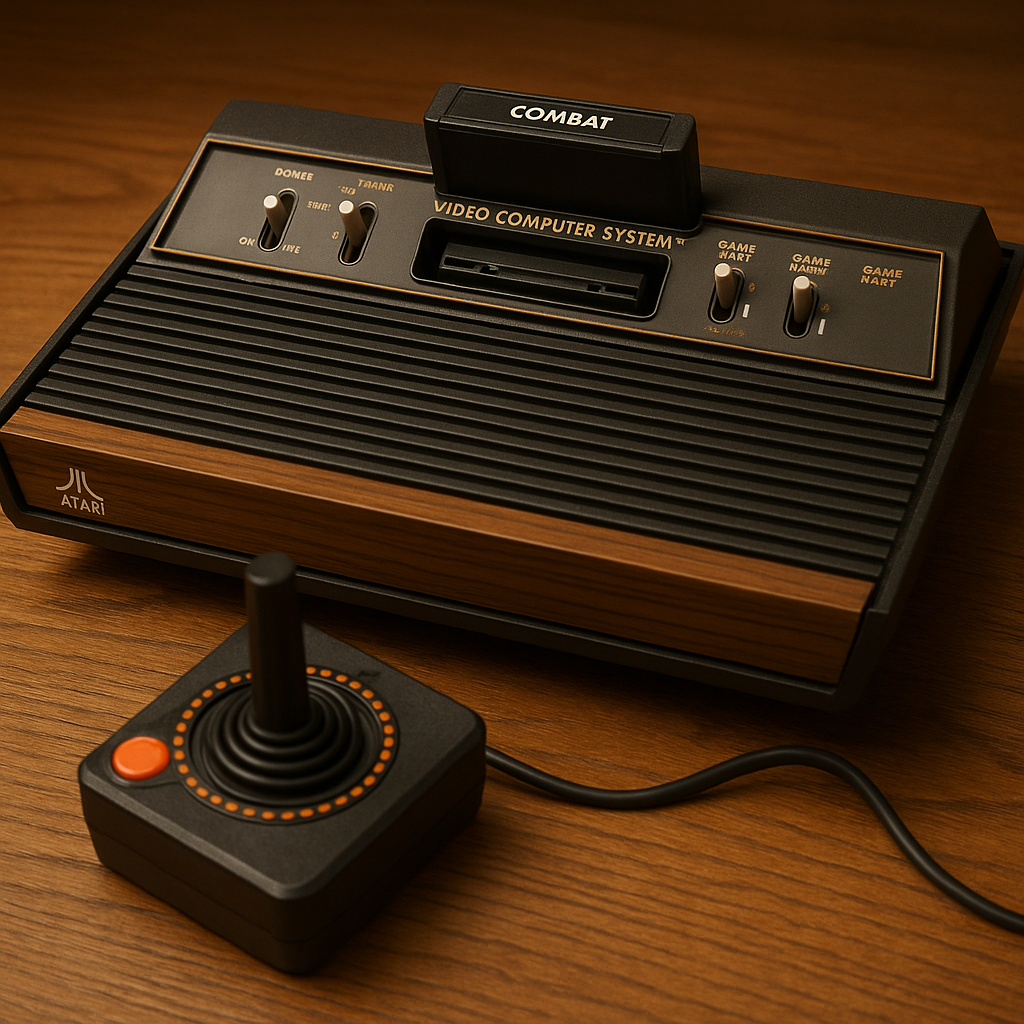
In practice, offering smooth gameplay was a feat. In Combat, planes and tanks do not just move: they respond to every joystick movement, with almost zero latency. Later, Adventure would even introduce the notion of collectible objects and “open world” movement, pioneering the action-adventure genre.
The MOS 6507 Processor and Its Limitations
The choice of the MOS 6507 — a cut-down version of the very popular 6502 — is explained by manufacturing cost savings. But with only 6 address pins, the CPU could only “see” 8 KB of ROM at a time. Hence the use of memory banks and “on-the-fly” switching to load different code segments.
These strategies gave rise to sophisticated cartridges, some embedding additional chips (F8, F6) to extend memory. Without these tricks, titles like Yars’ Revenge or River Raid would never have been possible on such a limited silicon block.
Competitors and the Video Game Landscape in the Late 1970s
At the turn of the 1980s, the Atari 2600 faced a swarm of rivals. Mattel Intellivision offered better graphics and stereo sound, while ColecoVision bet on its arcade-derived architecture. Microcomputers—Commodore 64, Apple II, TRS-80—were also seen as hybrid solutions, mixing games and programming.
For those wanting to place this battle in a broader console context, the évolution des consoles offers a detailed timeline of technological breakthroughs and competing formats, from the first arcade cabinets to the modern digital era.
- Intellivision (1980): finer graphics, matrix input.
- ColecoVision (1982): near-perfect arcade game ports.
- Commodore 64 (1982): generous RAM and SID music.
A Timeless Legacy
“Without the Atari 2600, no NES, no PlayStation, and without those, no 3D virtual worlds.”
More than a retro curiosity, the 2600 etched into the collective memory the idea that video games could be both an art and a viable business. Its model inspired the creation of entire studios, often made up of students fascinated by the magical cartridge to slip into the slot.
In a sense, every modern controller, wireless and ultra-responsive, owes a little to this rudimentary handful of buttons and these basic circuits. Here lies the very essence of gameplay: clear rules, a challenge to overcome, and the immediate pleasure of pressing Start.
FAQ
- What distinguishes the Atari 2600 from the VCS 2?
The VCS 2, a prototype never commercialized, was limited to a 4 KB ROM without switching. The final 2600 expanded the memory and introduced the standard joystick port. - Why was the RAM so low?
Around 128 bytes to hold the essential variables: sprite positions, game states. Everything else was managed via the cartridge ROM. - How to preserve your cartridge collection?
Store away from humidity, clean contacts with isopropyl alcohol, and replace cases if broken. - Can the Atari 2600 be connected to a modern screen?
With an RF to HDMI adapter, or by retrieving the composite output via a DIY setup.
