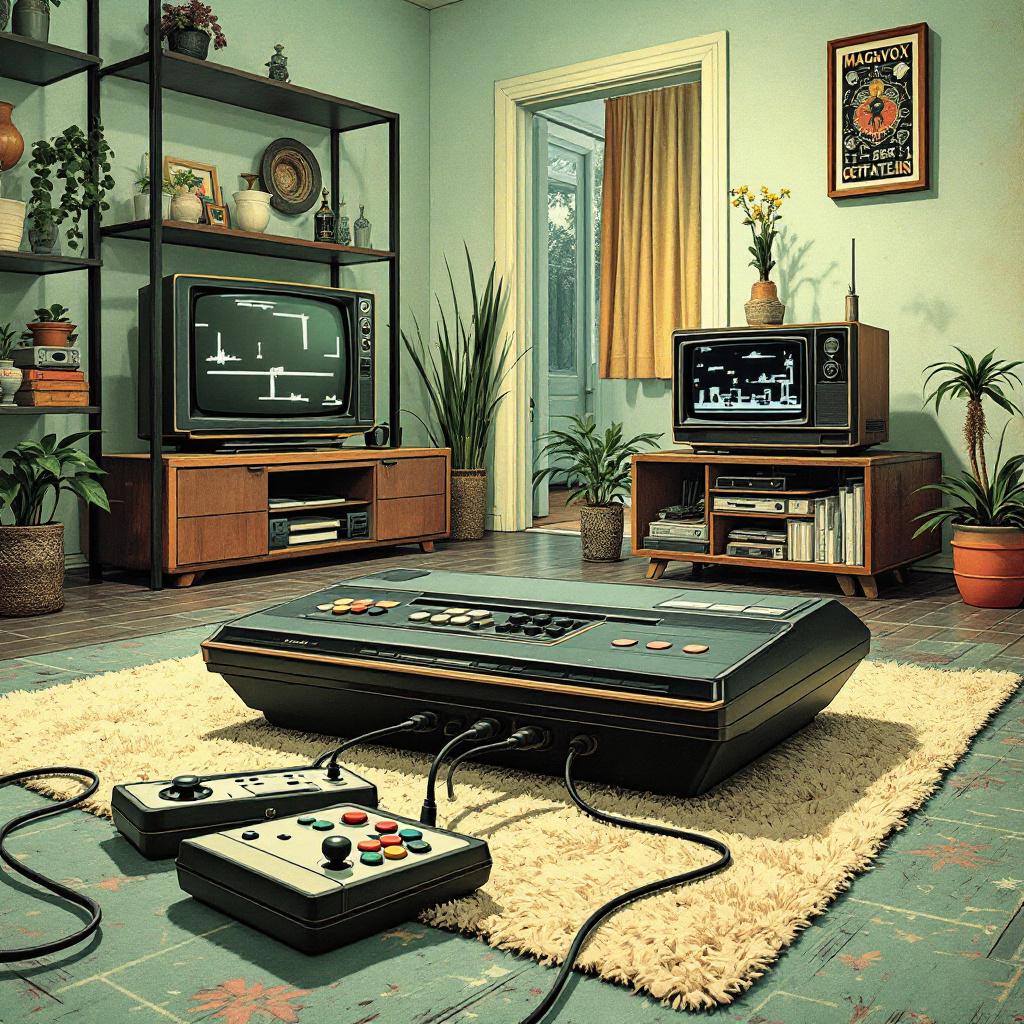
In 1972, against a backdrop of black and white televisions and rudimentary components, the Magnavox Odyssey laid the first stone of the domestic video game era. Born from the ingenuity of Ralph Baer, this console opens an unprecedented chapter: placing video games in the living room. Without a dedicated screen, without a powerful graphics processor, it nevertheless manages to electrify the collective imagination and show the way forward.
🎮 1972 marks the arrival of the Magnavox Odyssey, the very first home console designed by Ralph Baer.
⚙️ Its discrete processor, 40 diodes, and 8 game cards offer varied experiences, despite minimalist graphics.
🖥️ Compared to the first home computers, it stands out for its ease of installation and purely playful orientation.
🔗 This ancestor influences the entire industry: for a broader overview, explore the évolution of video game consoles from 1972 to today.
Sommaire
Genesis and context of the release
Birth of a revolutionary idea
In a small laboratory at Sanders Associates, Ralph Baer sketches the idea of a box capable of generating simple video signals. Like an inventor’s lab, Baer and his team explore all kinds of playful demonstrations: ping-pong, shooting, target tracking… By combining diodes, integrated circuits, and a television, they open the door to interactive entertainment. This project, initially unknown to the major firms of the time, gradually transforms into a marketable product.
A still virgin market
Before 1972, interactive gaming was limited to rare arcade machines or university prototypes. There was no entertainment offering directly connected to the television. The release of the Odyssey took place on an almost deserted field, crossing a new threshold: offering a playful experience without leaving the living room. This strategy, bold for a company specialized in military equipment, demonstrates a desire for diversification and marks the beginning of a flourishing market.
Architecture and technical innovations
Technical specifications
| Element | Specification |
|---|---|
| CPU | Custom dedicated, no classic microprocessor |
| Memory | No external RAM (stateless) |
| Graphics | 40 monochrome LED diodes |
| Game media | 8 interchangeable chip cards |
| Connectivity | RF output to TV antenna |
Design and interchangeable controllers
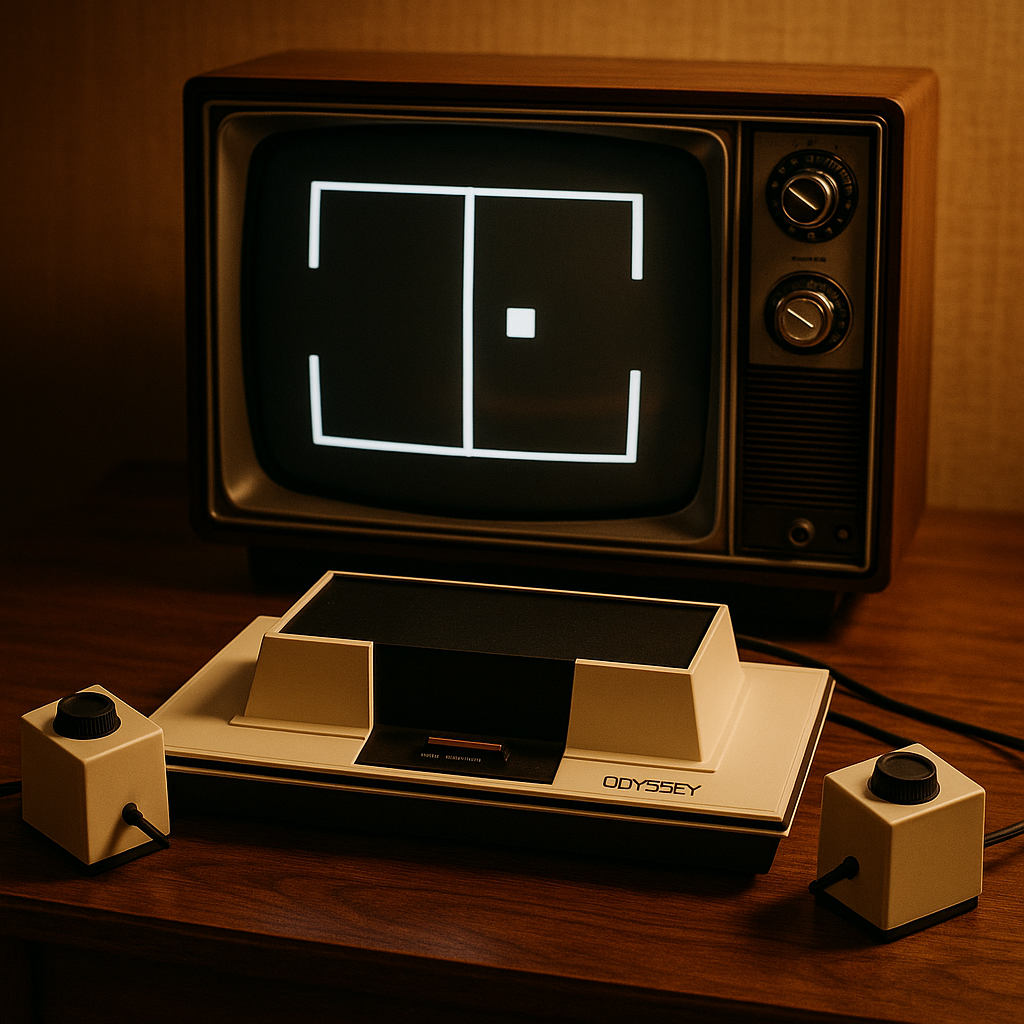
The console is presented as a compact box, on which two small controllers without joysticks are connected. Each game card modifies the internal circuits to offer a new type of game: tennis, frog racing, or simple shooting exercises. The controllers, sober and functional, rely on rotary potentiometers, offering basic but satisfying control for the time.
Graphics and Limitations
Without a microprocessor or dedicated internal memory, the Odyssey relies on diodes to display squares and dots. This graphic minimalism requires letting the imagination run free: players stick colored overlays on the screen to bring the scenes to life. This makeshift and participatory approach creates a direct connection between the machine and the audience, very different from the realism we know today.
A Rival for Early Personal Computers
Dedicated Computers of the Time
At the same time, machines like the Kenbak-1 or the Altair 8800 appeared, designed for computer experimentation rather than gaming. Between complex machine language and punched cards, these systems mainly attracted programming enthusiasts. In this respect, the Magnavox Odyssey positioned itself as the antithesis: an immediate experience, with no learning curve, accessible to the whole family.
Comparison with the Coleco Adam
A few years later, Coleco Adam attempted to merge console and family microcomputer, inspired by the modular spirit of the Odyssey. However, with its floppy disk drive and integrated keyboard, it aimed more for versatility, while the Odyssey focused on pure simplicity. This difference in positioning highlights how Baer’s original vision remained centered on leisure, not on computer experimentation.
Reception and Legacy
Immediate Impact
Marketed at a reasonable price for the time, the console sold about 100,000 units in a few months. Families discovered, sometimes with surprise, that all it took was a television and a box to play at home. Testimonials report a friendly atmosphere: several generations around the same screen, inventing new rules, tinkering with decorations and plastic prosthetics. A new breath swept through the very notion of home entertainment.
Long-Term Consequences
As often happens, the innovator rarely solves everything at once. The technical limits of the Odyssey were quickly surpassed, but its founding principle endured. Atari, Mattel, and other players took up the torch until the arrival of 8-bit microprocessors. Each new generation of consoles owes its existence to Baer’s first sketches.
FAQ
- When was the Magnavox Odyssey released?
- It was launched in the United States in September 1972.
- What do the graphics of the Odyssey look like?
- The console uses 40 monochrome light diodes, supported by colored overlays on the screen.
- What controllers come with the console?
- Two rotary potentiometer controllers, interchangeable depending on the game cartridges.
- Can the Odyssey be compared to computers of the time?
- Rather than a programming system, it offers immediate play, without coding or complex installation.
