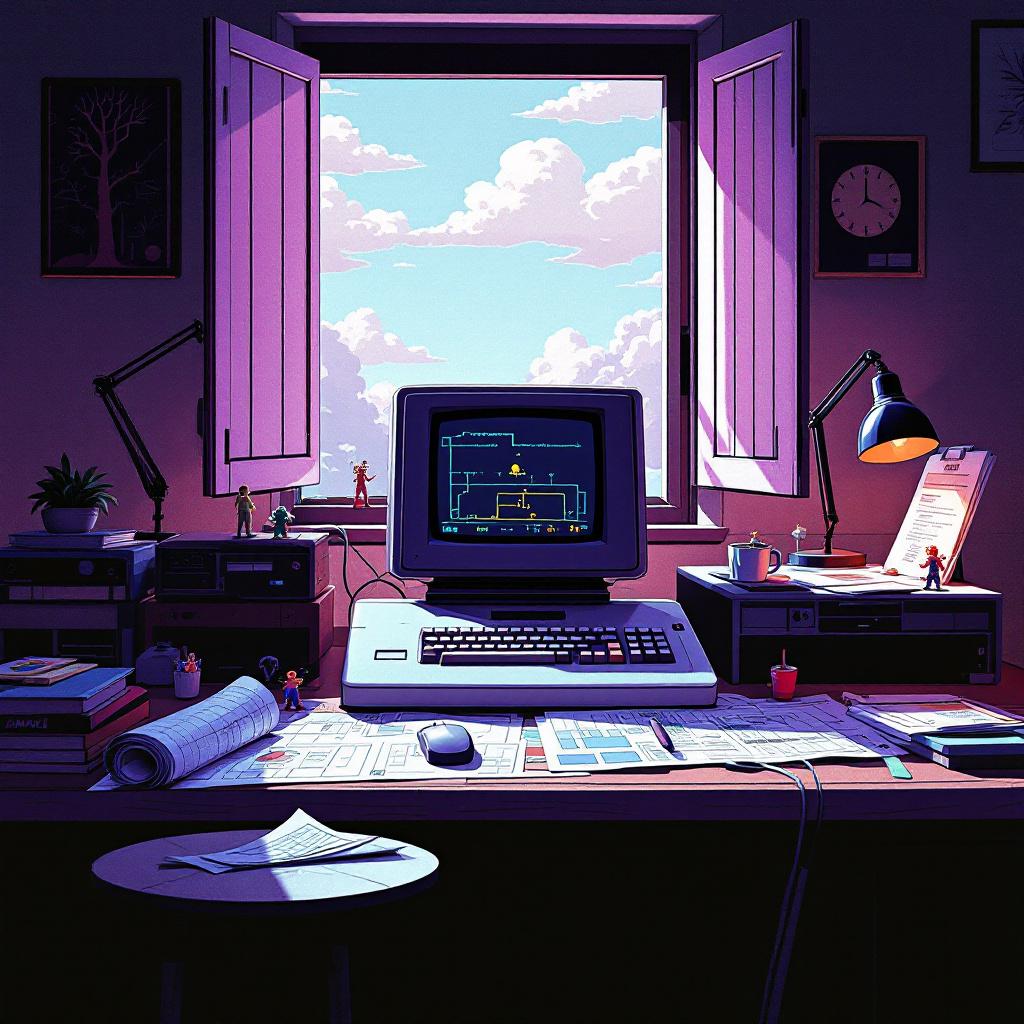
Released in the late 1980s, the Acorn Archimedes marked a technological breakthrough by integrating the brand-new ARM processor, the result of a collaboration between Acorn Computers and the University of Cambridge. Faster than most of its competitors, it offered an architecture optimized for floating-point calculations and vector graphics. However, its games, often developed on a small scale, remained outside the major video game collections. This article dives into the history of the machine, details its technical features, and highlights some gaming gems that escaped the spotlight.
Sommaire
In brief
🎯 Archimedes, launched in 1987, is the first microcomputer to use an ARM (Acorn RISC Machine) processor, foreshadowing the future dominance of this CPU family.
🕹️ Its computing power and vector graphics chipset offered a unique experience, but independent studios struggled to produce large-scale titles, resulting in a often confidential game catalog.
⚙️ With up to 8 MB of RAM and a modular format, the Archimedes competed with the Amiga and Atari ST, while paving the way for embedded systems.
💡 Several of its “forgotten” titles – from 3D simulation to isometric mazes – testify to a creativity that deserves to be rediscovered.
Genesis of the Acorn Archimedes
Origins rooted in Cambridge
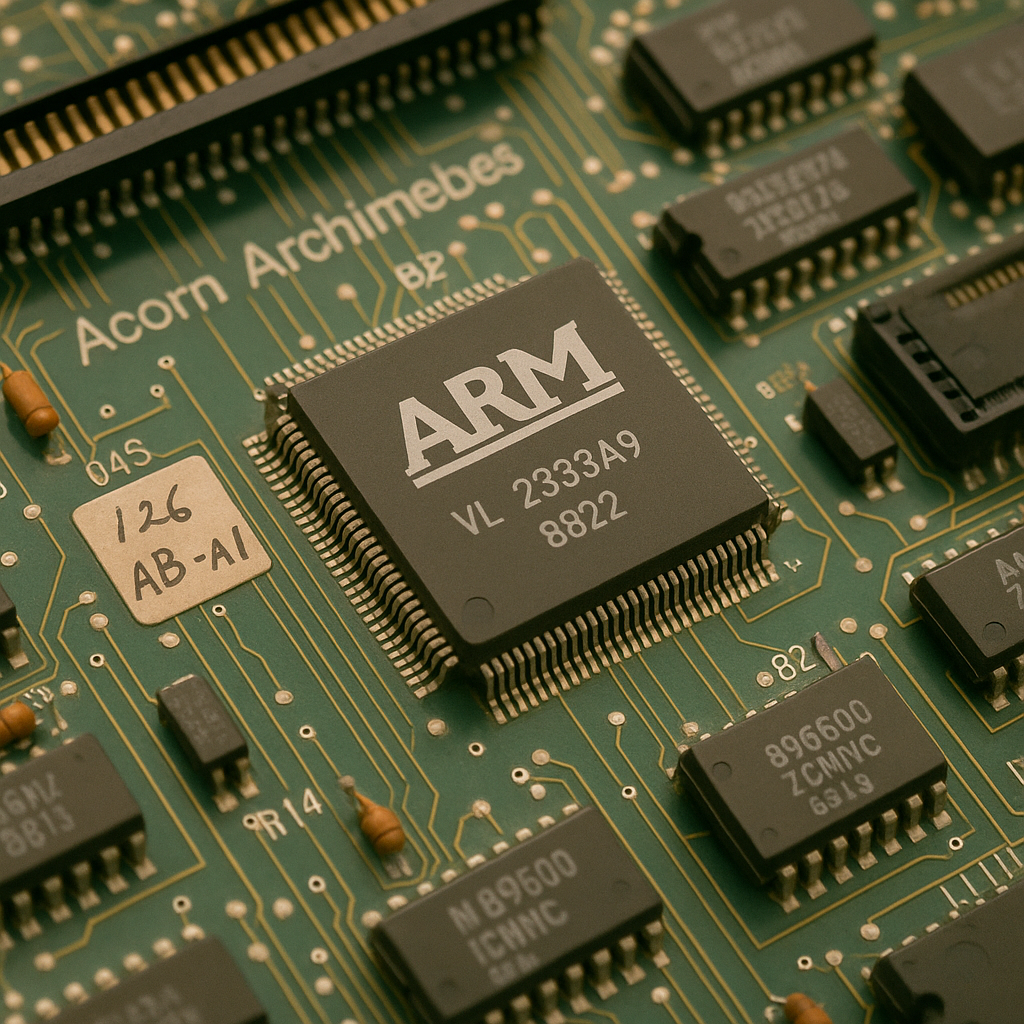
In the early 1980s, Acorn Computers sought to distinguish itself in a market dominated by the ZX Spectrum and Commodore 64. The laboratories of the University of Cambridge brought a fresh breath: researchers proposed designing a RISC (Reduced Instruction Set Computing) chip, capable of executing a reduced number of instructions very quickly. This project, quickly renamed ARM, took the form of a prototype housed on a card developed by Acorn. Enthusiasm grew when it became clear that this architecture not only offered unprecedented performance but also consumed less energy, an asset for the future of portable computing.
Hardware architecture and innovations
The Archimedes used a 16-bit internal bus for its RAM and a 32-bit external bus for the ARM2 processor clocked at 8 MHz (then ARM3 at 25 MHz). This separation guaranteed a bandwidth superior to that of competing machines. The “VIDC” chipset supported several graphic modes, including a 640×512 resolution in 256 colors. Finally, the NS32016 math coprocessor for certain versions further extended computing capabilities, appealing to CAD enthusiasts and early 3D modeling.
Technical specifications
| Feature | Detail |
|---|---|
| Processor | ARM2 @ 8 MHz / ARM3 @ 25 MHz |
| RAM | 512 KB to 8 MB (expandable) |
| Graphics | VIDC chipset, up to 256 colors |
| Storage | 3.5″ floppy drive, optional hard disk |
| OS | Arthur / RISC OS |
Little-Known Games of the Archimedes
A Variety of Genres to Rediscover
Unlike the giants of the Amiga or Atari ST, the Archimedes never benefited from a colossal marketing budget. Nevertheless, passionate developers explored different styles: flight simulation, mazes, shoot ’em ups, and even proto-3D. The technical constraint, far from hindering creativity, often pushed the invention of original renderings, such as vector backgrounds or precalculated isometric expanses.
Selection of Iconic Titles
- Zarch (Novagen): a pioneer of true 3D polygonal graphics, where you pilot a craft over fractal terrains.
- Microcosm (Psygnosis): dark atmosphere, smooth animations, and full-screen sequences.
- Red Sector (Binary Design): an intense vertical shoot ’em up, acclaimed for its fast-paced gameplay.
- Alleykat (Sunsoft): a colorful platformer with a bold artistic direction.
- Impression (Arachnid): an isometric puzzle where each piece resembles a moving mechanism.
Market Competition
In the home microcomputer segment, the Amiga 500 and Atari ST dominated thanks to their communities and game offerings. The Archimedes positioned itself on the sidelines, with a higher price but graphic and mathematical performances difficult to match. To place the Archimedes in a historical perspective, one can refer to the timeline of gaming computers, which offers a comprehensive overview of the sector, from the Sinclair ZX80 to modern PCs.
Legacy and Influence
Although it disappeared from consumer catalogs in the early 1990s, the Archimedes left a decisive mark. The ARM architecture, born from this project, is now omnipresent in smartphones, tablets, and connected devices. The concepts of lightweight design and energy-efficient chips, experimented with on the Archimedes, inspired a whole generation of engineers. Finally, some enthusiasts keep the homebrew scene alive, rewriting classic titles and developing new games adapted to modern RISC OS.
FAQ
What distinguished the ARM architecture of the Archimedes?
The simplicity of the RISC instruction set allowed each command to be executed in one clock cycle, offering speed superior to competing CISC processors. This efficiency proved decisive for miniaturization and low power consumption.
Could Amiga or Atari ST games run on the Archimedes?
No: the inherent architecture of the ARM2/3 and the RISC OS system were too different. However, some modest emulators emerged in the homebrew scene, but without achieving perfect compatibility.
How can one access the games today?
Several online communities offer disk images and emulators such as RPCEmu or Arculator. They allow rediscovering these titles on PC or Raspberry Pi.
Why didn’t the Archimedes reach the general public?
Its pricing positioning and fierce competition, combined with a rather limited consumer software catalog, hindered its adoption. Businesses and academic institutions, however, made extensive use of its power.
