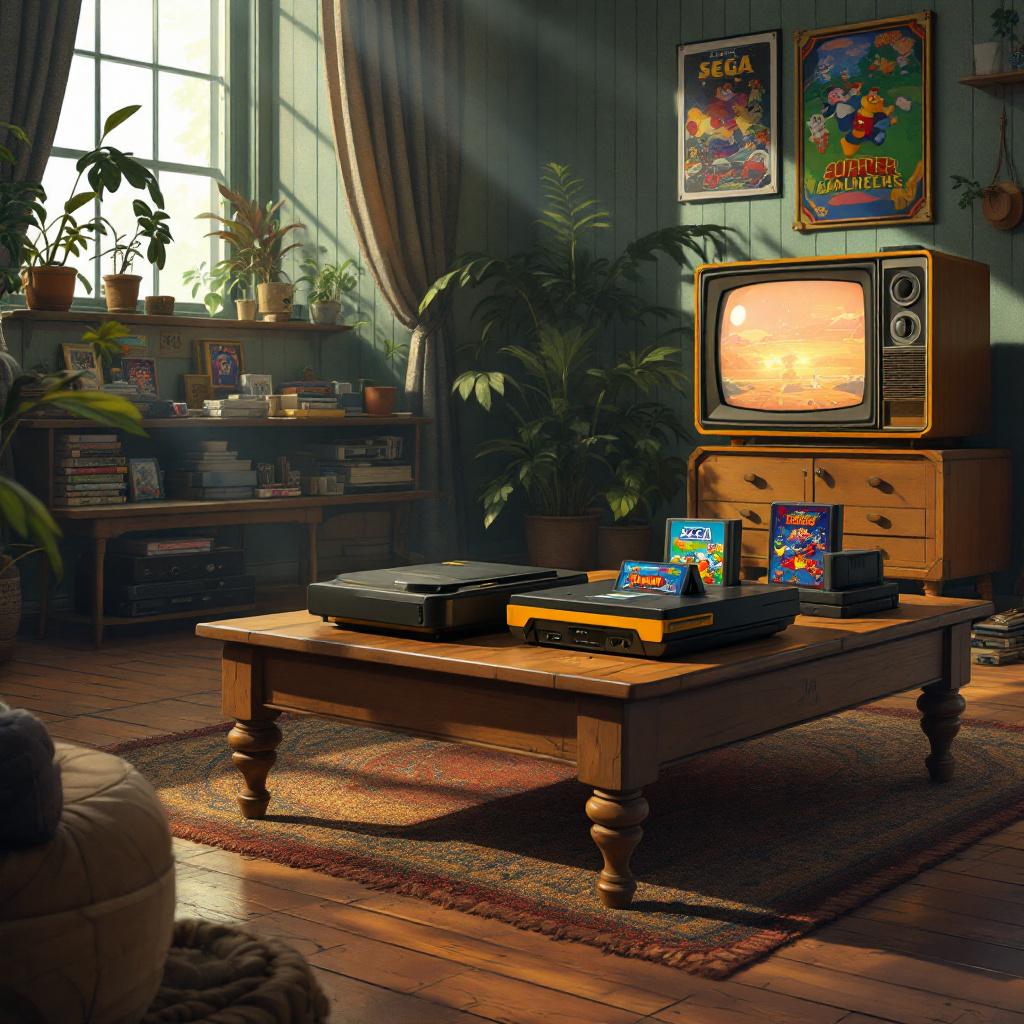
In 1994, Sega aimed to extend the success of the Mega Drive with a module intended to propel its console into the realm of 32-bit systems. Yet, a few months later, the Sega 32X faded into obscurity. What technical and strategic weaknesses hastened its fate? A look back at the choices that turned a promise of performance into a commercial fiasco.
Sommaire
In brief
🔧 32-bit extension for the Mega Drive, launched at the end of 1994, intended to compete with next-generation consoles.
💾 Dual SH-2 CPU clocked at 23 MHz, but 512 KB of RAM insufficient to attract developers.
🎮 A chaotic launch against the SNES, Jaguar, and Amiga or Atari computers, caused by faulty logistics and limited games.
📉 Ultimately, the 32X generated less than 1 million sales, illustrating the need for a clear roadmap for any hardware add-on.
Genesis and ambition of the Sega 32X
A quick response to the 16-bit → 32-bit transition
In the early 1990s, the Mega Drive dominated living rooms but without a real prospect of increased power. Rather than developing an entirely new console, Sega envisioned a modular extension capable of adding a 32-bit processor to the existing base. On paper, an economical and quick choice, avoiding the R&D effort of a complete system.
Goals and marketing promises
Marketed for less than €200, the 32X was supposed to offer finer graphics, extended colors, and PCM digital sound. Sega then touted full compatibility with the Mega Drive game library, hoping that developers and players would adopt this intermediary before the scheduled arrival of the Sega Saturn.
Image: visual demonstration

Technical specifications of the Sega 32X
| Component | Characteristic |
|---|---|
| Processor | Two 32-bit SH-2 at 23 MHz |
| Main RAM | 512 KB (DRAM) |
| Graphics | 256 simultaneous colors, 64×64 sprites |
| Audio | Stereo PCM, Yamaha 2151 channel support via Mega Drive |
| Media | Proprietary 32X cartridges |
| Compatibility | Mega Drive / Genesis |
| Launch price | ~€159 |
Reasons for a commercial failure
Fierce competition and consumer confusion
Just launched, the 32X found itself facing the Super Nintendo (16-bit), the Atari Jaguar (claimed 64-bit), and microcomputers like the Amiga 1200 or Atari Falcon, already well established among hobbyists and professional tool users. This profusion of platforms made the player’s choice uncertain: why invest in an add-on when a complete machine offered more guarantees? To place the 32X in the evolution of platforms and innovations, one can consult the hardware innovations that marked video games, highlighting the importance of a coherent offer from the start.
Lack of games and absence of support
Instead of lining up a range of flagship titles, Sega saw its internal studios waver between Mega Drive, 32X, Sega CD, and the imminent Saturn. Some third-party developers, puzzled by the kits and limited memory, quickly abandoned the platform. Result: fewer than 40 games available, including several botched ports of MD titles. The launch packs lacked exclusive and ambitious titles, weakening the purchase argument.
Technical and logistical complexity
Connecting the 32X to a Mega Drive required accommodating a clean video cable, a sound DSP module, and a specific power supply. Users had to juggle between controllers, adapters, and different TV ports. This hardware contraption contrasted with the plug-and-play simplicity of the SNES or Amiga computers, where a single cable often sufficed. Overwhelmed stores poorly cataloged the references, causing returns and dissatisfaction.
Legacy and lesson for the industry
The fate of the Sega 32X reminds us that an add-on does not conquer the market solely by the strength of its technical specifications. A solid ecosystem, clear partnerships, and a flawless launch are essential. Some concepts of the 32X—dual processor, early polygon rendering—foreshadow future advances, but the rush gave way to amateurism.
FAQ
What was the Sega 32X and why was it added to the Mega Drive?
It was a hardware extension designed to equip the Mega Drive with 32-bit capabilities without completely replacing the console, theoretically to offer a less costly and faster transition path.
Can I still find 32X games today?
Yes, but they are rare and often sold at high prices: cult titles like Knuckles’ Chaotix or Virtua Racing are among the most sought after.
What alternatives to the 32X existed at the same time?
Besides the Super Nintendo, the Atari Jaguar, and the Neo Geo CD, several microcomputers like the Amiga 1200 and the Atari Falcon already offered superior graphic and sound performance.
