
Few machines embody the desire to make home computing accessible as much as the VIC-20 and Plus/4 did. Released respectively in 1980 and 1984, these computers found their way under the Christmas tree of thousands of households, even before the Commodore 64 imposed its dominance. By revisiting their features and histories, we discover how much these “small” models contributed to popularizing the microcomputer, while paving the way for the dazzling success of their big 8-bit brother.
🖥️ VIC-20: the first microcomputer under $300, equipped with 5 KB of RAM and an integrated BASIC, it paved the way for home computing.
🎨 8-bit graphics and sound adapted to amateur games, its expandable cartridges allowed it to host more than 500 new software titles.
⚙️ Plus/4: enriched with office applications (word processor, spreadsheet), it targeted the versatile user despite limited compatibility with the VIC-20 and C64.
🏁 Major legacy: both platforms formed a dynamic community, influencing the timeline of gaming microcomputers and preparing the arrival of the C64 and far beyond.
Sommaire
Genesis and market positioning
At the end of the 1970s, personal computing was still in its infancy. Commodore, buoyed by the success of its PET, sought to reach a broader audience by lowering the price of a microcomputer. The VIC-20 project was born from this desire: to embed a 6502 microprocessor under a sleek design, facilitate programming in BASIC, and offer aggressive pricing. The goal: to stand out from the TRS-80 or Apple II, while competing with the Sinclair ZX81.
VIC-20: the birth of a bestseller
From the “Vixen” prototype to the finalized VIC-20, Commodore played the minimalism game. Equipped with a VIC SoC for video management, a cartridge port, and the famous SID chip absent here, it proved capable of displaying 22 columns of text and a palette of 16 colors. Its RAM, admittedly modest (5 KB), could be expanded via an external module to over 30 KB, transforming a basic machine into a true amateur development station.
Plus/4: the office attempt
Four years later, the Plus/4 focused on versatility. With 64 KB of RAM, a new BASIC Plus 3.5 editor, and especially a suite of applications (micro-spreadsheet, word processor, database manager), it directly targeted small entrepreneurs and educators. Alas, its cartridge port differed from the VIC-20 and C64, depriving users of the vast library of compatible games and software.
Detailed technical aspects
Exploring the technical specifications of the VIC-20 and Plus/4 reveals sometimes surprising choices, as well as compromises dictated by production costs.
Processor and memory
- VIC-20: MOS 6502 @ 1 MHz, 5 KB RAM, 20 KB ROM (BASIC and kernal)
- Plus/4: MOS 7501/8501 @ 0.985 MHz, 64 KB RAM, 32 KB ROM integrating BASIC Plus 3.5 and four utilities
Graphics and sound
The VIC-6560 video chip of the VIC-20 is limited to 176×184 pixels in multicolor mode, while the Plus/4 benefits from the VIC-II at 320×200 pixels. However, the presence of a simplified sound generator on the Plus/4 remains inferior to the capabilities of the C64’s SID, hence the majority adoption of the VIC-20 in the gaming sphere — where sound makes all the difference.
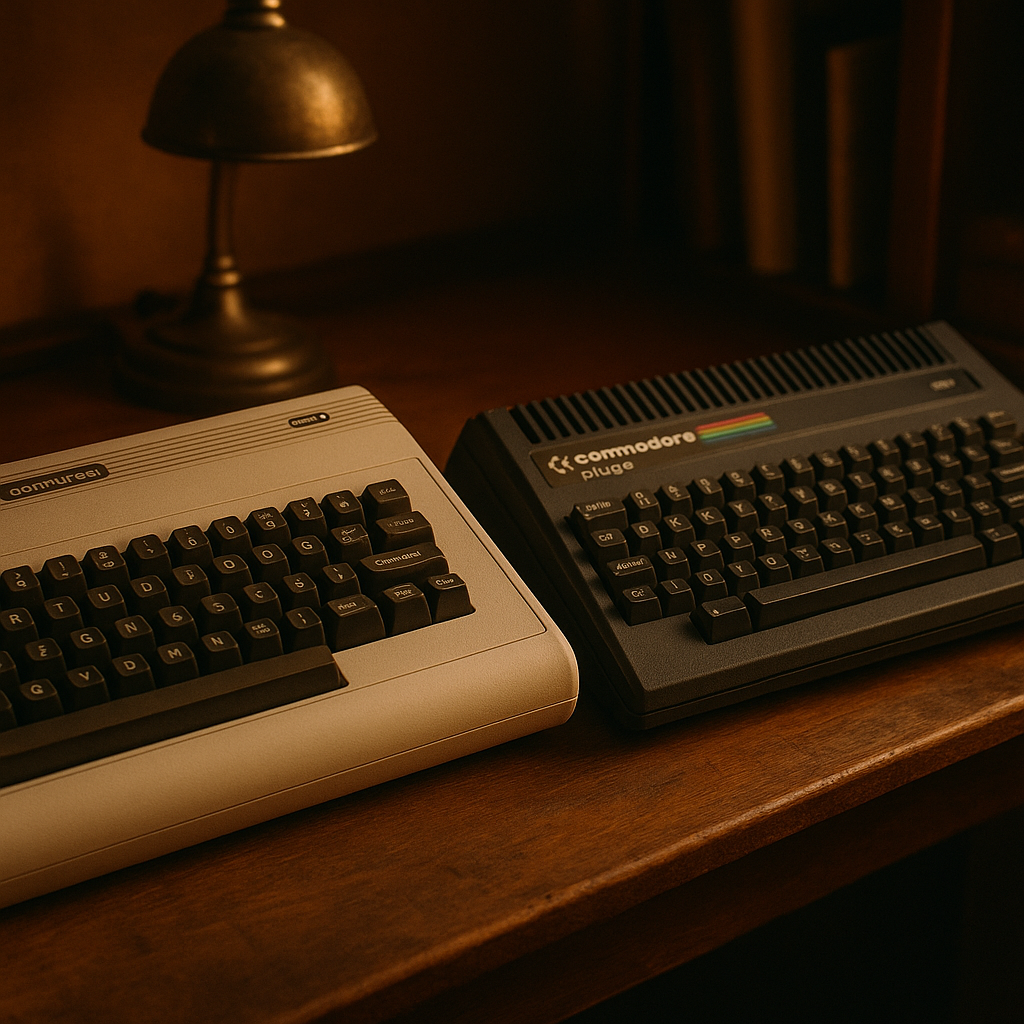
Software Library and Iconic Games
While the VIC-20 initially won over users with its accessibility, its success is owed to a varied game library, often developed by enthusiasts. From the shoot ’em up “Space Invaders” to homemade clones of “Donkey Kong,” as well as educational titles, the catalog exceeds 500 references.
Cartridges and Cassettes
The cartridge port, a valuable asset, allows memory expansions and almost instantaneous access to programs. In return, using audio cassettes remains the most economical solution, despite loading times that can reach several minutes.
Professional Applications
With its included suite, the Plus/4 stands out: GeoCalc, WordPro, and Filmaker offer a glimpse of the potential of a microcomputer in SMEs or educational institutions. However, their adoption remains limited by the competition from the PC XT and Atari ST, which are more powerful and compatible with a wider range of software.
User Community and Legacy
Like the previous generation, amateur developers form an active community, exchanging tips and programs via Bulletin Board Systems (BBS) or fanzines. Although the release of the C64 quickly captured attention, the VIC-20 did not fade into oblivion: technical demonstrations and programming contests continued to flourish until the late 1980s.
Emulation and Preservation
Today, the VIC-20 and Plus/4 can be found in faithful emulators — VICE leading the way. Thanks to reverse engineering, every chip, every timing is reproduced, allowing nostalgics and the curious to relive the sensations of 8-bit programming, far from modern GPUs and overclocking.
A Springboard to the C64
By preparing production logistics and refining a distribution network, these two models served as a testing ground for Commodore. This is how the 1980s giant was able to launch the C64, a true star of microcomputers, while having a user base ready to migrate to more powerful machines.
In Brief
🔑 VIC-20 democratized the microcomputer thanks to a record price and built-in BASIC.
📚 Plus/4 attempted the office suite gamble with integrated software, without fully convincing professionals.
💾 Cartridge and cassette ports paced the discovery of coding and homemade games.
🌐 The 8-bit community and contemporary emulation ensure the longevity of these machines.
FAQ
What is the main difference between the VIC-20 and the Plus/4?
The VIC-20 focuses on financial accessibility and playful discovery, while the Plus/4 offers increased memory and an integrated office suite, at the cost of reduced compatibility.
Is it possible today to develop new programs for these computers?
Absolutely. Modern compilers and 6502 assemblers, such as CBM prg Studio, allow coding for the VIC-20, Plus/4, and C64 alike, with loading via emulator or original hardware.
Which accessories were essential?
Besides the joystick, memory expansion modules for the VIC-20 and software cartridges for the Plus/4 were among the essentials to fully exploit each machine’s capabilities.
Where can original games and software be found?
Several online archives (such as those hosting legal ROMs) and collector communities offer access to cartridge images, often accompanied by digitized boxes and manuals.
How to understand the place of these machines in the history of video games?
Their impact is better measured by looking at a timeline of gaming computers, which shows the transition from affordable microcomputers to more powerful platforms.
