
During the microcomputer boom in the early 1980s, a small gem from Wales made a splash among programming enthusiasts: the Dragon 32/64. Designed to combine affordability with decent performance, it quickly brought together a community of apprentice coders attracted by its ease of use and integrated BASIC environment. Even today, its retro charm and clear architecture appeal to those who want to understand the basics of playful computing.
🚀 Welsh origin: launched in 1982 by Dragon Data, this microcomputer is derived from the TRS-80 CoCo but stands out with a well-crafted case and well-thought-out distribution in the United Kingdom.
💾 Expandable memory: from 32 KB of RAM on the initial model to 64 KB on the improved version, the Dragon allowed programming simulations, games, and even simple utilities.
🎨 Graphics and sound: thanks to its Motorola 6809E processor, the 256×192 pixel screen and three monophonic audio voices offered a creative playground at low cost.
🔧 Old memories: restored or emulated today, it remains an emblematic machine for understanding the rise of amateur micros and their technical limits.
Sommaire
Origin and industrial context
From design to marketing
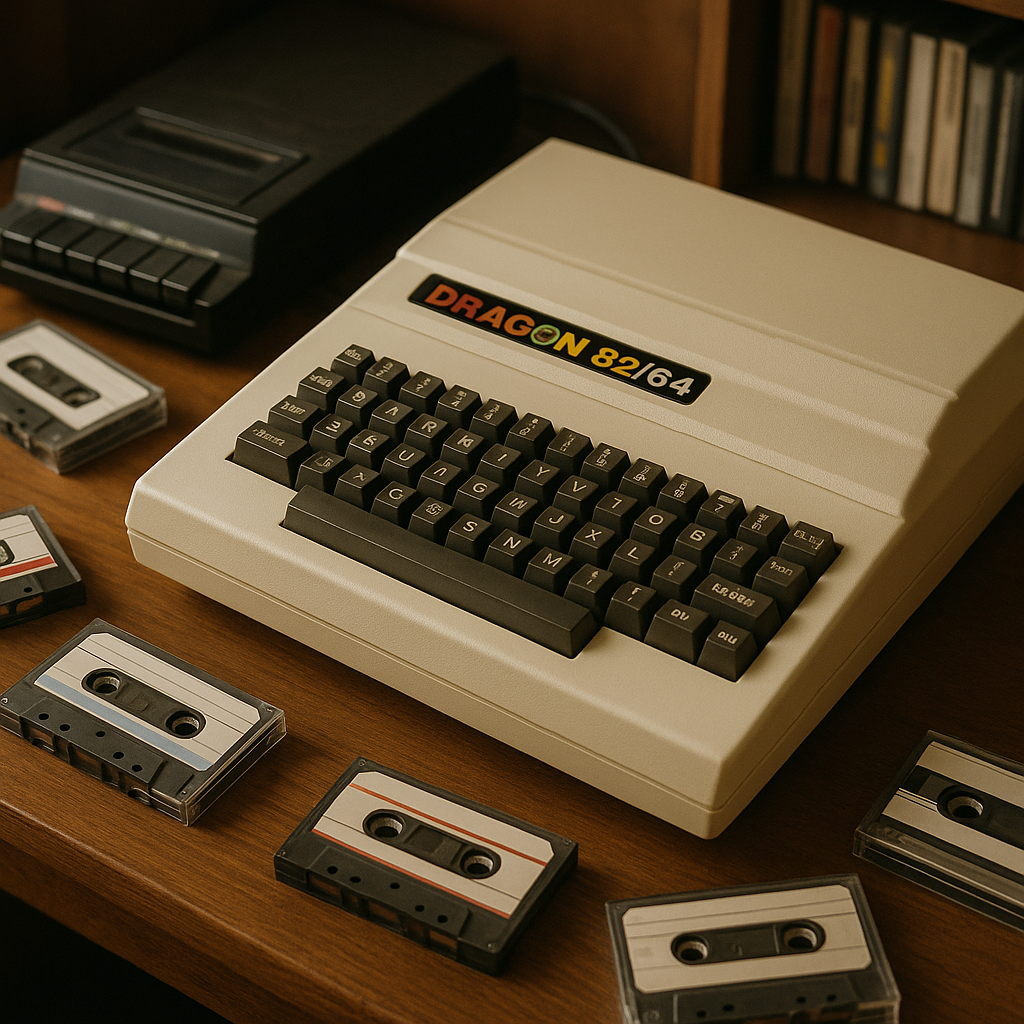
At the end of 1981, Video Technology International sought to expand its range after the mixed success of the MC-10. In collaboration with Dragon Data, a Welsh startup, the project was born to create a less expensive and better-distributed version of the TRS-80 Color Computer in the United Kingdom. Assembly took place in a Swansea factory, emphasizing local pride. The launch was accompanied by a chiclet keyboard, a cream and green case, and a clear manual to lower the learning curve.
Detailed technical specifications
Hardware architecture
At the heart of the Dragon 32/64, a Motorola 6809E processor clocked at 0.89 MHz orchestrates operations. Coupled with a video circuit leveraging the MC6847, it displays up to 9 colors in a 256×192 pixel mode. On the sound side, three monophonic channels suffice for jingles, tones, or small sound effects.
Memory and storage media
The first units offered 32 KB of RAM, expandable to 64 KB on the Dragon 64. On the front, a standard cassette port allows loading programs at about 1500 bps, while a 5.25-inch disk interface is optionally connected for those seeking faster data access.
| Feature | Dragon 32 | Dragon 64 |
|---|---|---|
| RAM | 32 KB | 64 KB |
| Processor | Motorola 6809E @ 0.89 MHz | |
| Display | MC6847, 256×192, 9 colors | |
| Sound | 3 monophonic channels | |
| Storage | Cassette 1500 bps | Cassette + 5.25″ Disk |
A springboard for amateur coders
Programming and learning
The Dragon relies on an integrated Microsoft BASIC, accessible as soon as it is powered on. No assembler needed to start: commands are entered directly in text mode, and the user can save programs on cassette. This intuitive simplicity was a key factor in its success among students and non-IT hobbyists.
Evolution of Modern Gaming Computers
On the same trajectory as other machines from the 1980s, the rise of the Dragon illustrates the progression from the first microcomputers to modern gaming PCs: learning to code on a Dragon meant understanding the hardware basics before the arrival of 32-bit processors and dedicated graphics cards.
Iconic Projects and Demos
Through specialized magazines, readers shared their small BASIC games: mazes, rudimentary driving games, or graphic utilities. Some of the most curious minds even explored the 6809E assembler to push the machine to its limits, generating scrolling routines or sound effects more complex than a simple beep.
Heritage and Collector Passion
Online Communities and Retro Shows
Today, forums dedicated to retrocomputing welcome Dragon 32/64 nostalgics: repair tutorials, ROM exchanges, and advice on modifying the power supply. Every year, European gatherings showcase restored machines, where cases, original manuals, and rare software are compared.
Restoration and Emulation
For those without access to a physical model, emulation remains an excellent compromise. Software like MESS or XRoar faithfully reproduces the behavior of the Dragon, including cassette loading times. .cas and .d64 images circulate freely, allowing players to replay forgotten titles or test their own programs.
FAQ
What is the difference between the Dragon 32 and the Dragon 64?
The Dragon 64 simply doubles the RAM, increasing from 32 to 64 KB, which allows writing larger programs. The rest of the architecture remains identical, and software compatibility is complete.
Can you program in assembler on the Dragon 32/64?
Yes, although the BASIC environment is the entry point, 6809E assemblers exist, often distributed on cassette or disk. They offer direct access to CPU registers and video memory for enhanced performance.
Where can I find original software and manuals?
Many retrocomputing websites publish scans of manuals and archives of disks or cassettes. Amateur communities also share unpublished programs on their collaborative repositories.
Did the Dragon 32/64 have any successors?
Dragon Data considered a more powerful “Dragon Alpha” model, but the project was abandoned before production. The brand then disappeared, making way for other microcomputers.
