
| Key Points | Details to Remember |
|---|---|
| 🚀 Processor Evolution | Custom architectures like the Cell pushed the limits of parallel computing |
| 🎨 Graphic Revolution | Dedicated chips enabled the leap from 2D to 3D and then ray tracing |
| 💾 Innovative Media | Equipped cartridges or high-capacity discs transformed possible content |
| 🔊 Immersive Audio | Specialized synthesizers created unique soundscapes |
| ❄️ Thermal Management | Cooling solutions determine the power of modern consoles |
| 🕹️ Touch Interfaces | Next-generation controllers redefined player-machine interaction |
The history of video games is intertwined with that of its hardware revolutions. Behind every technological leap, bold components enabled creators to push the boundaries of what was possible. It is no coincidence that some consoles remain memorable for their technical feats rather than their game libraries. Hardware innovations have constantly served as a catalyst for creative evolution, turning physical constraints into springboards for imagination. From transistors to parallel computing flows, let’s explore these quantum leaps that have shaped our gaming experience.
Sommaire
Custom Processors: Architectures Tailored for Gaming
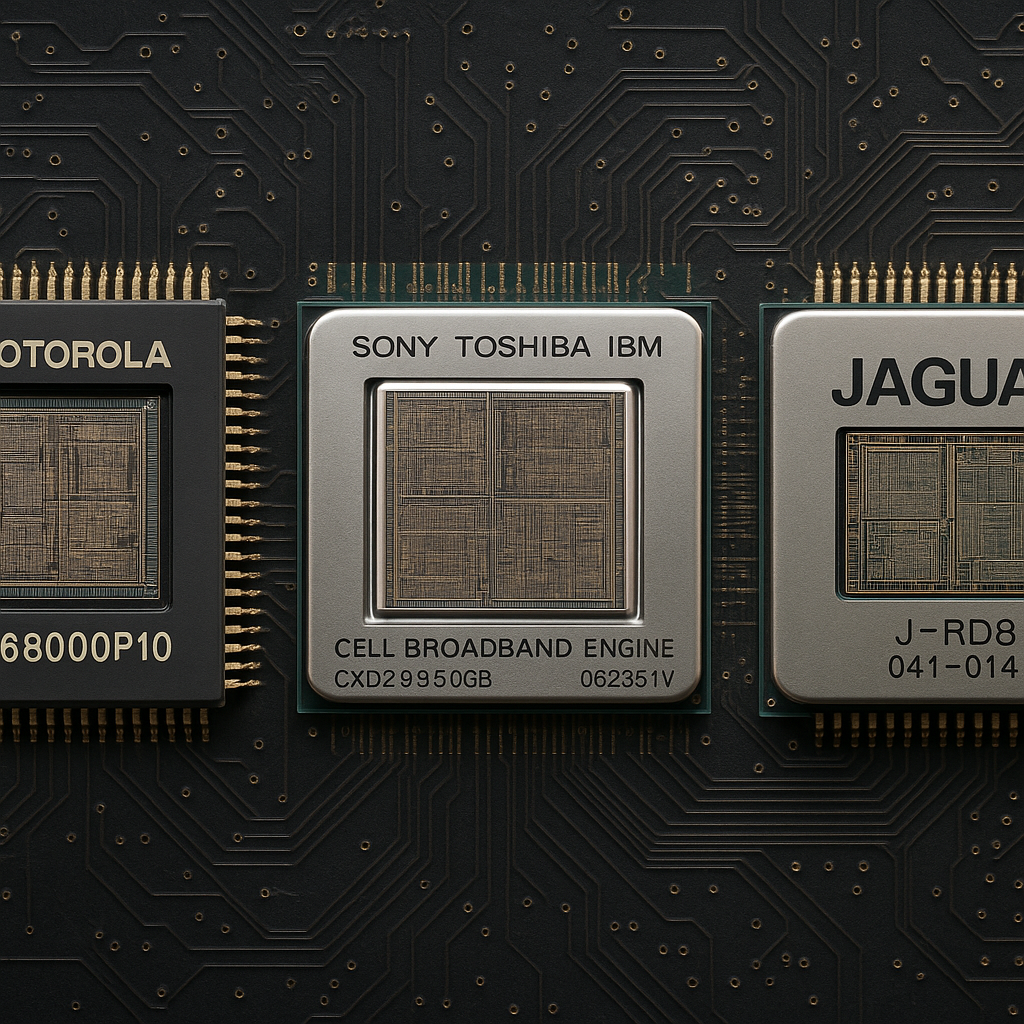
The era of in-house CPUs began with the Motorola 68000 of the Mega Drive, a counterintuitive choice that offered a 16-bit bus while maintaining 8-bit compatibility. This flexibility allowed Sega to offer games with more sprites and smoother animations than the competition. Later, the PlayStation 3’s Cell made waves for its heterogeneous structure: a PowerPC core assisted by eight specialized SPEs. This configuration enabled massively parallel calculations, exploited in titles like Uncharted 2 for its physics and particles. The Atari Jaguar, with its multi-processor architecture, aimed for 64 bits but stumbled on programming complexity that limited its real potential.
Notable Graphics Chips: From Rudimentary 3D to Photometric Realism
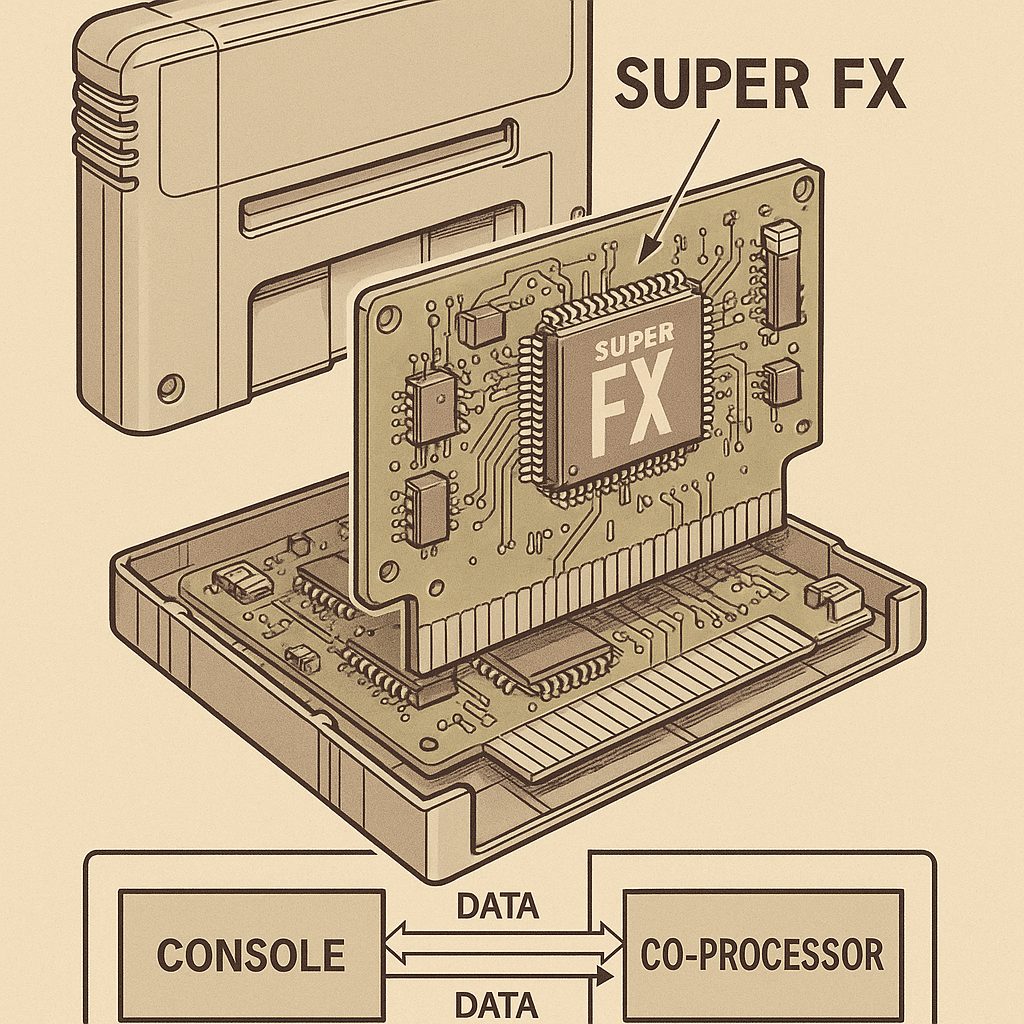
The Super FX cartridge was an ingenious response to the SNES’s lack of power. By integrating a RISC coprocessor directly on the cartridge, it enabled polygonal rendering in Star Fox, proving that dominant 2D could coexist with 3D experiences. The 3dfx Voodoo revolutionized PC gaming by democratizing accelerated 3D rendering, paving the way for consoles like the Dreamcast. The NV2A of the original Xbox, developed jointly by Microsoft and Nvidia, introduced programmable shaders heralding the modern era. Today, hardware ray tracing in contemporary GPUs simulates the physical behavior of light in real time, creating shadows and reflections with unprecedented realism.
Special media: when the container exceeds the content
Co-processor cartridges like the Super FX or the SVP of Virtua Racing bypassed hardware limitations. But this approach reached its limits due to production costs, pushing towards optical media. The Dreamcast’s GD-ROM offered 1 GB compared to 650 MB for standard CDs, vital space for its detailed textures. The PS3’s Blu-ray, with its initial 25 GB, met the growing need for high-definition assets. The Sega 32X illustrates the risks of a fragmented approach: this hardware add-on complicated development without offering a convincing quality leap.
Storage & memory: the invisible that changes everything
External memory cards in the 90s freed players from save codes. The N64 introduced the RAM expansion pack, boosting resolutions in Perfect Dark. Today, the PS5 and Series X NVMe SSDs reduce loading times to under a second thanks to speeds of 5 GB/s. This speed enables level designs previously impossible, such as instant zone transitions in Ratchet & Clank: Rift Apart.
Evolution of storage performance
| Generation | Media | Typical loading time |
|---|---|---|
| PS1 (1994) | CD-ROM (2x) | 15-30 seconds |
| Xbox 360 (2005) | DVD (12x) | 8-15 seconds |
| PS5 (2020) | NVMe SSD | 0.5-2 seconds |
Dedicated audio: chips that compose the atmosphere
The SNES’s SPC700 generated 8 ADPCM channels to create memorable soundtracks like that of Chrono Trigger. The Mega Drive’s Yamaha YM2612 used FM synthesis for more aggressive sounds, perfect for its action games. Today, Dolby Atmos for video games allows 3D positioning of sounds, crucial for immersion in titles like Hellblade: Senua’s Sacrifice where spatial audio literally guides the player.
Cooling & thermal design: the race against overheating
The Xbox 360’s Red Ring of Death was a brutal reminder: pushing components without adequate thermal solutions leads to disaster. Sony and Microsoft have since adopted radical approaches:
- The PS5 uses a vapor chamber heatsink and a variable-speed fan
- The Series X opts for vertical airflow passing through the entire tower
- The Switch OLED integrates a new internal radiator to stabilize performance
Interface innovations: breaking the screen-player barrier
The Wiimote democratized motion detection with its infrared sensor and accelerometer, making gaming accessible to the general public. The PS5’s DualSense goes further with its haptic motors that simulate textures and resistance: you feel the tension of a bowstring or the difference between dirt and snow. These sensory feedbacks create a physical dialogue between the game and the player, adding a tactile dimension to the experience.
Future horizons: where is gaming hardware going?
Cloud gaming promises to offload computation to servers but still struggles with latency. DLSS and other AI upscalers compensate for hardware limits through artificial intelligence. Custom ARM chips, like in the Switch, could replace x86 architectures for their energy efficiency. Finally, microLED screens integrated into VR headsets will offer pixel densities impossible to distinguish from reality. These innovations will continue to transform the invisible into tangible experiences.
FAQ: Hardware Innovations in Video Games
Which processor posed the most challenges to developers?
The PS3’s Cell, with its asymmetric architecture, required a complete rewriting of game engines. Only persistent studios like Naughty Dog fully exploited its potential.
How did the Super FX cartridge change 3D on consoles?
By offering geometric processing directly in the cartridge, it allowed the SNES to compete with more powerful machines, paving the way for polygonal environments on home consoles.
Why is ray tracing so resource-intensive?
Simulating every light ray requires exponential calculations. Modern GPUs integrate RTX cores or AMD Ray Accelerators specially designed for these operations.
Which audio innovation had the most impact in your opinion?
The shift to spatial audio with Dolby Atmos transformed sound immersion, making headphone listening as directional an experience as speakers.
