
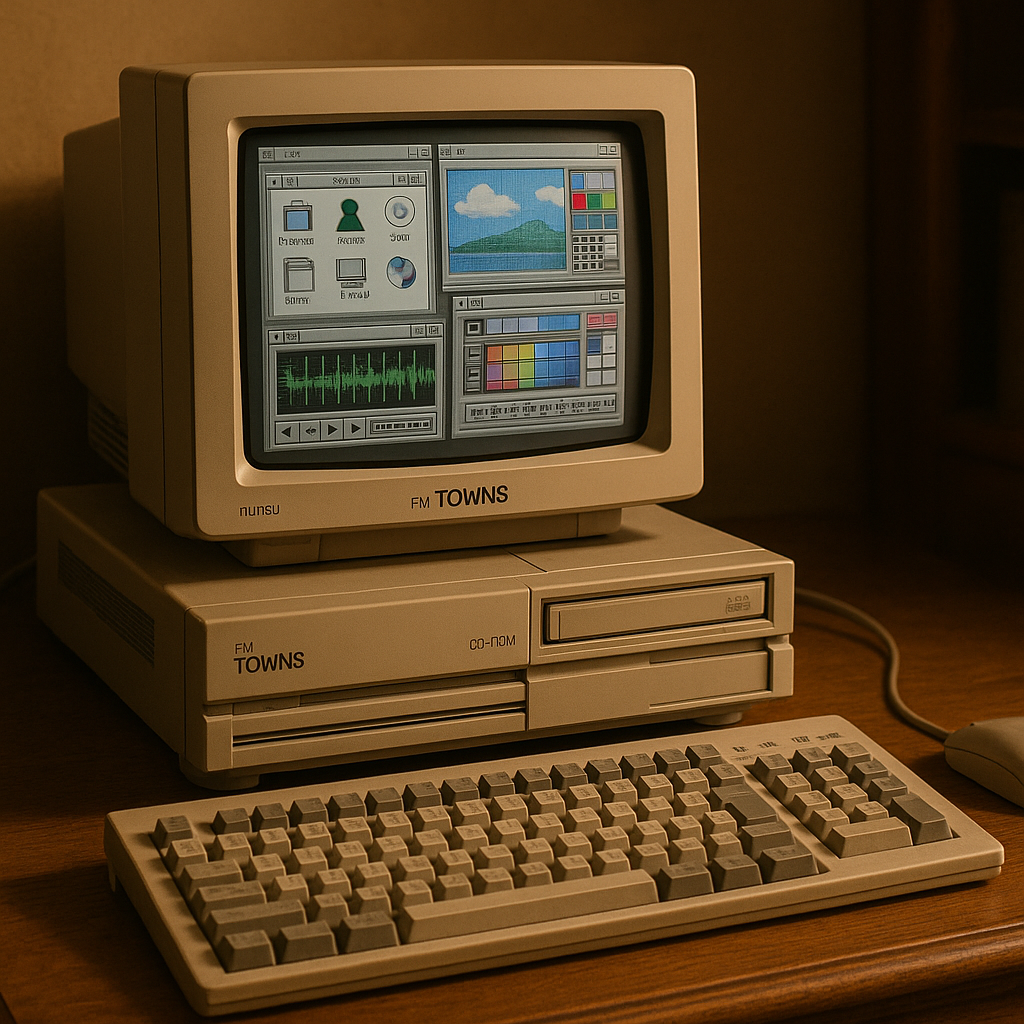
In 1989, Fujitsu unveiled the FM Towns, a microcomputer that challenged preconceived notions about multimedia: integrated by default with a CD-ROM drive and an advanced graphical environment, it was a pioneer. Long before consumer PCs popularized optical media, this device already offered music, video, and games on disc. Its story contrasts with the then-dominant 8-bit world and outlines the contours of the CD-ROM era.
Sommaire
In brief
🎯 Released in 1989, the FM Towns was the first Japanese microcomputer to come standard with a CD-ROM drive and a high-end graphics chip, paving the way for multimedia.
⚙️ Equipped with a 16-bit processor clocked at 12 MHz, 512 KB to 2 MB of RAM, and a stereo sound system, it quickly outperformed cassette or floppy disk machines.
🎮 The game library showcased these strengths with titles like Martial Champion or Polygonet Commanders, which utilized video and CD music in unprecedented ways.
🔍 Under its chassis, Fujitsu experimented with a hybrid model between PC and console, ultimately influencing the design of consoles such as the Sega CD or the PC Engine CD.
Context and genesis of the FM Towns
The emergence of multimedia computers
At the end of the 1980s, the consumer computing landscape still relied on floppy disks and magnetic media: Commodore 64, Amiga, or PC AT. In this context, the idea of delivering video, music, and graphical interfaces on a single optical disc seemed almost crazy. Yet, several manufacturers were already dreaming of a higher-capacity medium. The CD-ROM, which appeared at the start of the decade for audio, offered 650 MB, promising animated sequences and sound libraries that cassettes could not contain. Fujitsu seized this opportunity by positioning the FM Towns at the crossroads of the traditional PC and the entertainment console.
Fujitsu’s ambitions
Unlike NEC or Sharp, Fujitsu did not only target the business market. The company aimed at households equipped with arcade machines or 16-bit consoles by offering a machine as powerful as it was entertaining. The Towns project, named after the university city of Ōsaka, aimed to democratize access to multimedia while providing developers with a unified software environment. It featured a proprietary operating system, FM Towns OS, based on an iconic graphical interface and the X Window standard, already familiar to professionals but simplified here for the average user.
Technical specifications
CPU, memory, and storage
The heart of the FM Towns is an Intel 386SX processor at 16 MHz, accompanied by an optional math coprocessor. Its RAM ranges from 512 KB in the base configuration up to 2 MB thanks to an expansion card. On the storage side, the 3.5″ floppy drive remained standard, but it was the double-speed CD-ROM drive that attracted all attention: it allowed full exploitation of games designed for optical discs without being limited by floppy disk capacity.
| Component | Specification |
|---|---|
| Processor | Intel 386SX at 16 MHz |
| RAM | 512 KB – expandable to 2 MB |
| Removable storage | 3.5″ floppy disk & 2× CD-ROM |
| Graphics | 16.7M color palette, hardware sprites |
| Audio | 16-bit stereo PCM, FM synthesis |
CD-ROM Drive and Multimedia Innovations
The CD-ROM drive is no longer an accessory, but the central element of the FM Towns. Thanks to it, developers integrate animated videos, magnificent soundtracks, and voice sequences, pushing the limits of interactive storytelling. Fujitsu provides a complete development kit (SDK), combining graphic editors, sound libraries, and debugging tools adapted to the optical disk. This packaged approach quickly inspires other manufacturers, who will rush into the CD-ROM gap for video games.
Iconic Software and Games
Publishers and Compatibility
To encourage creation, Fujitsu signs partnerships with ASCII Corporation and Konami, guaranteeing compatibility with PC Engine titles. The FM Towns can therefore run certain games intended for NEC’s console, provided an adapter is added. This compatibility effort expands the game library to over 200 titles and attracts both Japanese publishers and some European studios eager to exploit the embedded electronics.
Flagship Games
Among the most notable titles are Den-One, a graphic adventure full of cinematics and point-and-click controls, or Police Quest, transferred from the PC thanks to increased power and CD sound. Fighting game fans are not left out with Martial Champion and its smooth animation. Polygonet Commanders, a strategy game, uses CD voices and detailed maps, offering an immersive experience never seen on floppy disk.
Impact and Legacy
Influence on the Industry
By placing the CD-ROM at the heart of the product, Fujitsu anticipates the rise of consumer multimedia. The idea creates imitators: Sega develops the Sega CD for the Mega Drive, NEC launches the PC Engine CD, while PC manufacturers eventually integrate the optical drive into their towers. The FM Towns is undoubtedly the first milestone of this optical revolution, paving the way for a market hungry for audio-video capabilities.
A Model for the Future of Hybrid Consoles?
In 2023, one sees in the FM Towns’ approach a clear resonance with modern hybrid consoles: portability, multimedia, unified development kits. The concept of a machine federating games, applications, and audiovisual content on a single medium has yet to stop inspiring innovations. For a broader dive into the evolution of gaming computers, see this timeline from early microcomputers to modern PC gaming.
FAQ
- What distinguishes the FM Towns from a classic PC? Its original CD-ROM drive, its graphic and sound system preconfigured for multimedia, and a user interface designed for the general public.
- Was the FM Towns compatible with DOS? Yes, it could run MS-DOS and many PC programs, but its main strengths were rather revealed in titles optimized for CD-ROM.
- What is the most iconic game? Den-One is often cited for its innovative use of video and voice on CD.
