In 1987, Commodore released the Amiga 500, a striking machine due to its unprecedented combination of visual power and audio quality. Halfway between a creative tool and a gaming platform, this personal computer left a lasting mark on gamers and developers, laying the foundations for an era where graphics and music play central roles in the interactive experience.
Sommaire
In brief
🎨 OCS Chipset equipped with a palette of 4096 colors and a blitter to accelerate rendering, the Amiga 500 far surpasses the visuals of its contemporaries.
🔊 The Paula chip manages up to 4 stereo channels, offering sound quality close to professional demos and paving the way for modular music.
⚡ Powered by a MC68000 at 7.16 MHz and featuring 512 KB of RAM, it offers a modular architecture, ideal for creatives and demanding gamers.
A turning point for gaming computers
Origins and ambition of Commodore
Commodore, already famous for its Commodore 64, targets a more demanding audience with the Amiga 500. Where the C64 sticks to 8-bit simplicity, the Amiga 500 presents itself as a true microcomputer with advanced graphic and sound capabilities. Engineers relied on a set of dedicated chips, a multitasking interface, and ergonomics designed for both leisure and content creation.
An architecture designed for multimedia
At the heart of the beast, a Motorola 68000 processor clocked at 7.16 MHz communicates with three specialized chips: Agnus for memory management and the blitter, Denise for high-resolution display, and Paula, dedicated to sound. This unprecedented division on a home computer frees the 68000 from graphic and sound tasks, ensuring responsiveness and smoothness, even in ambitious demos or games requiring multiple scrolling.
Graphics and sound under the microscope
Visuals beyond the standards
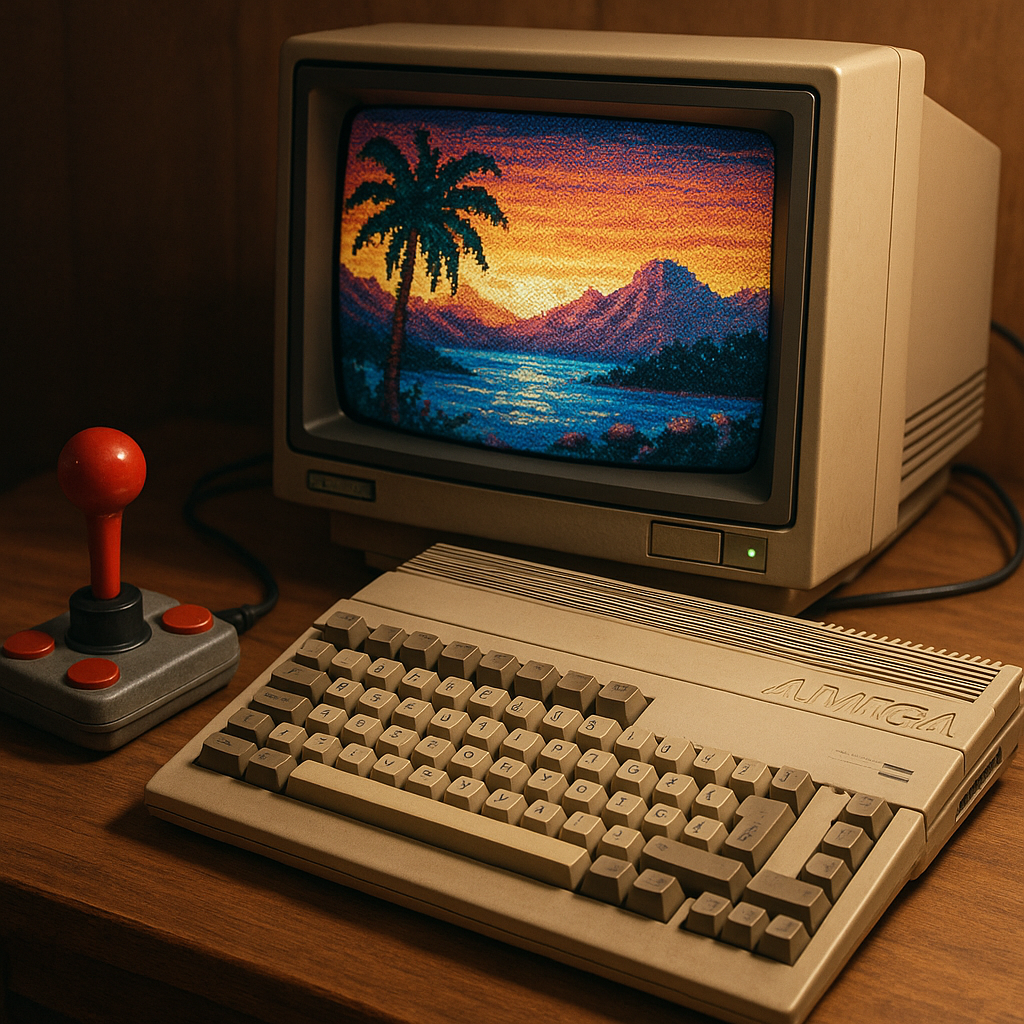
The Amiga 500 reveals on screen a system called OCS (Original Chip Set), capable of displaying up to 32 simultaneous colors on screen, or even 64 in Extra Half Bright mode. The full palette of 4096 shades allows recreating varied atmospheres, from the dark rendering of adventure platforms to the shimmering worlds of shoot ’em ups. Thanks to the blitter, large portions of the screen are copied or transformed without overloading the main processor, opening the door to parallax effects and detailed animations previously reserved for arcade games.
A soundtrack worthy of studios
With Paula, the Amiga 500 propels home computer sound into a new dimension. Four 8-bit stereo channels allow mixing samples, sound effects, and modular music. Demo creators exploit these capabilities to compose original tracks, often compared to professional chiptune productions. Games benefit from digitized voices and dynamic music, enhancing immersion compared to the monotonous tones of competing machines.
Competition and legacy
Alongside the Atari ST and DOS PCs
Facing the Amiga 500, the Atari ST responds with an integrated MIDI interface, appealing to musicians and composers. DOS PCs, for their part, gain in raw power thanks to the rapid evolution of VGA graphics cards, but remain behind in audio until the arrival of Sound Blaster. To follow the chronology of gaming computers up to current configurations, this overview highlights the importance of the Amiga as a technical milestone.
A legacy still alive
Despite the advent of gaming PCs and 16-bit consoles, the Amiga community endures: emulators, demo scenes, game re-releases. Independent game developers still draw inspiration from the limitations and strengths of the Amiga to create pixel art and chiptune experiences with a retro aesthetic. This enthusiasm underscores the longevity of the machine and its foundational role in video game culture.
Technical specifications
| Element | Specification |
|---|---|
| Processor | Motorola 68000 @ 7.16 MHz |
| RAM | 512 KB (expandable to 1 MB and beyond) |
| Graphics chipset | OCS: 32/64 colors, integrated blitter |
| Audio chipset | Paula: 4 stereo 8-bit channels |
| Storage | 3.5″ floppy drive (880 KB per side) |
| Operating system | AmigaOS 1.2 (Kickstart and Workbench) |
FAQ
What differentiates the Amiga 500 from its big brother the Amiga 2000?
The Amiga 2000 offers a larger chassis, Zorro II expansion slots, and a more powerful power supply, while the Amiga 500 favors compactness and reduced cost to reach a wider audience.
What are the flagship titles that exploited the Amiga 500?
Classics like Shadow of the Beast, Another World, or Speedball 2 demonstrate the machine’s graphical and sound power, with smooth animations and memorable music.
Can you still get an Amiga 500 today?
On the second-hand market, there are many restored units available. Modern projects like the A600 Mini also revive interest in the Amiga ecosystem.
