
At the crossroads of video games and electronic music, the Mega Drive made a lasting impression thanks to its YM2612 audio chip. Capable of generating rich tones, punchy bass, and percussive sound effects, it shaped the sonic identity of many 16-bit classics. This article breaks down its origin, operation, technical specifics, and lasting influence on video game music creation.
Sommaire
In brief
🎯 The YM2612 is a 6-channel FM chip used on the Sega Mega Drive. It offered a warmer and more varied sound than the PSG chips of the previous generation.
⚙️ Designed to relieve the Motorola 68000, it integrates a dedicated sound processor and specialized registers, thus freeing the main CPU for game logic.
🎵 Its footprint remains alive in the chiptune scenes and retro gaming soundtracks, while its limited technical resources stimulated composers’ creativity.
Genesis and historical context
Birth of an FM chip in a booming market
In the early 1990s, the race for bits was relentless. Sega chose to integrate an FM synthesizer into its new console to compete with the Super Nintendo’s Audio Processing Unit. FM (Frequency Modulation) already offered captivating sound on arcades, used on classic cabinets like those from Atari or Capcom. With the YM2612, derived from the Yamaha FM series, Sega took a step forward in complexity and harmonic richness, moving beyond the simple beeps of the previous generation.
Audio rivalries between consoles and computers
The era was not only about consoles: the Amiga used the Paula chip to produce four PCM channels, while the Atari ST relied on an AY-3-8910 capable of PSG sounds and low-quality samples. On IBM PC, the internal speaker still flirted with squeak-bang sounds. The Mega Drive joined this race, offering a more sophisticated FM synthesis. On par with GPU Ray-Tracing for graphics, its YM2612 chip symbolizes a major milestone in video game sound.
Architecture and operation of the YM2612
Principles of FM synthesis
FM synthesis is based on frequency modulation of a carrier oscillator by a modulating signal. By combining several operators (oscillators) in cascade or parallel, the YM2612 generates timbres ranging from metallic sounds to deep pads. Each channel groups six operators, capable of operating in algorithm modes 0 to 7, modulating intensity, envelope, and timing to sculpt the sound.
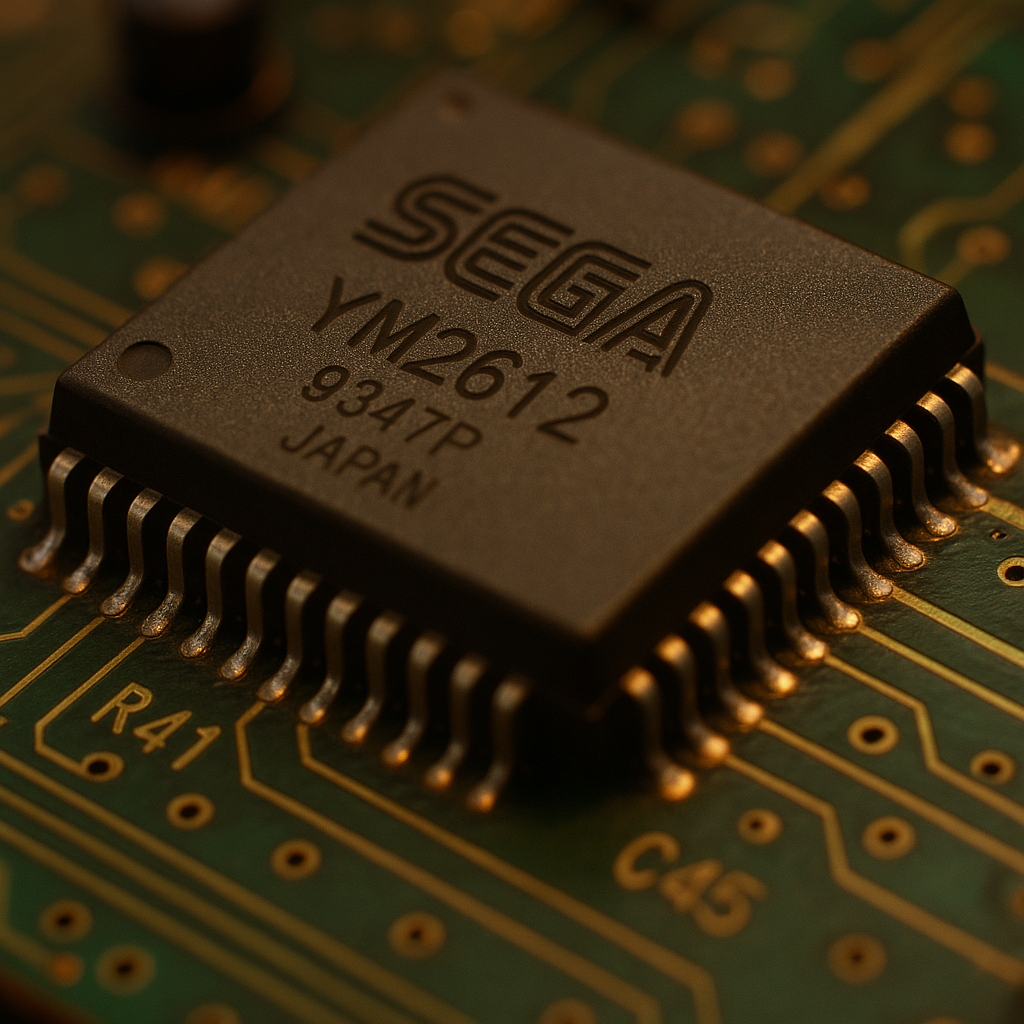
Under the hood, a 7.67 MHz internal clock drives the oscillators, while 8-bit registers adjust the modulation depth. Write access is performed via the data bus of the Z80 or the 68000, depending on the programmer’s choices.
Internal organization and key registers
The YM2612 has 32 registers per channel, managing frequency, ADSR envelope, volume curve, and operator connections. Among them, the F-Number and Block registers define the played note, while the LFO and internal DAC enrich the dynamics. One channel is even dedicated to 8-bit PCM playback, allowing FM and samples to be mixed on the same chip.
Technical Sheet
| Component | Specifications |
|---|---|
| Main Processor | Motorola 68000 at 7.6 MHz |
| Secondary Processor | Zilog Z80 at 3.58 MHz |
| RAM | 64 KB + 8 KB VRAM |
| Audio Chip | Yamaha YM2612 – 6 FM channels, 1 PCM channel |
| Media | ROM Cartridge |
Comparison with Computers of the Era
- Amiga 500: Paula chip, 4 channels 8-bit PCM, natural sound but no FM synthesis.
- Atari ST: AY-3-8910, 3 PSG channels plus a “DMA” mode to play rudimentary samples.
- PC MS-DOS: often confined to the internal speaker or AdLib cards using FM, which were more expensive.
- SNES: SPC700 + DSP, 8 PCM channels, superior sample quality but limited bandwidth.
Impact on Musical Creation
Iconic Games and Musicians
Titles like Sonic the Hedgehog, Streets of Rage, or Phantasy Star IV illustrate the elegance of FM. Composers such as Yuzo Koshiro or Hirokazu Yasuhara explored the YM2612 algorithms to craft instantly recognizable melodies, mixing rumbling basses and sharp leads. Their ingenuity lies as much in the chip’s limitations as in their taste for harsh and synthetic timbres.
Demos and Use in Chiptune Music
Far beyond gaming, demo scene enthusiasts quickly repurposed the YM2612 to create purely musical pieces. Using modified trackers or limited MIDI transmissions, they explored FM unison, microtonal detuning, and fast slide effects. Today, plugins like Deflemask or VOPM faithfully recreate the chip’s behavior, paving the way for contemporary productions.
Legacy and Contemporary Use
Despite its modest resources, the YM2612 has had a lasting influence on the video game sound palette. Modern musicians and developers continue to cite it as a reference, whether in reboots or tributes in “enhanced 8-bit” style. Accurate emulators and re-equipped original boards even allow playing on authentic hardware.
FAQ
What distinguishes the YM2612 from other FM chips?
Its ability to offer 6 FM channels coupled with an internal DAC and a PCM channel makes it more flexible than most other FM chips of the era, which were often limited to 4 channels.
How is FM synthesis programmed on this chip?
You write to a series of registers via the Z80 or 68000 bus, setting ADSR parameters, sinusoidal modulation, and frequency. Low-level languages or specialized trackers are commonly used.
Can you hear the difference compared to a Super Nintendo SPC700?
Yes: the SPC700 is oriented towards pure PCM with samples, whereas the YM2612 relies on FM, producing richer and more metallic harmonics.
Are there modern reissues of the Mega Drive with YM2612?
Some collectible micro-machines and custom cartridges featured original YM2612 chips, but most current “mini consoles” use software or FPGA emulators.
How to integrate YM2612 sounds into a current chiptune production?
Several VST plugins (VOPM, FM-Drive) faithfully emulate the chip. Deflemask or OpenMPT also allow exporting sound modules compatible with the chip.
