
In the mid-90s, 3D on PC was still in its infancy, burdened by poorly optimized drivers and performance below expectations. It was at this time that 3dfx Interactive shook up the market with its Voodoo range: dedicated cards built around an innovative chipset, capable of offloading the main processor from graphics calculations. The result? Games like Tomb Raider or Quake running smoothly and paving the way for an unprecedented immersive experience.
Sommaire
In brief
🛠️ Launch: 1996, introduction of the Voodoo Graphics, the first card exclusively dedicated to 3D acceleration.
⚡ Performance: up to 120 million operations per second, a significant gap compared to CPU-only solutions.
🔌 Connectivity: PCI interface, VGA pass-through outputs, simplified plug-and-play installation.
🤝 Competitors: Rendition Verité, NVIDIA Riva 128, ATI Rage Pro – a technological duel that fueled innovation.
Birth of 3dfx and pioneering vision of 3D
Origins and ambitions
Founded by former Silicon Graphics engineers, 3dfx set out to transform the graphics card into a 3D co-processor. At a time when CPUs struggled to maintain high frame rates in polygonal environments, this team bet on a parallel design, distributing the rendering load across specialized pipelines. The approach was not only technical but also marketing: to offer gamers a clear promise – virtual worlds without sacrificing smoothness.
Voodoo Graphics technology
The heart of Voodoo Graphics is based on a chip called “GLINT.” It integrated six texture mapping units and a 4 MB memory bus (expandable to 12 MB on some cards). The local memory ensured fast access to textures, while a blending and alpha blending engine allowed transparency effects never before seen on PC. The proprietary Glide API, minimalist and optimized, gave developers direct access to features, sometimes doubling the performance compared to the Direct3D or OpenGL of the time.
Revolutionary architecture and performance
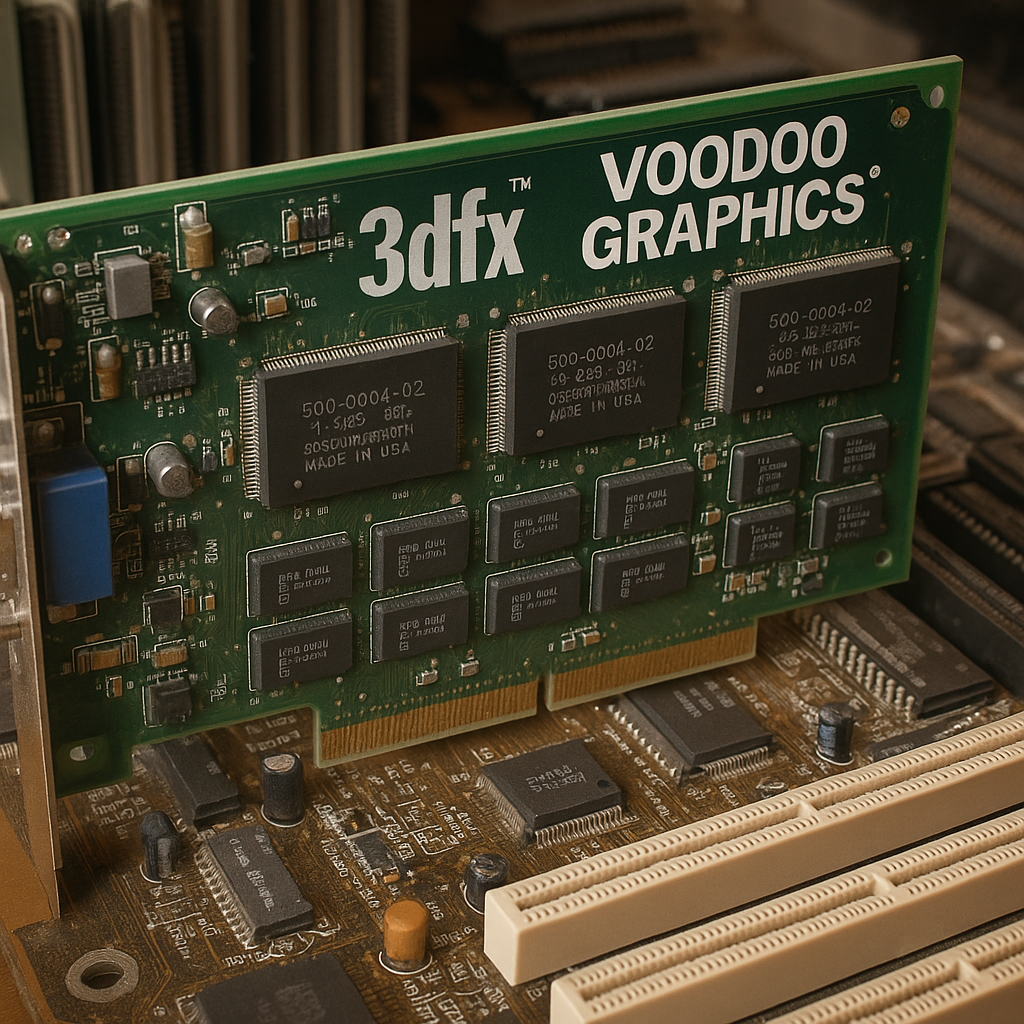
Technical specifications
| Element | Detail |
|---|---|
| Recommended CPU | Intel Pentium MMX 166 MHz or equivalent |
| RAM | 16 MB – 32 MB |
| Interface | PCI 2.1 |
| Video memory | 4 MB SGRAM (expandable to 12 MB) |
| API | Glide, Direct3D (dedicated drivers) |
Comparison with competing PCs
At the same time, NVIDIA launched the Riva 128, an all-in-one solution combining 2D and 3D acceleration. ATI, on its side, offered the Rage Pro, more focused on 2D rendering while exploring 3D. 3dfx’s strategy, exclusively centered on 3D, created a break: where its rivals tried to reconcile two uses, Voodoo Graphics put 3D front and center. Concretely, a Pentium 166 equipped with a Voodoo offered 30% superior 3D performance compared to an equivalent system with Riva 128.
Impact on the PC Gaming Industry
Flagship Titles and Outcomes
Tomb Raider, Quake II, Descent 2… the list of games leveraging Voodoo’s power is long. The challenge went beyond simple smoothness: it was the possibility to unlock more complex environments, detailed textures, and advanced lighting effects. To the point that some publishers calibrated their developments on Glide before porting their titles to Direct3D, making the 3dfx card a quality benchmark.
Legacy and Influence
Even though 3dfx disappeared at the end of the 1990s, its imprint is indelible. Modern rendering pipelines, the concept of a dedicated GPU, and the close collaboration between hardware manufacturers and game studios are directly inspired by this era. This legacy shaped the trajectory of iconic video game technologies, from the first polygonal engines to today’s Ray-Tracing GPUs.
FAQ
What distinguished Voodoo Graphics from other 3D cards?
Voodoo Graphics relied on an architecture specifically dedicated to 3D acceleration, with a lightweight API (Glide) and fast video memory. Its competitors often offered hybrid solutions, less optimized for pure 3D.
Why didn’t 3dfx survive against NVIDIA?
Despite a technological lead, 3dfx embarked on unfortunate acquisitions, notably the purchase of Evenflo, and underestimated the rise of Direct3D, driven by Microsoft. NVIDIA managed to diversify its offerings and invest heavily in R&D.
Which games benefited the most from Voodoo?
id Software titles like Quake II, Eidos’ Tomb Raider, and Wing Commander IV fully exploited Voodoo. These games displayed sharper textures and higher frame rates on equipped machines.
Are there emulators to relive the Voodoo experience?
Yes, open-source projects like Mesa3D now include partial support for Glide, and some enthusiasts recreate the Voodoo environment via software emulation to run classics on modern PCs.
