
In the mid-1980s, three brothers passionate about computing transformed a small workshop into a future multinational company. It was in Brittany, far from traditional technological centers, that Christian, Claude, and Yves Guillemot laid the first stone of Ubisoft. Their story combines entrepreneurial boldness, market insight for microcomputers, and a fierce determination to make French video games exist on the global stage.
⚙️ 1986: founding of Ubisoft in Carentoir, thanks to an Amstrad CPC microcomputer and a keen sense of distribution.
🌍 The Guillemots capitalize on a network of independent retailers to distribute innovative titles and conquer Europe.
🎮 Faced with the Atari ST and the Commodore 64, they bet on original creation rather than simple importation, laying the foundations of an ambitious catalog.
💡 Their bet: a multidisciplinary studio rather than a simple publisher, paving the way for the group’s international dimension.
Sommaire
The beginnings in Brittany: family context and computer passion
An unsuspected Breton soil
When Christian, Claude, and Yves Guillemot grew up near Rennes, consumer computing was only at the dawn of its democratization. The trio, from a family of teachers, became passionate about programming as soon as a monochrome terminal entered the house. Contrary to received ideas, it was not Paris but Brittany that offered a quiet environment, conducive to technical experimentation and informal exchange with other 8-bit enthusiasts.
First foray into the software world
Under the impetus of Jeffrey, their youngest brother, the group first trained in localizing English-language software for the French market. With a handcrafted method, they repaired audio cassettes, adapted manuals and interfaces, while forging links with independent developers. This concrete and almost empirical experience taught them the rigor of packaging and the importance of responsive customer support.
Ubisoft structures itself: from distribution to creation
The key role of the microcomputer
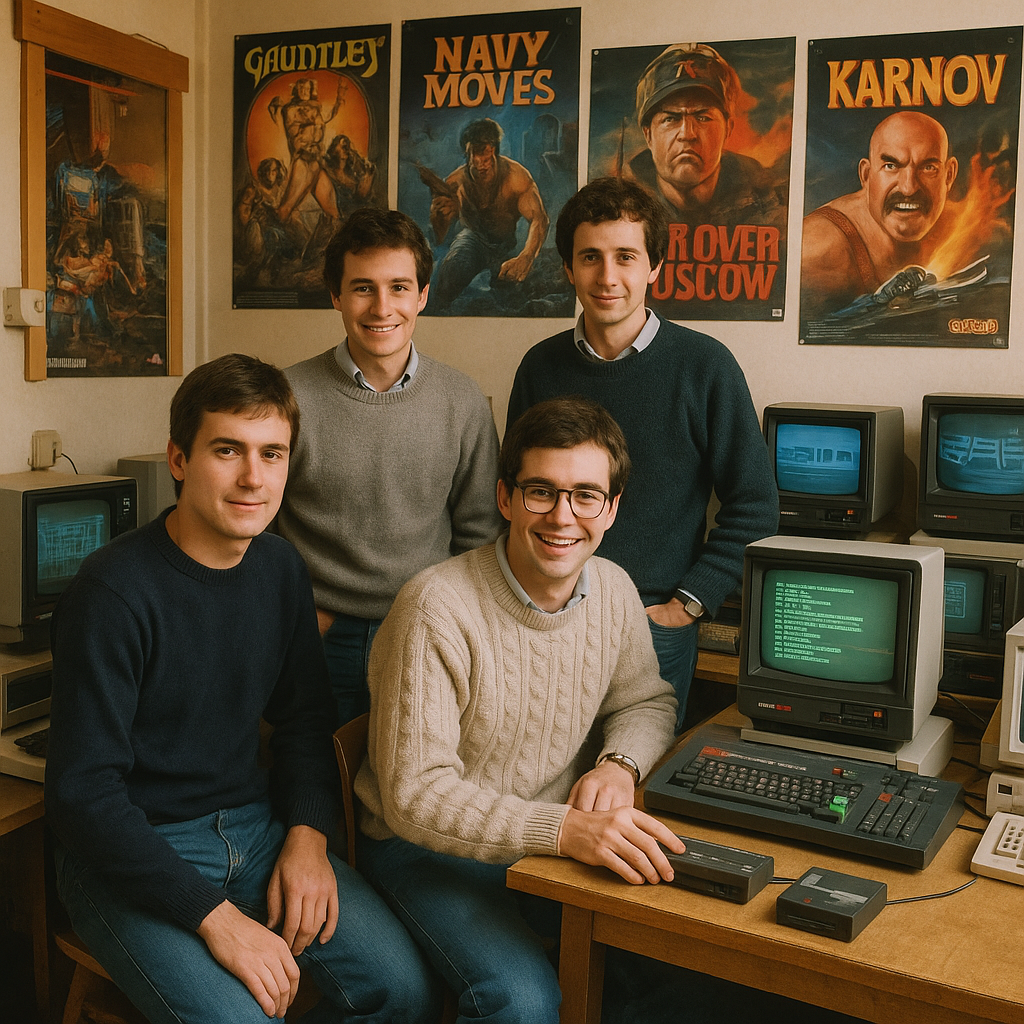
At the end of 1986, the choice of an accessible model was imposed: the Amstrad CPC seduced with its integrated color screen and robust hardware. Its Z80 architecture supports ambitious programs, and the cassette offered an affordable price for families. It was on this technical basis that the first Ubisoft-signed titles were developed, racing games with smooth scrolling that rivaled what was done across the Channel.
Competitors and platform
While Commodore’s C64 dominated the Anglo-Saxon market, the Atari ST made graphic artists dream with its extended color palette. The Guillemots played the versatility card and a packaged offer including case, manual in French, and hotline. They also did not hesitate to diversify towards the emerging PC-compatible market.
| Characteristic | Specification |
|---|---|
| CPU | Zilog Z80 at 4 MHz |
| RAM | 64 KB |
| Media | Audio cassette / 3” floppy disk |
At the same time, competition was organized around the Sinclair ZX Spectrum, famous for its low price, and the MSX family, particularly popular in Japan. Ubisoft stood out by focusing less on low-cost hardware and more on a refined user experience.
To understand how other pioneering studios shaped the industry, we will take a look at portraits of engineers and legendary studios with a focus on those who, like the Guillemots, bet on technical innovation and the structuring of a distribution network.
International expansion and legacy
At the dawn of the 1990s, Ubisoft became a full-fledged publisher, hiring internal developers and opening subsidiaries abroad. Successes followed one after another: Rayman, Assassin’s Creed, etc. This rise was based on Breton foundations: a family spirit, a taste for experimentation, and a forward-looking commercial approach. The Guillemot model has since served as a reference for regional tech start-ups.
FAQ
- Why Brittany?
The region offered a reasonable cost of living and an emerging IT community, ideal for testing projects without urban pressure.
- What was their first commercial success?
A scrolling racing game, sold on cassette for the Amstrad CPC, quickly won over players with its smoothness and complete packaging.
- How did Ubisoft finance its initial development?
Thanks to the distribution of imported software, the margins generated were used to finance internal development and the opening of subsidiaries.
- Who were their main competitors in 1986?
The Commodore 64, Atari ST, Sinclair ZX Spectrum, and MSX shared the market, each with its distinct strengths.
