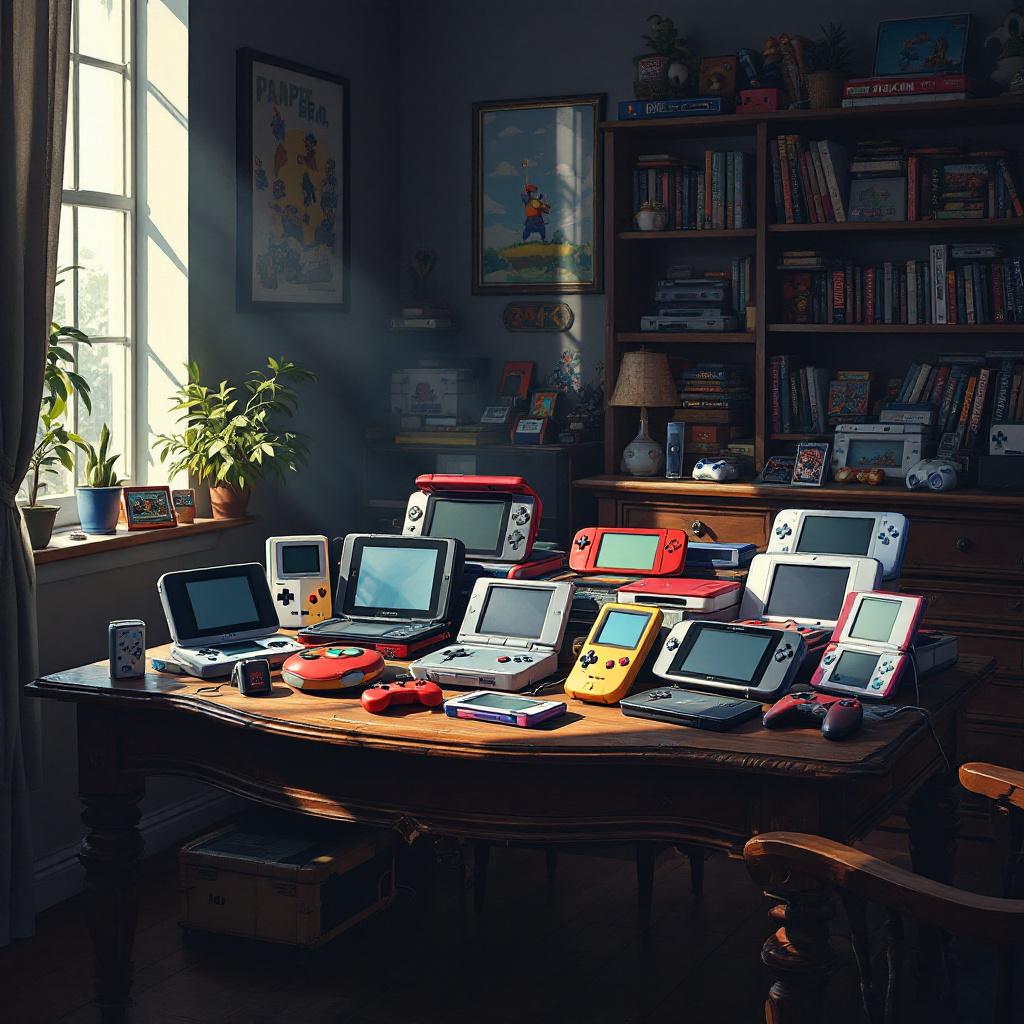
Before seeing the Nintendo Switch revolutionize the hybrid experience, several machines paved the way for portable gaming. From the first monochrome consoles to multifunction devices, each generation pushed technical limits and enriched the video game universe. This article explores this journey, highlighting innovations, competitors, and technological specifics.
Sommaire
In Brief
🎮 Beginnings: as early as 1979, the Microvision and Game & Watch inaugurated portable gaming, laying the graphical and ergonomic foundations.
📈 Innovations: the Game Boy (1989) democratized the pocket console thanks to its reliable screen and battery life, followed by the Game Gear and the Atari Lynx with color displays.
🔧 Technical: transition from a simple 8-bit processor to multi-core, increased RAM, and adoption of various media (cartridges, CDs, proprietary cards).
💡 Challenges: at the turn of the 2000s, Sony and Nintendo faced competition from laptops and smartphones before unifying the market with the Switch.
The First Steps of Handheld Consoles
At the turn of the 1980s, the very concept of playing on the go was a feat. In 1979, Milton Bradley launched the Microvision, the first handheld console with interchangeable cartridges. A year later, Nintendo surprised with its Game & Watch: a segmented LCD screen, a compact case, and exclusive titles (Donkey Kong, Ball). These machines, although rudimentary, shaped the idea of mobile entertainment.
The technical constraints were immense: crude processors, no backlighting, monochrome screens. Yet, these prototypes already set the milestones for ergonomics (directional pad, selection buttons) and modular design. Above all, they demonstrated that an audience existed, ready to carry their entertainment everywhere.
Iconic Consoles and Innovations
Nintendo Game Boy
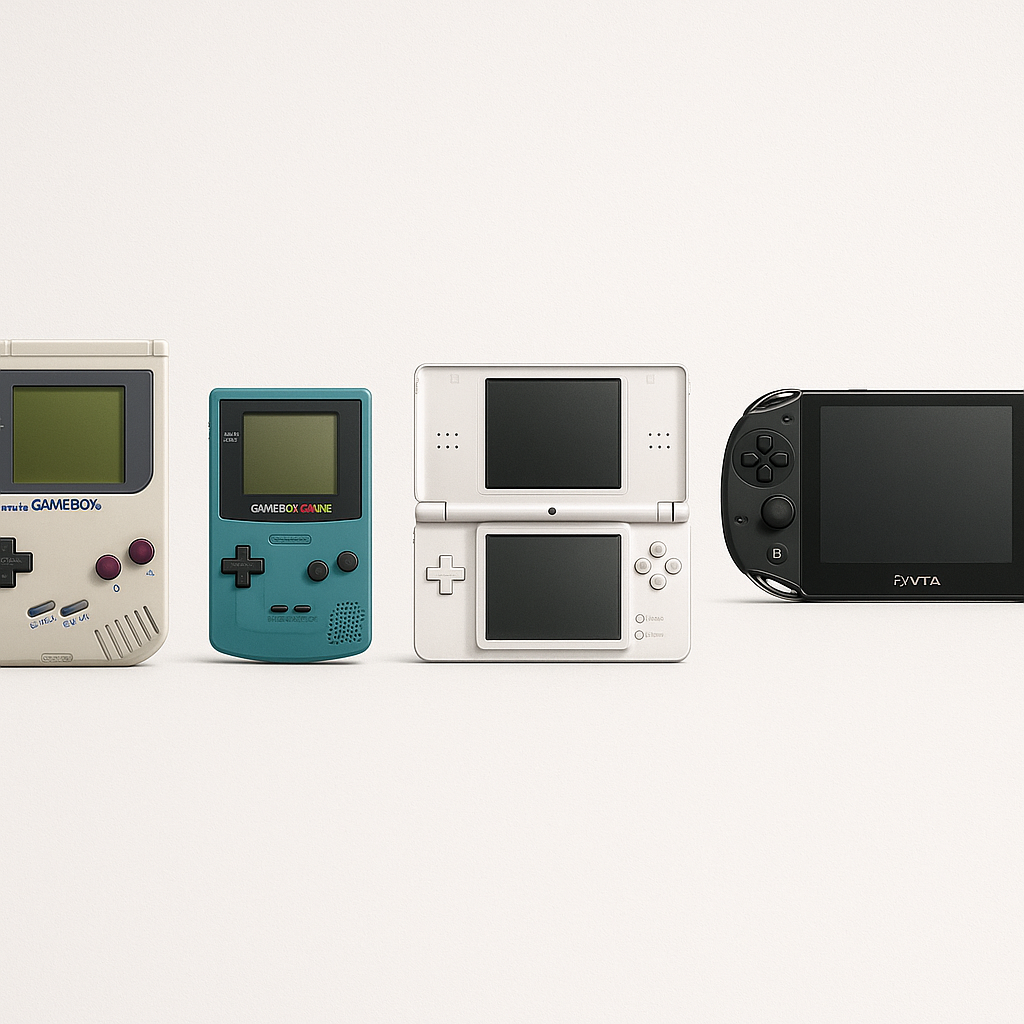
Released in 1989, the Game Boy embodies success. With a Sharp LR35902 processor at 4.19 MHz, 8 KB of RAM, and a simple green screen, it compensates with a 15-hour battery life on four AA batteries. The choice of a modest resolution (160×144 pixels) reduces consumption while offering a palette of games that became cult classics (Tetris, Pokémon).
Behind the scenes, Nintendo bet on aggressive marketing and a solid catalog. The flagship franchises were present, guaranteeing massive sales. This machine popularized the cartridge, a reliable and inexpensive medium that Sony or Sega would not immediately match.
Sega Game Gear and Colorful Challengers
Facing Nintendo, Sega responded with its Game Gear (1990). Backlit screen, 4,096-color palette, stereo sound: the experience is richer, but battery life drops to 3–5 hours. Atari answered with the Lynx, equipped with a 16-bit processor and a backlit screen, but the high price and limited library hindered its growth.
Meanwhile, Tiger Electronics flooded the market with low-cost models, often derived from famous licenses. These “budget” consoles sometimes offered a simple clone of Pong or Space Invaders, illustrating the growing demand but also the qualitative fragility of the segment.
Sony PSP: Towards High Fidelity
In 2004, Sony’s PlayStation Portable marked a turning point. MIPS processor at 333 MHz, 32 MB of RAM (expandable to 64 MB), 4.3-inch TFT screen, UMD drive: the PSP competes with some home consoles. The visual and sound quality, combined with a rich catalog (God of War, Gran Turismo), sparked enthusiasm.
For the first time, you hold in your hands a mini PlayStation, capable of browsing the Internet and playing videos. Despite a high price and average battery life (4–6 hours), the PSP redefined gamers’ expectations and forced Nintendo to react.
Technical Specifications
| Console | CPU | RAM | Media |
|---|---|---|---|
| Game Boy | Sharp LR35902 4.19 MHz | 8 KB | DMG Cartridge |
| Game Gear | Zilog Z80 3.58 MHz | 8 KB | GG Cartridge |
| Atari Lynx | 16-bit custom 16 MHz | 64 KB | Cartridge |
| PSP | MIPS R4000 333 MHz | 32–64 MB | UMD, Memory Stick |
| Nintendo DS | ARM9 67 MHz | 4 MB | DS Cartridge |
Competition from Laptops
In the early 2000s, ultraportable laptops and netbooks became widespread. Equipped with Intel Atom or AMD Geode processors, they offered basic PC games, emulation, and multimedia. Their larger screens, multitasking, and Wi-Fi connectivity attracted a different kind of audience. Some enthusiasts even used web browsers to play online mini-games, creating an indirect alternative to dedicated consoles.
However, their bulk, weight, and limited battery life made them less convenient than a console. When Sony and Nintendo redesigned their devices, they increasingly integrated multimedia features (music, video, browsing), responding to the demand for an all-in-one entertainment device.
On the Road to the Nintendo Switch
The arrival of the Nintendo DS (2004), with two screens, a stylus, and wireless communication, set the stage. It sold over 154 million units and proved that innovation can revive a saturated market. But it was in 2017 that everything changed: the Switch combined physical and digital executables, home console and mobile device. The “all-terrain” bet met worldwide success, the result of a long technical and marketing evolution.
To understand more broadly the context and timeline of consoles, one can dive into the history of video game consoles 1972-2025 to grasp all the revolutions and key dates (full title).
FAQ
What were the first portable consoles?
Milton Bradley’s Microvision (1979) and Nintendo’s Game & Watch (1980) paved the way, with LCD screens and built-in or interchangeable games.
Why did the Game Boy leave a mark?
It found a balance between battery life, cost, and game library with its monochrome screen and energy-efficient processor.
How did the PSP differentiate itself?
By audiovisual quality close to home consoles, a UMD format, and multimedia functions (video, Internet).
Did laptops really compete with consoles?
They provided alternatives through emulation and online gaming, but their weight and battery limited their portable use.
How did the DS prepare the Switch?
It popularized the touchscreen, local wireless multiplayer, and an innovative game library, paving the way for the hybrid.
