
At the turn of the millennium, the world of PC gaming experienced a rapid acceleration: faster processors, better-equipped motherboards, and fierce competition between Intel and AMD shaped the lines of our gaming experience. Between the birth of the Pentium III and the transition to the Athlon 64, gamers witnessed a true technological transformation, creating increasingly powerful configurations ready to run the most demanding titles of the time. A dive into this decade where every MHz counted.
🎮 Pentium III (1999-2003) inaugurated the era of CPUs over 1 GHz, paving the way for 3D games thanks to AGP and more stable chipsets.
⚙️ Athlon 64 (2003-2005) brought 64-bit to the general public, boosting RAM beyond 4 GB and gaining a lasting advantage over the Pentium 4.
💡 Chipsets from Intel and NVIDIA played a key role in managing memory and the PCI Express bus, anticipating the evolution of graphics cards.
🛠️ On the competition side, specialized microcomputers and consoles pushed PCs to compete in raw performance and upgrade flexibility.
Sommaire
The Emergence of the Pentium III
Intel launched the Pentium III in 1999 with an ambitious promise: to break the gigahertz barrier while refining its Coppermine architecture. We then discovered a 0.18 µm process, a full-speed integrated L2 cache, and the now famous SSE instruction set, designed to quickly decode the geometry of 3D games.
In practice, early fans of Quake III Arena or Counter-Strike saw their framerate jump, especially when paired with 256 MB of DDR-PC133. Socket 370 motherboards, often equipped with AGP 4× connectors, became widespread among assemblers and favored overclocking by tweaking the FSB.
Technical Sheet – Pentium III
| CPU | Pentium III (Coppermine) |
|---|---|
| Frequency | 500 MHz to 1 GHz |
| Typical RAM | 256 MB DDR-PC133 |
| Support | Socket 370, AGP 4×, Intel 815/830 chipset |
AMD and the Rise of the Athlon
While Intel reigned supreme, AMD responded at the end of 1999 with the Athlon (aka K7), immediately reaching 600 MHz thanks to a 0.18 µm process and an EV6 interface inspired by servers. The performance rivaled that of the Pentium III, and AMD hit hard by leaving the competition behind as early as 2001, when PC3200 and dual-channel memory appeared.
To understand the broader evolution of machines, you can follow this chronology of gaming computers, illustrating how each CPU changed the gaming landscape.
Transition to the Athlon 64
The Athlon 64 arrived in 2003, the first consumer 64-bit processor, paving the way for multi-core architectures and native access to more than 4 GB of memory. Equipped gamers noticed a significant gain on optimized 64-bit titles, despite an initially somewhat expensive platform.
Technical Sheet – Athlon 64
| CPU | Athlon 64 (ClawHammer) |
|---|---|
| Frequency | 1.8 GHz to 2.2 GHz |
| Typical RAM | 1 GB DDR-PC3200 |
| Support | Socket 754/939, PCI Express, HyperTransport |
At the Heart of Chipsets and Motherboards
The NVIDIA nForce and Intel 925X chipsets have refined performance by more efficiently managing the bandwidth of PCI Express and SATA ports. Overclockers are having a field day, tweaking multipliers to extract a few extra MHz.
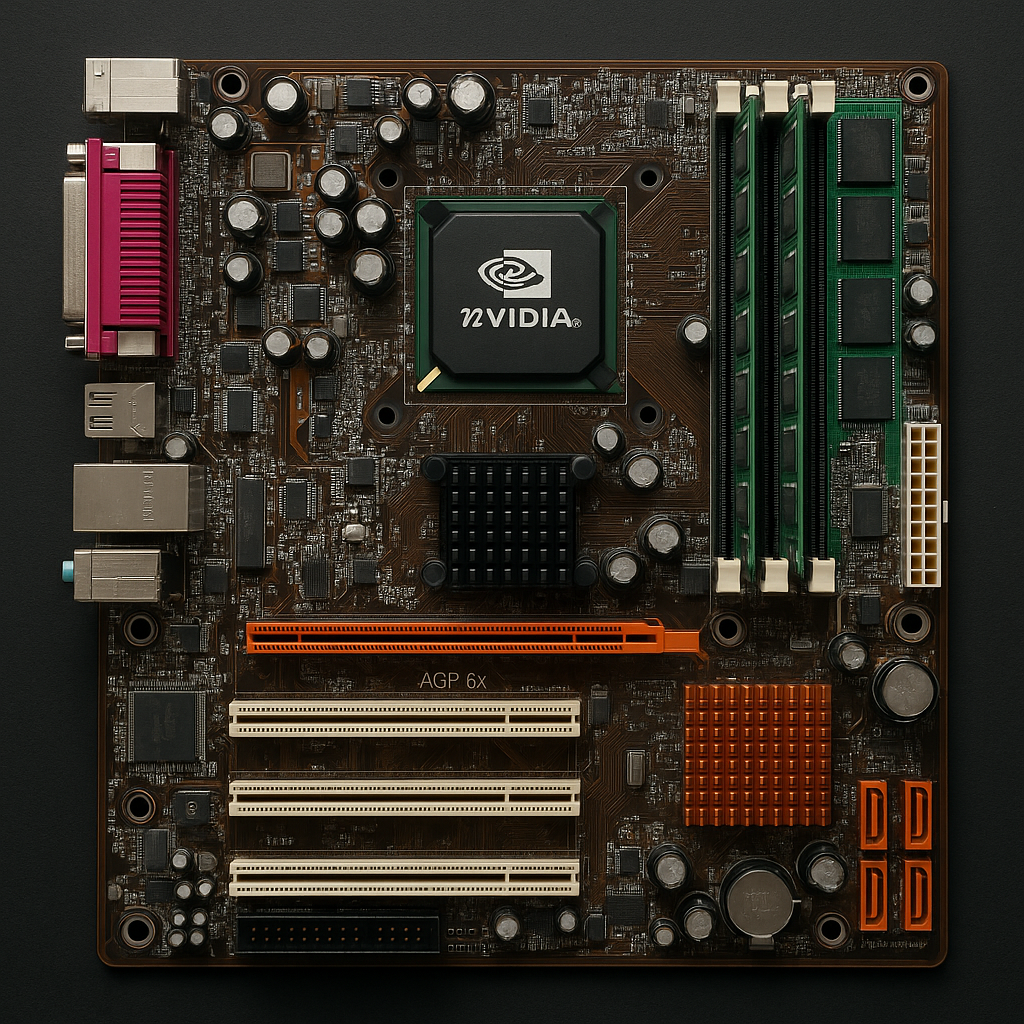
Between racks of IDE drives and early experimental SSDs, every component must meet the expectations of demanding gamers, eager for finer textures and more believable lighting effects.
Competing Platforms
While Intel and AMD CPUs are the most notable, other architectures played the troublemaker role: Cyrix, VIA C3, and even the first SLI servers dedicated to graphics acceleration. Not to mention home consoles, which push the PC to offer unmatched modularity and scalability.
FAQ
Why was the Pentium III a turning point?
The Coppermine introduced a full-speed L2 cache and the SSE instruction set, significantly accelerating 3D calculations and paving the way for the gigahertz era.
What does the Athlon 64 really bring with 64-bit?
Beyond the shift to 64-bit, it allows native addressing of more than 4 GB of RAM and lays the groundwork for future multi-core processors.
What is a chipset and why is it crucial?
The chipset manages the data flow between the CPU, RAM, GPUs, and peripherals. A good chipset ensures reduced latency and better stability.
Are alternative platforms still relevant?
They have often served as testbeds for innovations (SLI, liquid cooling) before Intel and AMD adopted them.
