
| Key points | Details to remember |
|---|---|
| 🕹️ Definition | Physical and digital media to store and distribute video games |
| 📼 Cartridge era | Instant loading but high production cost |
| 💿 Optical revolution | CD/DVD cheap but loading times longer |
| ⚡ Hybrid formats | Flash cartridges (Switch) and Blu-ray to balance performance and costs |
| ☁️ Current trend | Digital distribution surpasses physical but raises preservation questions |
| 🌍 Ecological impact | Production and recycling of physical media vs energy consumption of digital |
The history of video games is also told through its media. These plastic cases or dematerialized files have shaped our gaming experiences as much as processors. Who remembers the characteristic scraping of an NES cartridge that was blown on before insertion? The sound of the CD player of their PlayStation? These rituals have gradually given way to the silence of digital downloads. Behind these changes lie crucial technical challenges: storage capacity, access speed, production costs. Each transition reshuffled the cards in the industry, favoring some players while marginalizing others. Media choices even influenced the design of the games themselves.
Sommaire
ROM Cartridge (1977-1996): the golden age of silicon
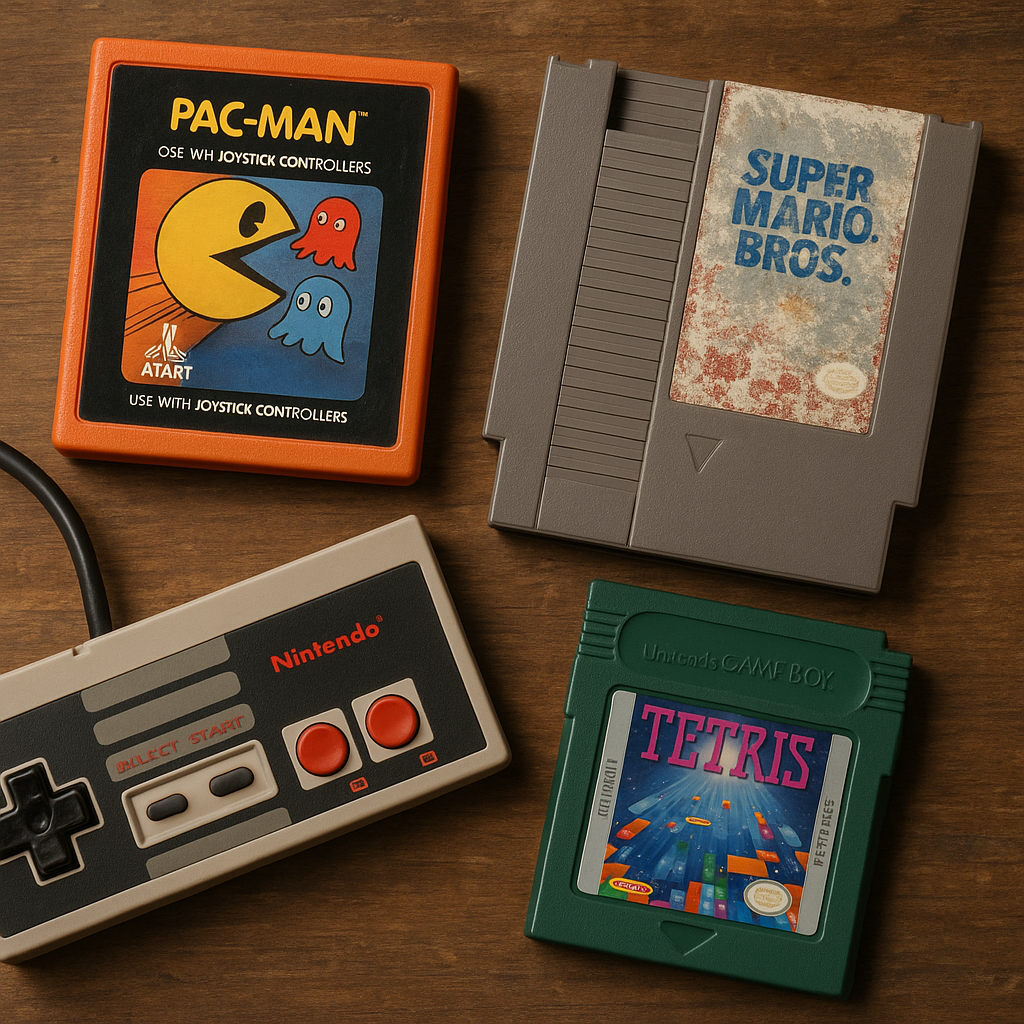
The first game cartridges appeared with the Fairchild Channel F in 1976. But it was the Atari 2600 that popularized this format. These cases contain ROM (Read-Only Memory) chips soldered directly onto a circuit board. Their great advantage? Almost instant access to data. No loading time: press power, the game starts immediately. Nintendo masterfully exploited this technology with its NES and then its Game Boy. The Japanese company even added dedicated coprocessors, like the famous Super FX which enabled the 3D graphics of Star Fox on SNES.
But this medium has a major drawback: its cost. Producing a cartridge involves electronic components far more expensive than a simple plastic disc. By the late 1990s, manufacturing a Nintendo 64 cartridge cost about $15 compared to less than $1 for a PlayStation CD. This difference explains why titles like Final Fantasy VII, initially planned for N64, ultimately migrated to Sony. The economic argument became decisive with the explosion of game sizes, making cartridges prohibitive for ambitious productions.
The twilight of cartridges facing the CD-ROM
In 1988, the CD-ROM promised a revolution: 650 MB of storage compared to a maximum of 4 MB for a Super Nintendo cartridge. Philips tried the adventure with its CD-i, but it was Sony who succeeded with the PlayStation in 1994. The success was stunning. Sega responded with its Saturn, but Nintendo resisted, skeptical about the reliability of optical drives. Their reluctance was explained by technical reasons: access latency, mechanical fragility, and above all – a crucial problem for action games – interminable loading times compared to the continuous flow of cartridges.
Yet, the cartridge production cost versus CD ratio will ultimately be fatal to the cartridge format in the era of home consoles.
Transition to Optical Media (CD, GD-ROM, DVD)
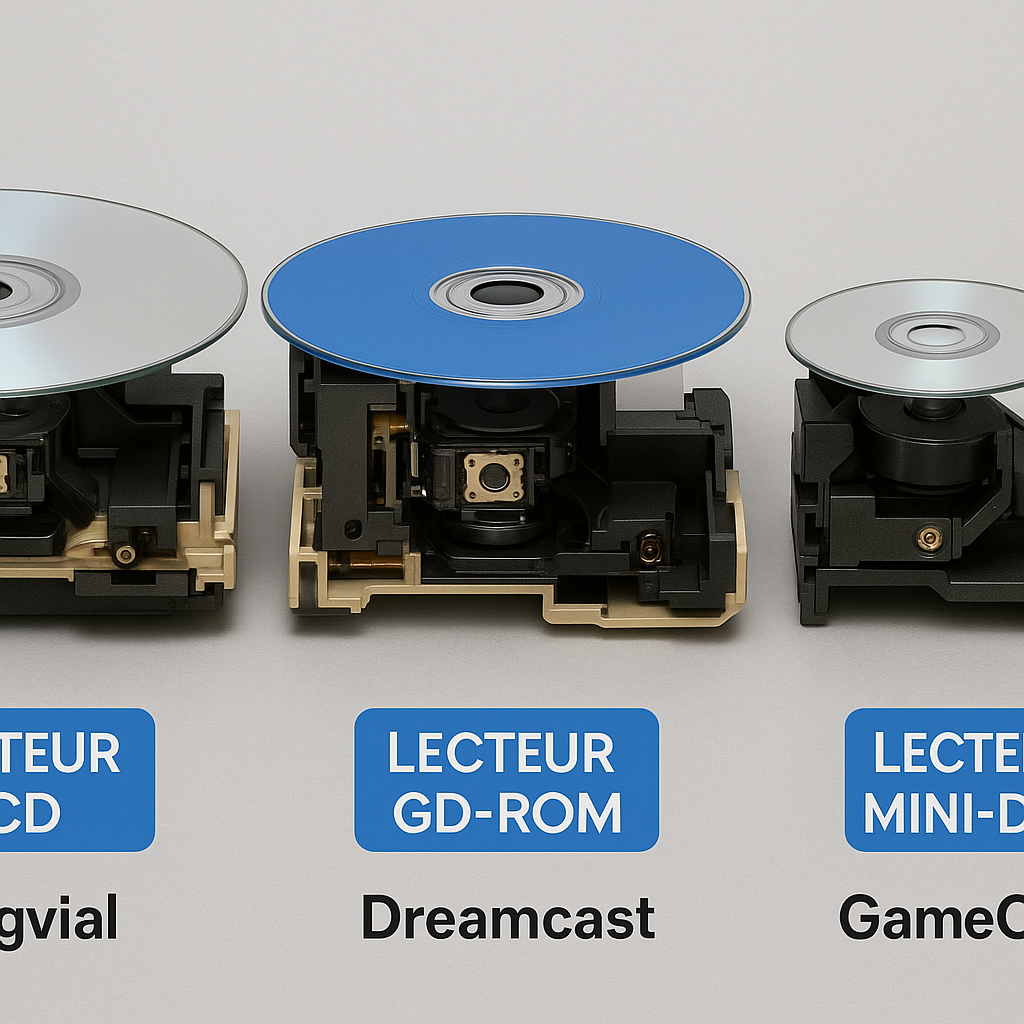
The massive adoption of the CD-ROM in the 90s coincides with two revolutions: the advent of polygonal 3D games and orchestrated soundtracks. Titles like Metal Gear Solid or Resident Evil fully exploit the audio capabilities of the medium. But this transition is not without difficulties. The first CD drives are slow – up to 150ms access time compared to 120ns for a cartridge. Developers have to get creative with loading screens or background data streaming.
Each manufacturer then develops its own proprietary solutions:
- Sega invents the GD-ROM for its Dreamcast (1.2 GB versus 650 MB)
- Nintendo opts for Mini-DVDs of 1.5 GB on the GameCube
- Sony bets on the standard DVD with its PlayStation 2
These technical choices respond to contradictory logics. Nintendo’s Mini-DVD certainly limits piracy but forces developers to heavily compress their assets. Conversely, the PS2’s DVD allows for richer games but facilitates illegal copying. Sony also plays the multifunctional media card: a PS2 becomes a family DVD player, a strong selling point in an era when these players were still expensive.
The Failure of Exotic Formats
Not all optical media succeed. The PSP’s UMD (Universal Media Disc) illustrates this paradox. Sony tries to create a closed ecosystem: movies and games on this proprietary mini-disc. But the format suffers from technical limitations: insufficient capacity (1.8 GB), insufficient data rate, and inability to burn discs oneself. As a result, publishers quickly prefer downloading via Memory Stick. This failure foreshadows the difficulties physical media face against the rise of digital.
Blu-ray, Flash Cartridges (Switch): The Coexistence of Formats
The HD era demands increased capacities. Blu-ray establishes itself with the PS3 (25 GB per layer) then the PS4 (50 GB). Microsoft follows with HD DVD before giving up. But simultaneously, Nintendo revives the cartridge in the form of a flash card with its Switch. A return to the roots? Not exactly. These modern cards combine the advantages of old ROMs (durability, speed) with those of digital (rewritability). Their secret: NAND flash memory, much denser and more economical than the ROM chips of the 90s.
This choice responds to a hardware logic: the Switch is a hybrid console, constantly on the move. An optical drive would have been too fragile, too power-hungry, and too bulky. Technically, these cartridges offer data rates superior to Blu-rays (up to 1 GB/s versus 72 Mb/s). But they are limited by their capacity (32 GB max versus 100 GB on triple-layer Blu-ray). As a result, Switch games often require additional downloads, even in physical versions. A compromise that well reflects the ambiguity of our era.
The Rise of Downloading & Cloud Gaming
The shift to digital truly begins with the Xbox 360 and its Xbox Live Arcade. Steam had paved the way on PC as early as 2003, but it is on consoles that the change becomes massive. The advantages are immediate:
- No more out-of-stock situations in stores
- Permanent availability of retro catalogs
- Automatic updates
- Innovative economic models (free-to-play, subscriptions)
Yet, this model raises concerns. Actual ownership of the game fades: you buy a revocable license. And the explosion in game sizes poses problems: a modern Call of Duty exceeds 200 GB, saturating hard drives.
Cloud gaming (Stadia, Xbox Cloud) promises to solve this last point by outsourcing processing. But this technology depends entirely on network quality and raises the question of long-term preservation. What will remain of our digital libraries in 30 years?
Physical games still represented 80% of the market in 2010. In 2023, this proportion has reversed in favor of digital.
Economic & ecological impact of media
The video game economy has been disrupted by these transitions. With cartridges, high production costs limited print runs and favored blockbusters. The CD democratized development, allowing the emergence of independent studios. Today, digital eliminates distribution intermediaries but concentrates power on a few platforms (Steam, App Store, PlayStation Store).
Ecology introduces a new dilemma. The manufacture of physical media consumes plastic and rare metals. The global transport of cartridges and discs generates CO2. But digital is not neutral:
| Physical media | Digital distribution |
|---|---|
| Plastic (20-30g/unit) | Data centers (1kg CO2/hour of play) |
| Maritime/air transport | Energy-intensive network infrastructure |
| Electronic waste | Accelerated hardware renewal |
Some publishers attempt compromises. Limited Run Games reissues digital games in physical collector boxes. Nintendo includes cartridges in its Switch but encourages downloading through “download only” versions. The industry is still seeking its balance between accessibility, profitability, and sustainability.
Conclusion: towards an “all digital” future?
The total disappearance of physical media seems inevitable in the medium term. Yet, resistances persist. Collectors value the object, its manual, its materiality. Rural players with poor connections still depend on cartridges or discs. And legally, the revocation of digital licenses is debated. The ideal might lie in a hybrid model: physical “activation key” media associated with downloads, guaranteeing both ownership and accessibility. One certainty: like music or cinema, video games are completing their transformation to all-digital. The challenge remains to preserve our gaming heritage during this transition.
FAQ: Cartridge, CD, digital and game media
Why were cartridges faster than CDs?
Unlike CDs which require a laser to read sequential data, cartridges allow direct random access to memory. Latency times are thus reduced by several orders of magnitude.
Which media holds the greatest storage capacity?
Currently, the triple-layer UHD Blu-ray used on PS5 and Xbox Series X offers 100 GB, compared to a maximum of 32 GB for Switch cartridges. But digital has no theoretical limit.
Can you still buy cartridge games today?
Yes, the Nintendo Switch still uses flash cartridges. Some publishers like Limited Run Games also offer reissues on cartridge for retro consoles.
Will physical games disappear?
Although its market share is constantly decreasing (less than 20% in 2023), physical media should persist for collectors and areas poorly served by the internet. But in the long term, it will become marginal.
What is the ecological impact of digital gaming?
A 50 GB digital game would generate about 20kg of CO2 during its download (source: Carbon Trust). Its footprint then depends on the energy used by data centers during gameplay.
