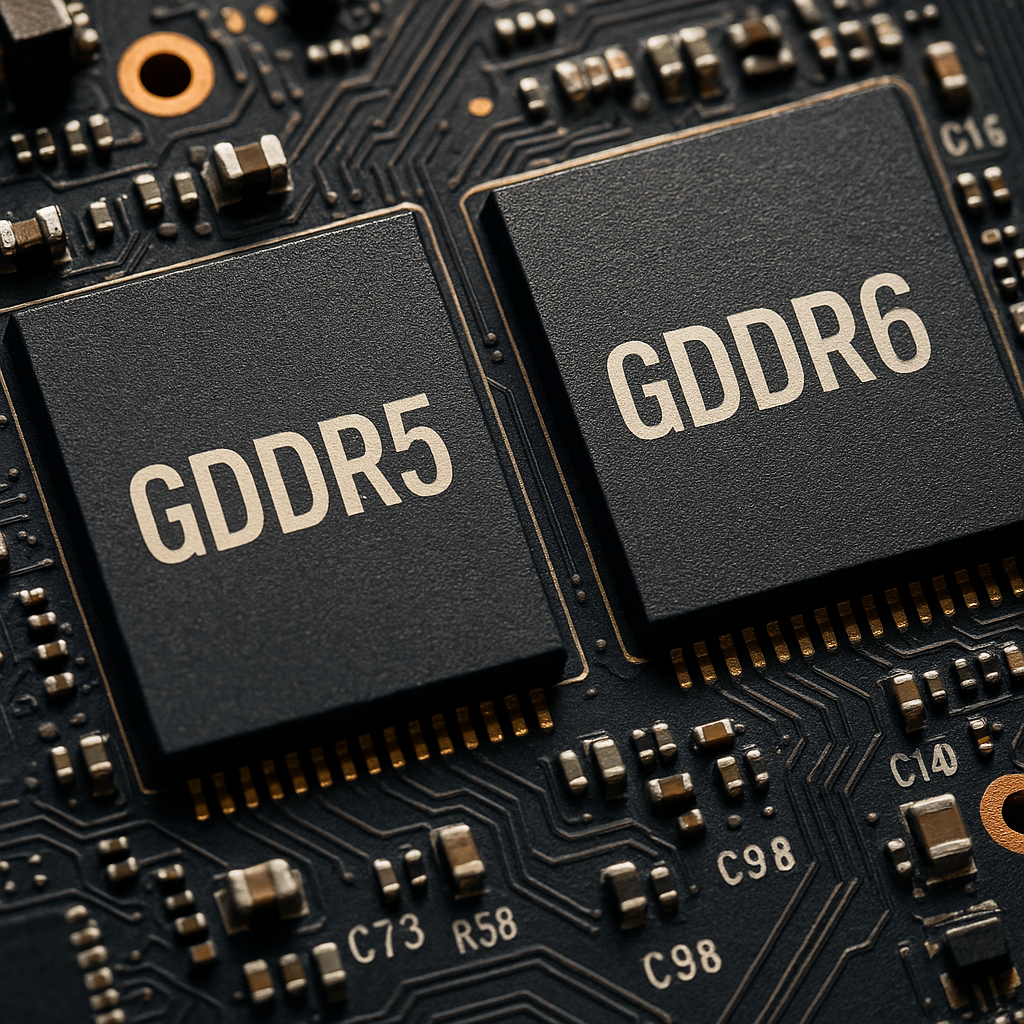
At the heart of every graphics card, video memory plays a decisive role in running current titles. While GDDR5 has long been the standard in gaming, GDDR6 is now gaining ground thanks to increased bandwidth and reduced latencies. Exploring these two generations means understanding how they shape fluidity, visual quality, and the user experience in modern games.
🎯 GDDR6 offers up to 50% more bandwidth compared to GDDR5, directly translating into a framerate gain in demanding scenes.
⚙️ Regarding latency, GDDR6 features a more optimized architecture, reducing delays in texture loading in open worlds and limiting stuttering.
🚀 On high-end setups, GDDR6 makes it easier to handle 4K texturing and post-processing effects, providing richer and more detailed visual rendering.
Sommaire
Understanding GDDR5 and GDDR6 Memory
Origins and Evolutions
GDDR5 was introduced in 2008, succeeding GDDR3 with doubled frequency and an optimized architecture for serial transfer. Since then, it has equipped entire generations of GPUs, from the GTX 900 series to the first RTX models. In 2018, GDDR6 took over, relying on a finer process and higher densities: a clear signal that the industry now targets 4K resolutions and intensive ray tracing usage.
Key Technical Differences
Beyond frequency figures, GDDR6 offers an internal dual channel per chip, whereas GDDR5 only has one. This duplexing reduces electrical voltage while increasing speed, going from 8 Gbps to 16 Gbps per pin in the latest models. Another crucial point: the error correction scheme (simplified ECC) improves stability during prolonged sessions or heavy computational operations.
Impact on Modern Gaming
Bandwidth and Framerate
The higher the memory bandwidth, the less the GPU is blocked waiting for data. In an open-world title, where ultra-detailed textures are loaded on the fly, GDDR6 frees up to 80 GB/s more on a typical RTX 3060 card compared to a GTX 1060. Result: a more stable average framerate, especially at high resolution. Benchmarks often show a 10 to 20% gain depending on the graphics engine.
Loading Times and High-Resolution Textures
Beyond FPS, memory speed also affects responsiveness. Quickly moving from point A to point B in a map with 4K textures requires continuous streaming of assets. With GDDR5, a loading screen can last several seconds longer than with GDDR6. This difference seems minor but becomes obvious in competitive sessions where every millisecond counts.
Competing Computers and Recommended Configurations
On the market, configurations range from mid-range gaming PCs to dedicated workstations. For those seeking excellent value for money, a card equipped with GDDR5 remains viable under 1080p and medium to high settings. However, to aim for 1440p at over 60 fps or to cross the 4K threshold, GDDR6 becomes almost essential.
On the laptop side, the rise of GDDR6 memory is accompanied by more energy-efficient modules, limiting fan noise. In towers, a solid power supply and good airflow will take advantage of higher bandwidths without overheating.
Technical Sheet
| Component | GDDR5 Configuration | GDDR6 Configuration |
|---|---|---|
| CPU | Intel Core i5-9600K | Intel Core i5-12600K |
| RAM | 16 GB DDR4-2666 MHz | 32 GB DDR5-4800 MHz |
| Storage | 500 GB SATA SSD | 1 TB NVMe PCIe 4.0 SSD |
In Practice: Choosing Your Card Wisely
First of all, ask yourself if you mainly play at 1080p or if you aim higher. If the screen exceeds 144 Hz, extra bandwidth is always beneficial. GDDR6 cards also tend to better handle anti-aliasing and intense post-processing (bloom, basic ray tracing). For a comprehensive exploration of graphic techniques, including the evolution of rendering and innovations like ray tracing, this retrospective will immerse you in the history of these advances.
- If on a limited budget: opt for a GTX 1660 SUPER with GDDR5X for a good compromise.
- For 1440p: bet on an RTX 3060 or RX 6600 XT with GDDR6.
- Ambition for 4K or VR: an RTX 3080 or RX 6800 XT with full GDDR6(X) is a must.
FAQ
- What is the real performance difference between GDDR5 and GDDR6?
- Generally, up to a 15% improvement in average framerate at 1440p is measured, with more marked gains on heavy textures or open world games.
- Can the memory alone be upgraded?
- No, the video memory is soldered onto the graphics card PCB. Only a complete card can be replaced.
- Does GDDR6 consume more energy?
- No, thanks to lowered voltages and better internal efficiency, consumption remains comparable or even lower on some models.
