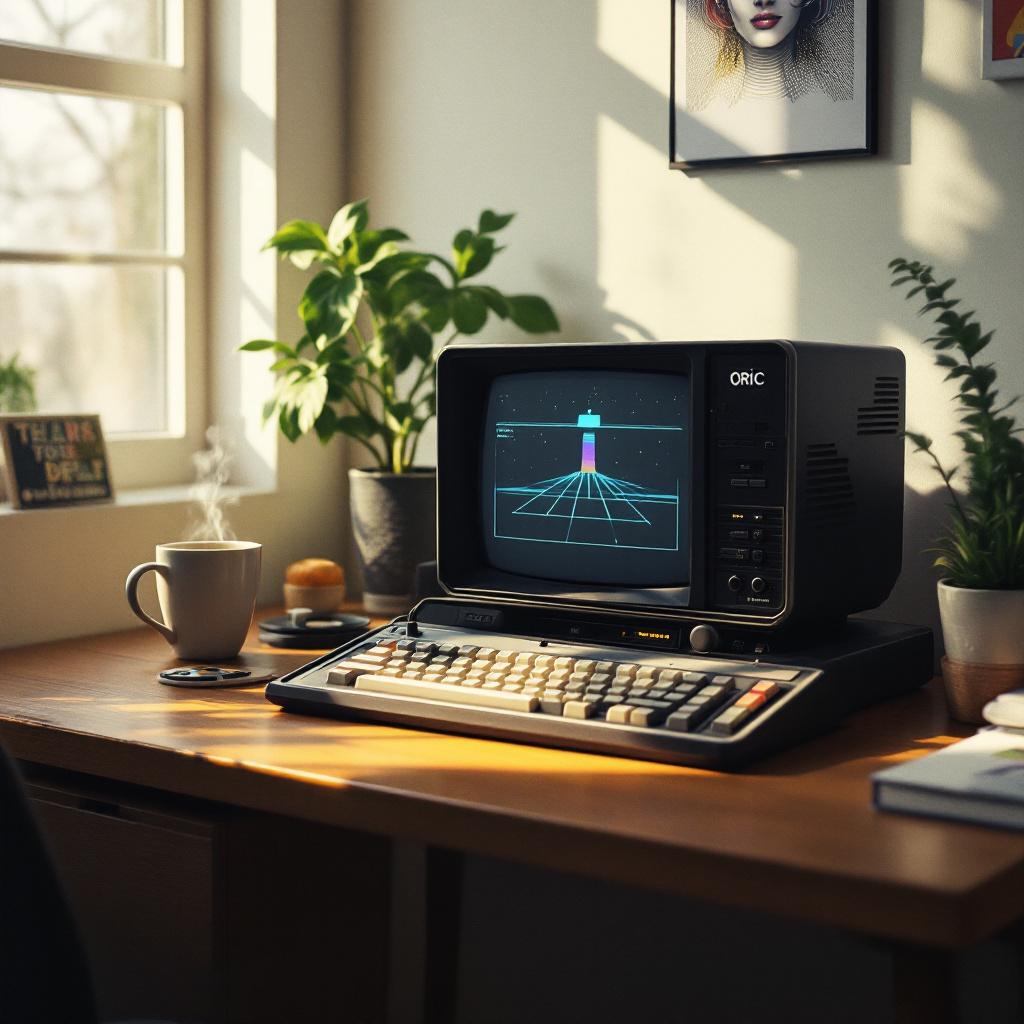
In 1984, at the heart of a microcomputer scene dominated by the ZX Spectrum, a small British publisher intended to shake up the habits: Tangerine Computer Systems launched the Oric Atmos. Behind this somewhat exotic name hides a microcomputer designed and largely manufactured in France, with the ambition to offer both technical power and refined ergonomics. Although the Atmos never dethroned the Spectrum, it remains, thirty-five years later, the symbol of a distinctly French industrial and creative adventure.
Sommaire
Genesis and ambitions of a Franco-British challenger
From Tangerine to Oric: birth of a brand
In the early 1980s, Tangerine Computer Systems was just a start-up nestled in the London suburbs. Its founders, convinced of the explosion of the microcomputer market, decided to develop a machine more powerful than the existing ones. Thus was born the Oric-1, presented in September 1983. But very quickly, user feedback pointed out keyboard defects and some system bugs. To remedy this, Tangerine launched, a year later, the Atmos, equipped with a redesigned case and a revised microprogram.
Careful manufacturing… half French
While the design of the Atmos was overseen in London, the assembly and a good part of the production chain took place in Saint-Quentin (Aisne). This industrial establishment was a first in the consumer microcomputer segment, until then dominated by manufacturing in the United Kingdom or Hong Kong. This choice allowed Tangerine to reduce logistical delays and claim a marketing advantage: “a microcomputer assembled in France and for France.” Local distributors echoed this, which consolidated sales in the hexagon.
Technical architecture: beyond aesthetics
Processor and memory: more breath
The Atmos is built around a Z80A clocked at 1.77 MHz, compared to 3.5 MHz for the Spectrum. At first glance, the Oric seems less swift, but a redesigned memory bus and optimized access routines largely compensate for this gap. On the RAM side, the Atmos offers 48 KB of RAM (compared to 16 KB or 48 KB optional on the Spectrum), allowing for more demanding software and larger BASIC compilations.
Graphics and sound: the little French extra
Graphically, the Oric Atmos offers a palette of 16 colors and a “high resolution” mode at 240×200 pixels, whereas the Spectrum tops out at 256×192 pixels with only 8 colors. Hardware sprites are absent, but a cleverly designed set of video registers reduces the well-known “color clash” familiar to Sinclair programmers. The sound, for its part, relies on an AY-3-8910 three-voice generator, already used on some British models, but rarely exploited so finely by French-speaking publishers.
A rapidly growing software library
Iconic games and French titles
From its first months, the Atmos received a warm welcome from the domestic scene. Publishers like Microids or Loriciel released original titles taking advantage of the machine’s sound and image capabilities. Chariot, Deflektor, and Space Ranger became references, mixing action and reflection, whereas many Spectrum applications were limited to pure arcade.
Communities and magazines: founding an ecosystem
The development of a microcomputer is not limited to hardware. Several specialized magazines, including “Micro News” and “Hebdogiciel,” dedicate entire sections to the Oric Atmos, offering BASIC listings, tests, and tips for tinkering with the machine. Soon, local clubs form in Paris, Lyon, or Marseille, organizing meetings where people exchange floppy disks and programming advice. This excitement somewhat recalls the Commodore 64 scene, where unusual tricks were discovered to squeeze extra kilobytes of memory, as recently reported in a feature on the Commodore 64 little-known facts.
Oric Atmos vs ZX Spectrum: duel at the specs table
| Characteristic | Oric Atmos | ZX Spectrum |
|---|---|---|
| Processor | Z80A at 1.77 MHz | Z80A at 3.5 MHz |
| RAM | 48 KB | 16 KB or 48 KB |
| Colors | 16 (with fine management) | 8 |
| Resolution | 240×200 px | 256×192 px |
| Audio | AY-3-8910 (3 channels) | Internal buzzer |
Industrial challenges and fierce competition
Poorly controlled deadlines
At the time, every month counts. Faced with an active and well-established Sinclair, Tangerine struggles to speed up production: assembly delays, component shortages, and recurring firmware bugs slow the distribution of the Atmos. In some Parisian shops, customers sometimes wait two to three weeks between ordering and delivery, while a new Spectrum is almost immediately available in stock.
The price and licensing war
To attract players, Sinclair multiplies promotions and signs exclusive agreements with Ocean or Ultimate Play the Game. For its part, the Oric team turns to local partnerships and quickly transfers its rights to External Software, Tangerine’s French subsidiary. But the surge in licensing costs and distribution rights in Europe limits access to major titles, and the Atmos remains confined to a less extensive catalog than that of its British rival.
Legacy and posterity: when the Atmos became cult
Collectors show up
Thirty years later, the Oric Atmos still generates some enthusiasm. Vintage machine enthusiasts hunt for units in good condition, often accompanied by their manuals in French. Prices, while remaining reasonable compared to those of the Commodore 64 or Spectrum, reflect a stable value: between €80 and €150, depending on the keyboard condition and the presence of original floppy disks.
Reviving old glories
A few passionate fans keep the flame alive: new cartridges, advanced emulators, demo compilations distributed on the Internet. Demomakers even organize competitions dedicated to the Oric, reminding us that a machine reputedly minor indeed fueled the creative spirit of an entire generation of French programmers. And to place the Oric Atmos in the long evolution of gaming machines, one can consult a very comprehensive chronology of gaming computers.
An Underdog Turned Legend
Too late to dominate the market, too early not to inspire French-speaking players in gaming computing, the Oric Atmos found its rightful place in history. Neither a superstar nor a mere extra, it embodies the will of a manufacturer to offer a polished alternative to the Sinclair giant. Through its software successes, its refined aesthetics, and its still active community, the Atmos reminds us that 1980s microcomputing remains an adventure rich in experimentation.
FAQ
Why didn’t the Oric Atmos oust the Spectrum?
Despite technical advantages, the Atmos suffered from production delays and a lack of major licenses, allowing Sinclair to strengthen its position as leader.
What is the most iconic game on the Oric Atmos?
Chariot remains undoubtedly the reference, both for its original gameplay and for its soundtrack fully exploiting the AY-3-8910.
Can you still program on an Oric Atmos today?
Yes, thanks to modern emulators and FPGA cartridges, it is possible to run and develop new programs just like in the old days.
