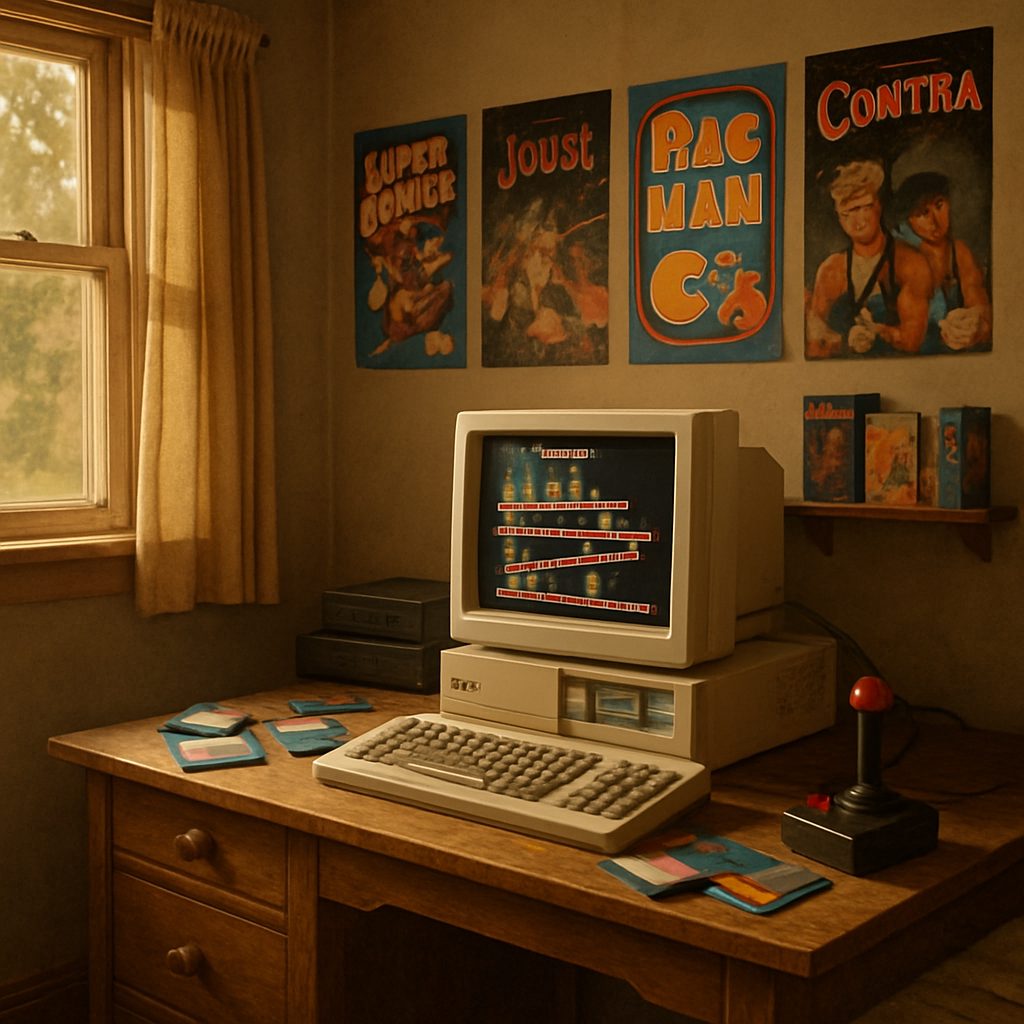
In 1981, IBM launched its PC under DOS: a generic platform where the scale that video gaming would take was not yet imagined. For a decade, enthusiasts pushed this machine to its limits: writing their own graphic engines, inventing genres, distributing demos via BBS and sharewares, laying the foundations of future PC gaming. This article traces the metamorphosis of the IBM PC compatible, from its first rudimentary games to CGA/EGA standardization, up to the creative explosion that already announced the modern era of microcomputer gaming.
🕹️ IBM PC DOS 1.0 arrives in 1981, opening the door to text mode games and early minimalist simulations.
📈 The introduction of CGA and then EGA cards redefined graphics: colored pixels, extended palettes, and the first graphic adventures emerged.
💾 The community structured itself around shareware and BBS, laying the groundwork for autonomous distribution far from traditional publishers.
🧩 Today, this pioneering decade can be rediscovered through DOSBox and various preservation projects, to (re)discover the classics that shaped PC gaming.
Sommaire
The arduous beginnings: first text mode games
In the years 1981-1983, the IBM PC had no dedicated graphics chip. Early developers turned to text mode, where each ASCII character became a rudimentary pixel. You piloted a plane in Flight Simulator 1, explored a dungeon in Rogue or Zork, and juggled cards and handwritten commands. These games were not spectacular, but they showed surprising ingenuity, playing more on the player’s imagination than on display power.
Flight Simulator 1 and aviation simulation
Simply named Flight Simulator, the first installment developed by SubLOGIC offered, on a green monochrome screen, an unprecedented flying sensation. The computer displayed the horizon with thick lines, used characters to draw the cockpit, and calculated gravity and weather in real time. For an aviation hobbyist, this already amounted to a small technological miracle.
Text adventures and emerging RPGs
Alongside simulation, text adventures were all the rage. Zork and its puzzles, Rogue and its randomly generated levels laid the foundations of RPGs on microcomputers. Behind their austere appearance, these titles offered rich scenarios, strong replayability, and inspired communities and specialized fanzines to share tips and codes.
The graphic revolution: the advent of the CGA card
In 1982, IBM introduced the CGA (Color Graphics Adapter). For the first time, the PC displayed 4 colors at 320×200 pixels, or 2 colors at 640×200. Admittedly, the palette—blue, cyan, white, and magenta—seemed limited, but developers competed in cleverness to circumvent these constraints. The very visible square pixels gave an immediately recognizable style, which became the trademark of nascent PC gaming.
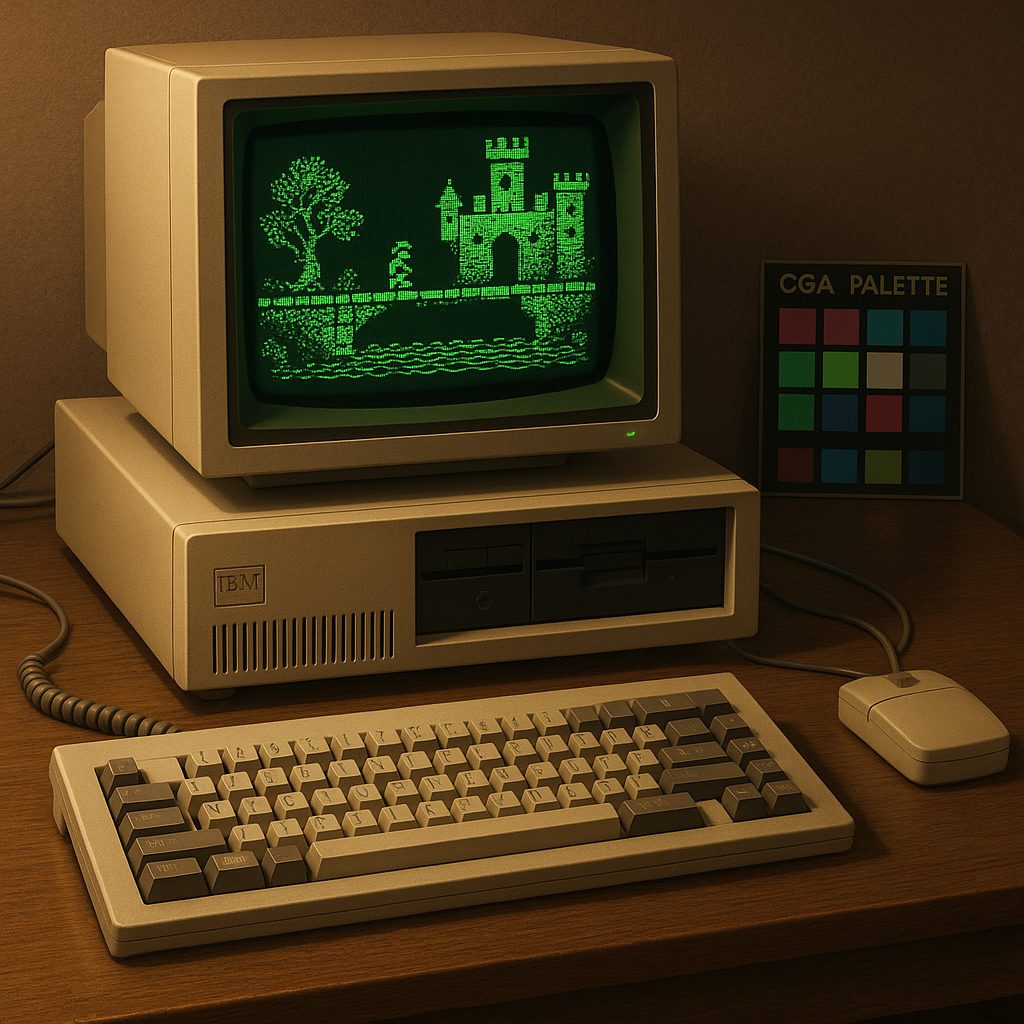
Thanks to CGA, true colorful 2D environments appeared. Titles like King’s Quest I or Lode Runner offered lively and detailed backgrounds. The first programmers at Sierra and Brøderbund refined their engines to make the most of the three color bits available.
The rise of genres: strategy, action, and RPG on PC DOS
Little by little, PC DOS became the preferred playground for strategy fans. Sid Meier’s Civilization (1984) laid the foundations of an empire developed turn by turn, while the MicroProse studio made a name for itself in military simulation. At the same time, the first shareware FPS games began to emerge, preparing the ground for a revolutionary distribution.
Turn-based and real-time strategy
Civilization explored human history on a grid, with each unit and resource managed step by step. In 1989, Populous invented real-time strategy, where players shaped the terrain to dominate a rival people. Two diametrically opposed but complementary approaches, showcasing all the creativity the PC platform was capable of.
Graphic adventures and immersive RPGs
Meanwhile, Sierra’s point-and-click adventures (Space Quest, Police Quest) and Lucasfilm Games (The Secret of Monkey Island) carved out a strong visual identity. Tactical RPGs, like Wasteland, offered epic quests and rich dialogues, long before 3D would revolutionize everything.
Community and distribution: shareware and BBS
When the Internet was still just a dream, enthusiasts shared their productions via BBS (Bulletin Board Systems). The shareware model took hold: a first episode was distributed for free, then payment was required to unlock the rest. This method propelled cult titles, including Doom, which would soon shake up the industry. To grasp the impact of this decentralized distribution, one can also delve into the era of DOS sharewares.
In practice: emulation and preservation of DOS games
Today, relaunching these games is almost a sacred ritual. DosBox remains the reference for faithfully emulating PC DOS, recreating period timings and resolutions. Projects like GOG.com or archive.org offer complete catalogs, often preconfigured. A simple way to relive these pixelated masterpieces without digging out a dusty 5150 from the garage.
Summary table of PC DOS configurations (1981-1990)
| Year | Model | CPU | Graphics | Iconic Game |
|---|---|---|---|---|
| 1981 | IBM PC 5150 | Intel 8088 @4.77 MHz | Monochrome | Zork |
| 1982 | IBM PC CGA | Intel 8088 @4.77 MHz | CGA 4 colors | Lode Runner |
| 1984 | IBM PC AT | Intel 80286 @6-8 MHz | EGA 16 colors | Civilization |
| 1987 | IBM PS/2 | Intel 80286-80386 | VGA 256 colors | King’s Quest IV |
FAQ
- How to install a DOS game today?
- The easiest way is through DosBox, which can be downloaded for free. You just need to mount a folder containing the game files as a virtual drive.
- What is the difference between CGA and EGA?
- CGA is limited to 4 colors at low resolution, while EGA extends the palette to 16 colors and offers better graphic rendering.
- Where to find period ROMs?
- Online archives (archive.org, GOG.com) offer refurbished games, sometimes accompanied by automatic installers for DosBox.
