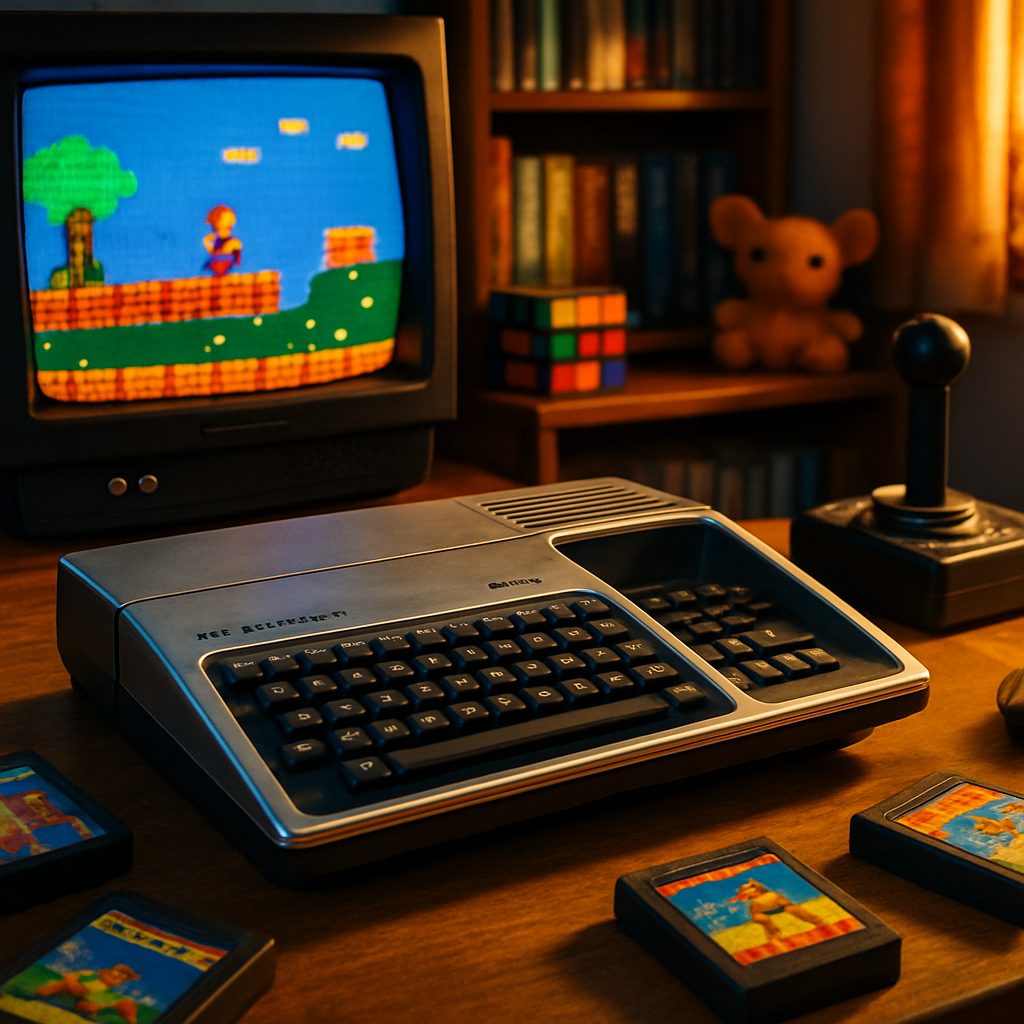
At the border between the home console and the personal microcomputer, the Texas Instruments TI-99/4A long puzzled gamers and tinkerers. Launched in 1981, this system promised as much video game fun as educational power, thanks to its proprietary BASIC and its refined connectivity. Yet, behind the “console” label hides an atypical architecture, surprising technical choices, and sometimes limiting compromises. By exploring the history and architecture of the TI-99/4A, one discovers a visionary product, often underestimated, that shaped part of the consumer computing landscape of the 1980s.
Sommaire
Context and genesis of the TI-99/4A
Birth at Texas Instruments
At the end of the 1970s, Texas Instruments was not just a semiconductor supplier: the company dreamed of democratizing home computing. Inspired by the rise of microcomputers like the Apple II or the TRS-80, TI’s educational department hired a team of engineers to design a hybrid device. The result: a full keyboard, a cartridge reader, a mapping port for extensions, all in a case with angular lines, ready to appeal to parents and children.
Market positioning
In 1981, the TI-99/4 arrived in the high-end segment, priced around $1150, well beyond competing consoles. Quickly, TI adjusted its strategy: the TI-99/4A became less expensive (around $525) and aligned more closely with the prices of the Atari 2600 or the Commodore 64. However, from a marketing standpoint, ambiguity remained: should it be called an educational computer or a leisure console? This hybrid positioning offered excellent potential but complicated public understanding.
Architecture and technical particularities
An amazing chip: the TMS9900
The heart of the TI-99/4A rests on the TMS9900, one of the first 16-bit microprocessors for the general public. Where most competing machines used 8-bit CPUs, TI bet on calculation precision and addressing power. In theory, this ensures superior performance; in practice, access to video memory and its limited cartridges slowed down the demonstration. Nevertheless, the TMS9900 remains the signature of an uncommon technical ambition at the time.
Graphics and sound: the TMS9918 video chip
For display, Texas Instruments relies on the TMS9918 chip, capable of managing 16 colors, a sprite mode, and a resolution of 256×192 pixels. These specifications were close to those later found in many MSX computers. This choice favors sharp and dynamic graphics, notably in the early arcade games adapted for the TI-99/4A. On the audio side, the integrated sound generator produces simple tones but proves effective when effects are judiciously dosed in an action title or educational software.
BASIC on cartridge and extended RAM
Rather than integrating a factory BASIC interpreter, TI offers an external module: the “TI BASIC” cartridge. Installing it provides a complete environment to code, save programs, and experiment. The RAM, initially limited to 256 bytes for the main processor, can be expanded thanks to an 8 KB or larger RAM cartridge. This modularity already recalls, in some respects, the standards found in the MSX standard, even if TI adopts its own architecture.
Software library and uses
Memorable games, between arcade and puzzle
More than 200 cartridges were available, covering various genres: adaptations of arcade titles like Parsec or TI Invaders, clever puzzles like Alley Cat, and educational simulations. The catalog reflects the “console” vs “computer” duality: alternating between reflexes and learning, between improving scores and developing lines of code. Developers, sometimes small independent teams, exploited the video chip to produce surprising graphics, notably in Joust or Montezuma’s Revenge.
Amateur programming and educational environment
In many primary schools and associations, the TI-99/4A was prized for introducing students to coding. The in-house BASIC, relatively complete, allowed creating simple games, animating sprites, and manipulating tile walls. Some enthusiasts embarked on more ambitious projects, such as mini-databases or small utility applications. This playful approach to programming recalls that at the same time, the rise of microcomputers encouraged direct interaction between hardware and budding coders.
Comparisons with its contemporaries
| Characteristic | TI-99/4A | Commodore 64 | Atari 400/800 |
|---|---|---|---|
| Processor | TMS9900 16-bit | MOS 6502 8-bit | 6502C 8-bit |
| RAM Memory | 256 bytes (+ cartridge) | 64 KB | 8 KB to 48 KB |
| Display | 256×192, 16 colors | 320×200, 16 colors | 320×192, 128 colors |
| Audio | Simple tone(s) | 3-channel SID | 4-channel POKE Y |
A console with the soul of a microcomputer: paradoxes and limits
Beyond marketing, the TI-99/4A embodies a paradox: it aspires to be a microcomputer but is constrained by console specifications. The low RAM, BASIC on cartridge, and absence of a standard expansion bus often hinder programmers’ ambitions. In return, its robust casing and playful-educational versatility appeal to a family audience. This opposing duality results in an experience where nostalgia mixes with technical frustration.
- Graphic performance: impressive for a console of its time.
- Software flexibility: significant thanks to RAM and BASIC cartridges.
- Constraints: limited processor memory, slow video access time.
Legacy and posterity
The community and retro-gaming
Enthusiasts continue to explore the TI-99/4A, developing new games, adapting demos, and proposing hardware improvements. Dedicated forums host tutorials to replace the sound chip, increase RAM, or transform the machine into a cartridge emulator. This activity highlights that the TI-99/4A, despite its flaws, has generated a cult following whose energy rivals that of computers from its era.
Influence on successors
TI’s strategy, aiming for a product halfway between entertainment and education, foreshadows some concepts later widespread in the world of modular consoles. To place this journey in a broader perspective, the evolution of gaming computers sheds light on the unique position of the TI-99/4A, between the first consumer machines and today’s powerful gaming PCs.
Why Remember the TI-99/4A
At a time when consumer computing was becoming standardized, the TI-99/4A embodied boldness: daring to offer a 16-bit home computer when the world was still on 8 bits. Its console/computer hybrid was not always practical, but it helped spread the idea that an entertainment device could also be an educational tool. Although it did not dominate the market, its originality and technical innovations continue to inspire collectors, video game historians, and all those who believe that a machine retains its magic when you understand its workings.
