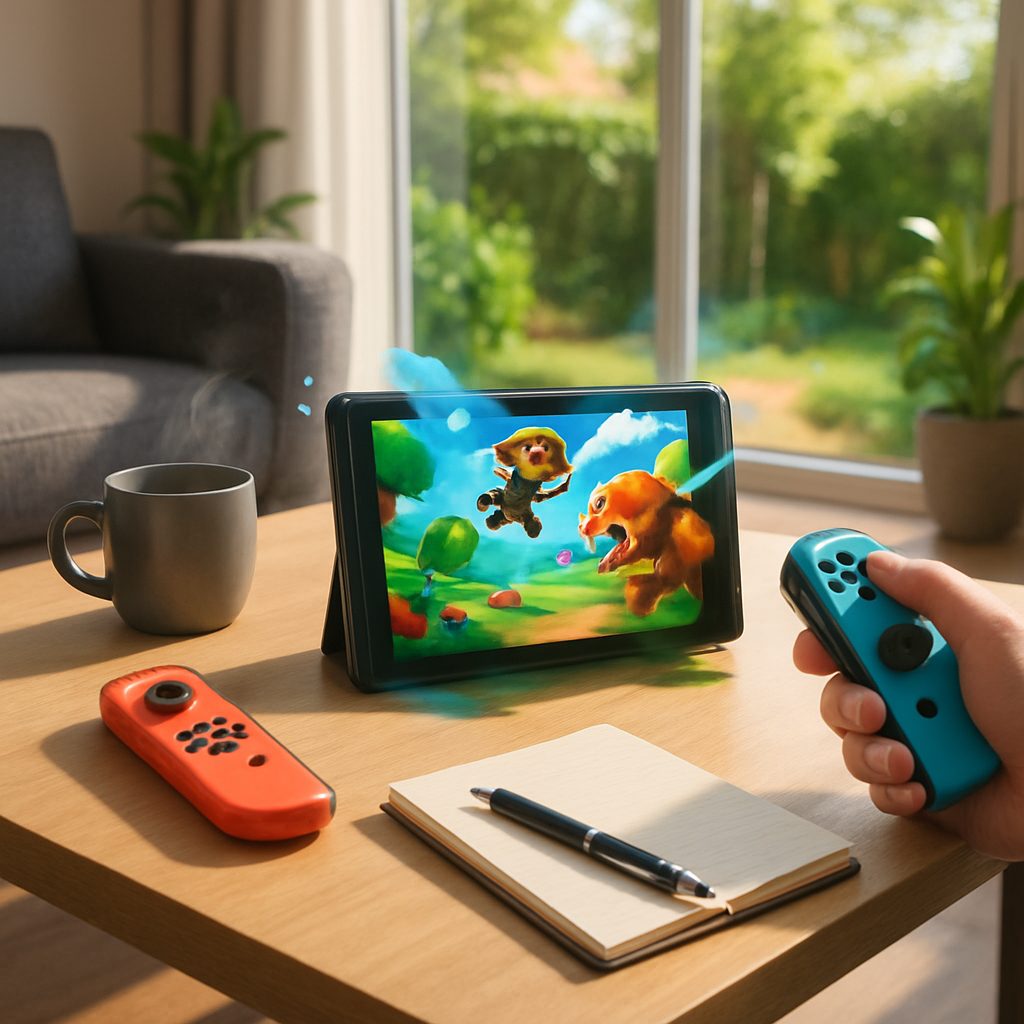
The Nintendo Switch has established itself in just a few years as an unprecedented phenomenon: home console, portable platform, socialization tool… it blurs the lines between fixed and mobile entertainment. Behind this ingenious design lies a technological bet and a content strategy that have propelled the machine to worldwide success.
Sommaire
In brief
🕹️ Dual use: the Switch switches in one click from the TV to the hand, offering a seamless experience both on the go and at home.
⚙️ Technical specifications: Nvidia Tegra chip, 4 GB RAM, 6.2″ touchscreen and expandable storage, a balance between power consumption and performance.
🎮 Complete catalog: from Nintendo exclusives (Zelda, Mario) to third-party titles, it attracts both casual and hardcore gamers.
🌎 Global success: over 100 million units sold, massive adoption across all continents, from Tokyo to New York.
The rise of a hybrid console
At a time when tablets and smartphones dominate attention, Nintendo took the risk of returning to the dedicated console market with a unique concept. Heir to the Wii U on the home side and the DS on the portable side, the Switch retained the idea of an accessible experience while correcting the flaws of its predecessors. To understand this evolution, one can go back to the era of the NES, a pivot between a struggling industry and creative renewal. By betting on modularity and ease of use, Nintendo found the formula to appeal to an audience spanning generations.
Technical specifications
| Component | Specification |
|---|---|
| Processor | Nvidia Tegra X1+ |
| RAM | 4 GB LPDDR4 |
| Internal storage | 32 GB (expandable via microSD) |
| Screen | 6.2″ capacitive LCD (1280×720) |
| Battery life | 4.5–9 hours (depending on the game) |
| Connectivity | Wi-Fi 802.11ac, Bluetooth 4.1, USB-C |
| Media | Proprietary cartridges, microSDXC |
A design conceived for mobility and versatility
Game modes and ergonomics
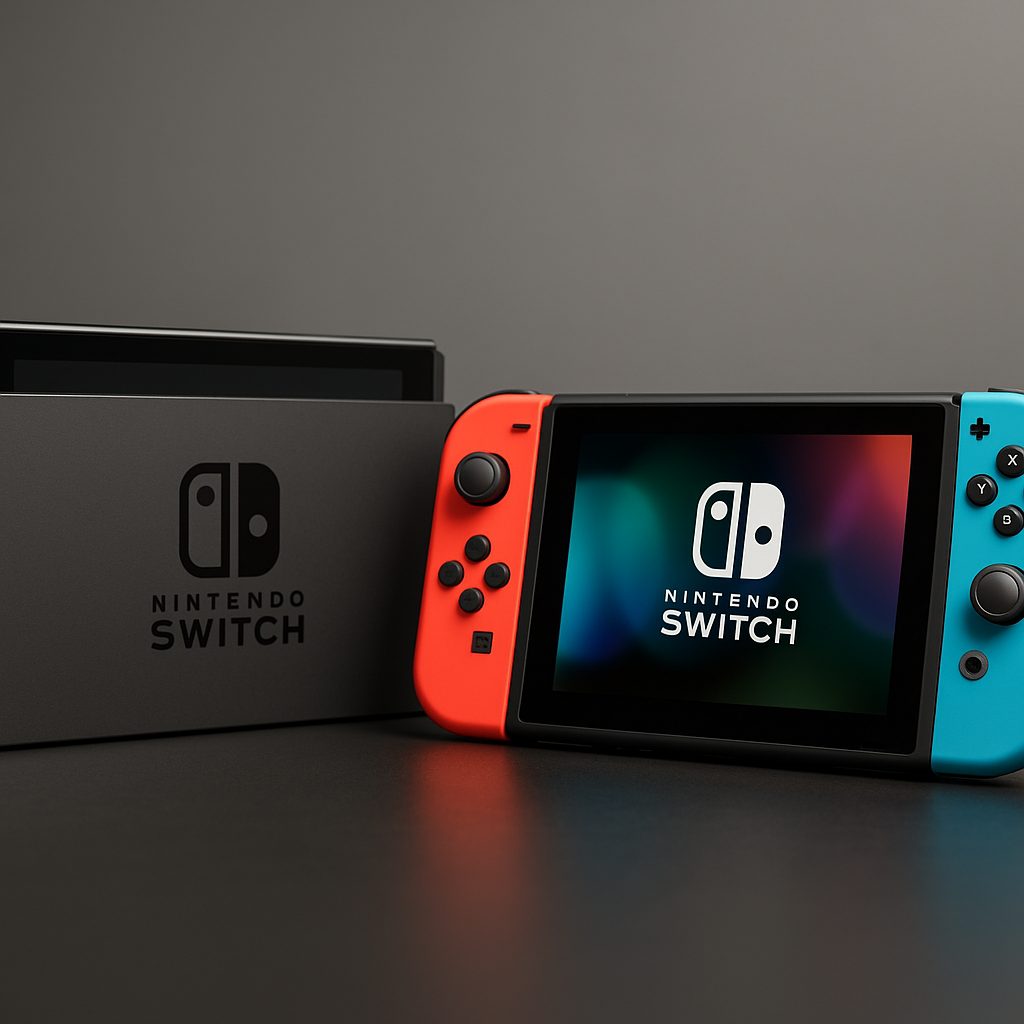
The switch between docked and handheld mode happens in seconds: clip or detach the Joy-Con controllers, insert the dock, and the image appears on the big screen. The handling remains consistent, without adapting the gameplay, whether for long RPG sessions or short games on the move. Fingers naturally find their place thanks to a studied size/weight ratio, allowing hours of play without excessive fatigue.
Joy-Con controllers and accessories
The Joy-Con controllers, true autonomous mini-peripherals, integrate motion sensors, HD Rumble, and an infrared camera. Beyond the base pack, several accessories enrich the experience: steering wheel for racing, fitness rings, more traditional Pro controller. Each option illustrates Nintendo’s desire to adapt its console to varied uses, from group play to more serious competitions.
Performance and Competition in the Market
Against Gaming Laptops and PCs
Although the Switch does not compete with a gaming laptop equipped with an RTX card, it positions itself as a lightweight and affordable alternative. Laptops often exceed a hundred watts of power consumption, while the console remains under 20 W. Result: acceptable battery life for a machine of this power and a more compact design than a standard laptop, without noisy fans or complex cooling systems.
Against Portable Consoles and Cloud Gaming
In the portable segment, the Switch faces high-end smartphones, tablets, and game streaming services. While a smartphone can launch a title via the cloud, latency and dependence on a stable connection limit the experience. The Switch, on the other hand, carries the game locally, ensuring smoothness and no micro-stutters related to the network. This execution autonomy clearly distinguishes it from purely cloud offerings.
The Steam Deck Head-to-Head
The release of the Steam Deck has revived the debate around mobile consoles. Behind its thick form factor and more classic pad, Valve offers a complete PC library, while Nintendo relies on a closed and optimized ecosystem. Each camp attracts a different audience: one seeks flexibility and the PC game library, the other prefers simplicity, the quality of Nintendo exclusives, and proven technical reliability.
A Global Success and an Ambitious Software Strategy
Exclusive and Third-Party Game Catalog
At the heart of the phenomenon are iconic franchises: Super Mario, Zelda, Splatoon, which draw crowds of fans with each new release. Added to this are partnerships with third-party publishers (Ubisoft, Capcom, Square Enix), who adapt their hits to take advantage of the portable aspect. The mix of strong exclusives and multi-platform titles ensures a rare diversity on console.
Updates and Software Innovations
Nintendo does not just sell a machine: the console regularly receives system updates, introducing features such as video captures, icon folders, and an extension store. The latest interface, more streamlined, improves navigation and integrates voice chat via smartphone. These evolutions illustrate the care given to the product’s longevity.
Future Prospects
As the Switch approaches its tenth year, speculation about its successor is intensifying. Larger OLED screen, increased power, return of modular design: Nintendo could rely on feedback to refine its offer. One thing is certain, the Switch’s lesson will endure: today’s player demands a console that adapts to their lifestyle and encourages sharing, two now essential pillars.
FAQ
- What is the difference between the Switch and the Switch Lite?
- The Switch Lite is a 100% portable version, without a dock or TV output. It is lighter and less expensive, but without gameplay on a big screen.
- How to optimize battery life?
- Reducing brightness, disabling Wi-Fi, or turning off HD Rumble vibration helps extend gaming sessions.
- Can external hard drives be used?
- No, only microSDXC cards are recognized. The dock’s USB-C ports do not support external storage.
- Does the console support 4K?
- No. The TV output is limited to 1080p. In portable mode, the screen caps at 720p.
