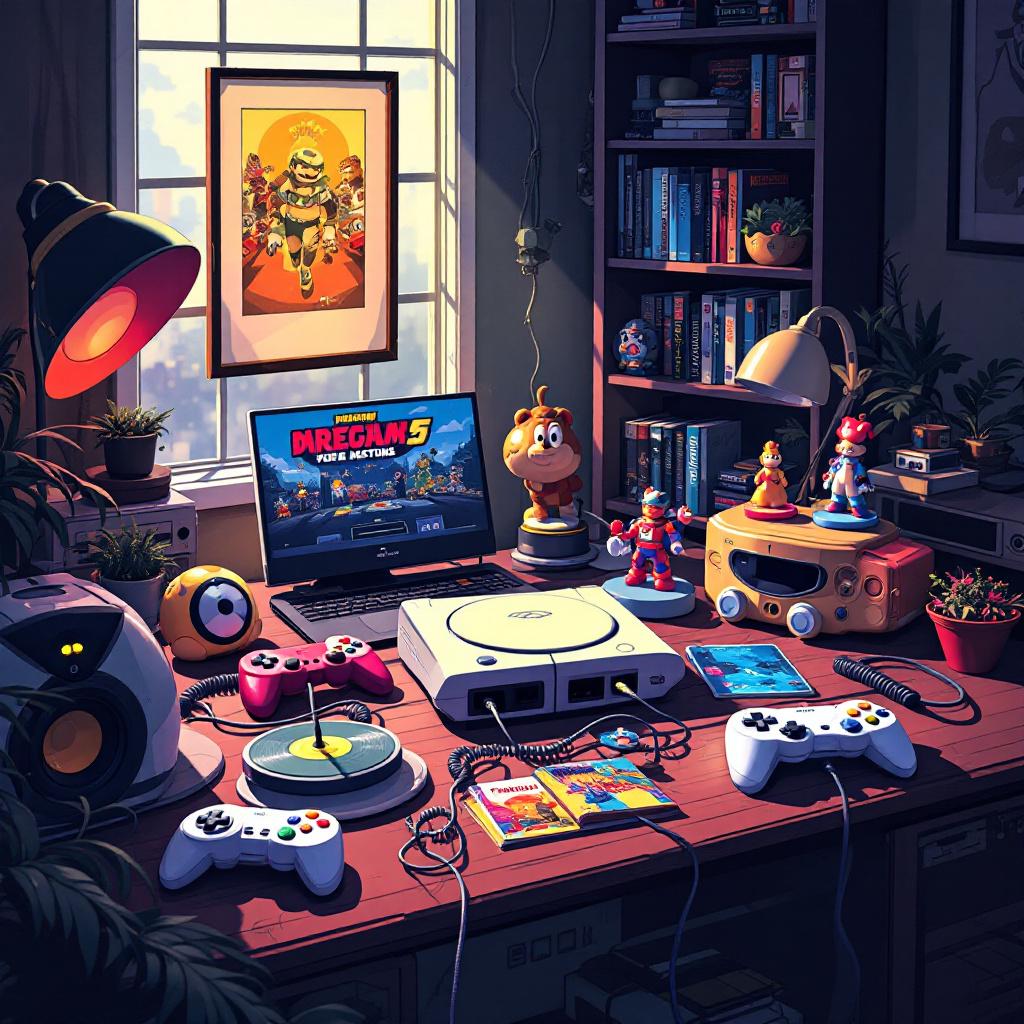
In 1999, Sega launched the Dreamcast, the last console in its range, supported by ambitious hardware and a promising software library. Yet, barely three years later, the Japanese company announced the end of its production. How did such an innovative project commercially fail, before building its legend among enthusiasts? This autopsy reviews the technical choices, strategic errors, and the legacy of a machine ahead of its time.
📌 Innovative hardware: 200 MHz processor, specialized graphics chip, built-in modem, the technical boldness of the Dreamcast is undeniable.
⚙️ Marketing failures: Premature release, rampant piracy, and shaky promotion against Sony and Nintendo quickly diminished its impact.
📊 Fierce competition: PlayStation 2, Nintendo GameCube, Xbox – the Dreamcast quickly found itself isolated in the midst of a titans’ war.
🔍 Cult legend: Despite everything, flagship titles like Shenmue or Sonic Adventure forged a lasting attachment that endures among collectors.
Sommaire
Birth of a pioneering prototype
In the mid-90s, Sega was looking to reconnect with success after the Saturn, considered too complex to program. The idea: to offer a powerful console, internet-enabled, easy to develop for third-party studios. From its announcement, the Dreamcast presented itself as the answer to developers’ accumulated frustrations. The introduction of a 56k modem directly in the console already anticipated the era of online gaming on home consoles.
An architecture turned towards the future
Technically, the Dreamcast was an UFO. It featured a Hitachi SH-4 processor at 200 MHz, supported by a PowerVR2 graphics chip capable of handling lighting effects and 3D textures with fluidity rarely seen at the time. Compared to the CGA and SVGA of 1999 gaming PCs, it competed without complex. But this performance was just one of the strengths planned by Sega.
Technical specifications
Key specifications
| Component | Details |
|---|---|
| Processor (CPU) | Hitachi SH-4 @ 200 MHz |
| Graphics power (GPU) | PowerVR2 – 3 DOPS and T&L effects |
| RAM | 16 MB main + 8 MB video |
| Storage | GD-ROM (1.2 GB) |
| Connectivity | Built-in 56k modem, serial port |
| Peripherals | Vibration controller, VMU (Visual Memory Unit) |
Competitors and market dynamics
When Sega launched its Dreamcast, Sony was already preparing the PlayStation 2, whose release in March 2000 would shake up the industry. Microsoft announced the arrival of its Xbox with a PC hardware-oriented approach, while Nintendo bet on the GameCube, less powerful in raw terms but supported by strong family-oriented communication.
The race for power
Each manufacturer bet on their strength: Sony installed a DVD player, Microsoft capitalized on DirectX, Nintendo played originality. Sega, for its part, bet on network gaming and flexibility for developers. While the homebrew community celebrated this openness, the general public remained attached to the Sony and Nintendo universes, supported by massively funded communication.
Echoes from Personal Computing
At the same time, the desktop computer was moving towards Windows 2000 and 3D accelerator cards. When a PC gamer invested in a GeForce 256 or a Radeon, they found sometimes comparable performance, and above all, broader access to updates and mods. Although the Dreamcast was a console, it dangerously flirted with the PC world, without benefiting from its software ecosystem.
Why Did the Dreamcast Falter?
Several factors combined to precipitate the commercial failure of the Dreamcast despite its potential.
The Timing Mistake
A rushed launch in September 1999, four months before the PS2, allowed Sega to grab initial market share, but also plunged the console into an anxious wait. No major game was ready, and the marketing campaign failed to maintain enthusiasm. The public, accustomed to well-orchestrated launches, quickly lost confidence.
Piracy in the Background
Soon, tools to burn the GD-ROM appeared, making the Dreamcast the most pirated console of its time. Piracy not only affected game sales but also weakened studios, limiting new developments and discouraging third-party publishers.
“We were too inclined to think that technical innovation would be enough. We underestimated the importance of partnerships and the marketing plan.”
The Legacy of a Cult Console
Fifteen years after its disappearance, the Dreamcast still fascinates. Several factors explain this renewed affection:
- A remarkable software library: Shenmue, Jet Set Radio, Sonic Adventure remain unique experiences.
- An active community: fans, homebrew, retro gaming events keep the flame alive.
- Timeless design: compact, pristine white, the Dreamcast still stands out in any collection.
To place the Dreamcast within the evolution of consoles and better understand its impact, one can consult the history of video game consoles (1972-2025), a comprehensive overview of the technological and cultural revolutions that have shaped the industry.
In Brief
The Dreamcast will always illustrate the tension between technical boldness and commercial realities. It also proves that yesterday’s failure can become tomorrow’s cult.
