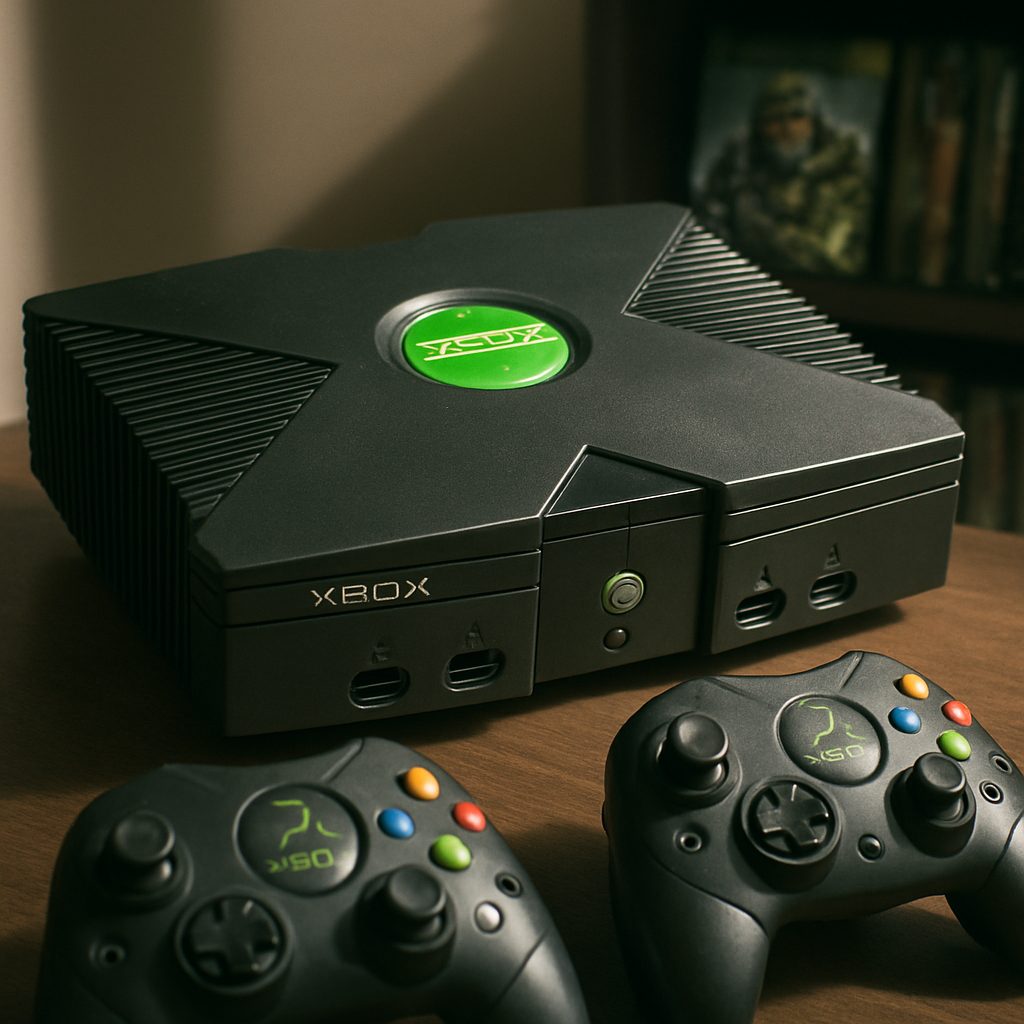
November 2001. While Sony reigns supreme in the market with its PlayStation 2, a new player bursts through the doors of the industry: Microsoft. The Xbox is not a console like the others. Designed by PC engineers, equipped with a hard drive and an Intel processor, it represents an unprecedented foray by the software giant into the consumer hardware domain. Behind this boldness lies a strategy as brilliant as it is risky: using video games as a Trojan horse to impose Windows in living rooms. A look back at a technological gamble that would redefine the rules of the console war.
💥 A technological shock: With its Intel Pentium III 733 MHz processor and integrated 8 GB hard drive, the Xbox technically outclasses the PS2. Its PC architecture greatly simplifies development for studios accustomed to coding on Windows.
🎮 Halo, the ultimate weapon: The exclusivity of Halo: Combat Evolved became the console’s best-selling title (5 million copies), demonstrating the power of FPS on consoles and literally saving the launch.
🌐 Xbox Live, the online revolution: Launched in 2002, this paid service ($50/year) introduced structured online gaming with friends lists and voice chat – a first for consoles that would influence an entire generation.
💸 A war price: Sold at $299 (100$ less than its production cost), Microsoft absorbed a $4 billion loss to gain market share against the PS2.
Sommaire
A boiling market: the pre-Xbox context
When Microsoft announced its “Midway” project in 1999, the industry was dominated by two titans: Sony, whose PS2 was about to crush all competition with 155 million units sold, and Nintendo, which was betting on the GameCube and its family-friendly game library. But this period also saw the collapse of the old gladiators. Sega, exhausted by the commercial failure of the Dreamcast, had just announced its withdrawal from the hardware market. Atari was dying after the fiasco of its Jaguar, technically advanced with its 64-bit architecture, but undermined by lack of publisher support. This strategic void offered an unexpected window for Microsoft.
The genesis of a crazy idea: from PC to living room
It all started during a legendary meeting in 1998. Bill Gates, alerted by the exponential growth of video games, exclaimed: “Why isn’t our operating system in the living room?” Under the direction of Seamus Blackley, a former physicist and developer at DreamWorks, a clandestine team (“the cabinet of curiosities”) explored the idea of a console based on DirectX. Their goal? To create a machine powerful enough to compete with gaming PCs, but plug-and-play like a console. The technical challenge was colossal: miniaturizing a PC tower, managing the heat of the Pentium III, and convincing wary publishers. Unlike Sony’s or Nintendo’s vertical approach, Microsoft bet on an open architecture, close to the PC, to attract Western studios like Bungie or Epic Games.
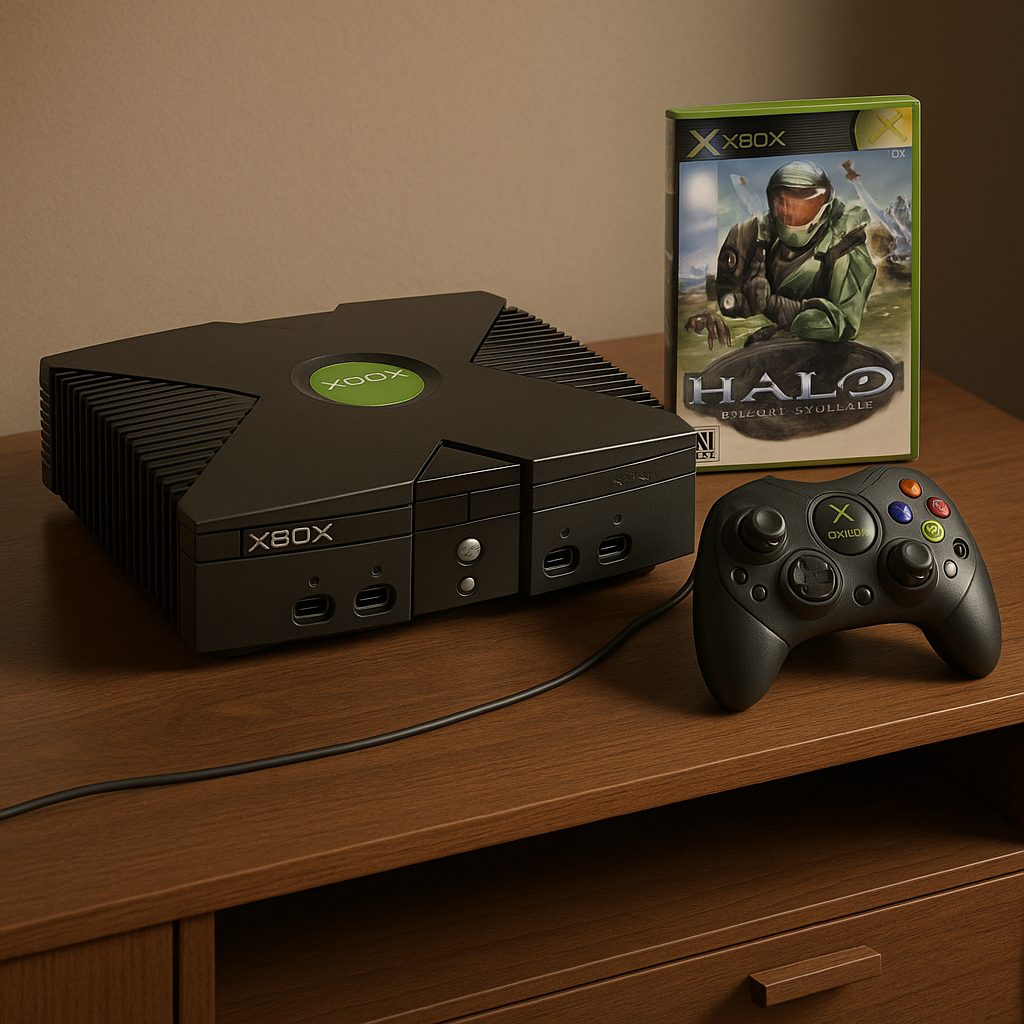
Technical dissection: the PC disguised as a console
Under its iconic black hood, the Xbox hides a surprise: it is essentially an x86 computer optimized for gaming. This approach breaks radically with the proprietary architectures of competitors. Let’s see why in this comparative technical sheet:
| Component | Microsoft Xbox (2001) | Sony PlayStation 2 | Nintendo GameCube |
|---|---|---|---|
| CPU | Intel Pentium III 733 MHz | Emotion Engine 294 MHz | IBM PowerPC “Gekko” 485 MHz |
| GPU | NVIDIA NV2A 233 MHz | Graphics Synthesizer 147 MHz | ATI “Flipper” 162 MHz |
| RAM | 64 MB DDR SDRAM | 32 MB RDRAM | 24 MB MoSys 1T-SRAM |
| Storage | 8 GB Hard Drive + DVD-ROM | DVD-ROM (no HDD) | Proprietary 1.5 GB Optical Disc |
| Max Resolution | 1920x1080i (HDTV) | 1280x1024i | 640x480p |
This configuration enables unprecedented feats such as displaying high-resolution textures or near-instant loading of levels thanks to the HDD. But it comes at a cost: the Xbox is massive (3.86 kg), noisy, and heats up enormously – a flaw that will cause the famous “red ring” overheating issue. Another major innovation: the “Duke” controller, with its 8 analog buttons and headset port, designed for American hands but considered too large by Japanese and European players. Microsoft corrected this with the Controller S model in 2002.
The secret weapon: when games make history
Without a convincing game library, even the best console fails. Microsoft understood this by acquiring Bungie in 2000, thus obtaining Halo: Combat Evolved. This revolutionary FPS demonstrates the machine’s power with its vast environments, innovative enemy AI, and cooperative mode. But the Xbox also boasts other notable exclusives:
- Project Gotham Racing: graphical showcase with realistic reflections on car bodies
- Dead or Alive 3: constant 60 fps combat, an unmatched technical feat
- Fusion of PC/console worlds: ports of Morrowind and Counter-Strike
The real feat? Convincing third-party publishers like EA Sports, initially reluctant, thanks to development tools similar to those of the PC. Result: versions often superior to those on the PS2, such as SSX Tricky or Burnout 3.
Marketing strategy: the giant’s bet
Microsoft deploys colossal means to establish itself. The American launch on November 15, 2001, was preceded by a shock campaign: TV spots showing babies born with the Xbox logo tattooed, partnership with Mountain Dew, and even a Rolling Stones concert. The message? “Power without compromise.” But the real stroke of genius lies in the aggressive pricing. Sold at $299 – cheaper than its components – the console creates a psychological shock. Sony counterattacks by lowering the PS2 to $199, but Microsoft maintains pressure by including Halo in some bundles.
“We are not selling a console, we are buying market share. Every Xbox sold is a strategic victory.” – Robbie Bach, head of the Games division at Microsoft (2002)
The business model relies on game royalties and the future Xbox Live. A risky approach that pushes Microsoft to lose $126 per console in the early years. But this sacrifice allows selling 24 million units – far behind the PS2, but enough to establish legitimacy.
Xbox Live: the ultimate legacy
Launched in November 2002, this premium service ($50/year) revolutionized online console gaming. Unlike the rudimentary system of the PS2, Xbox Live offers:
- A unique identifier (Gamertag)
- A centralized friends list
- Voice chat via included headset
- Weekly leaderboards and challenges
Titles like MechAssault or Tom Clancy’s Splinter Cell leveraged this network, but it was Halo 2 in 2004 that transformed competitive gaming into a social phenomenon. This infrastructure laid the foundation for the modern Xbox Network, now used by millions of players.
The historical impact: a springboard to the future
Despite a third place behind PS2 and GameCube, the original Xbox was a strategic success. It forced Sony and Nintendo to take online gaming and PC technologies seriously. It also opened the market to Western studios, previously marginalized on consoles. Without this first foray, franchises like Gears of War or Forza Horizon probably wouldn’t exist. The follow-up with the Xbox 360 would prove that Microsoft was not just a guest, but a lasting player who managed to turn its initial handicap into strength.
The console war often resembles a game of chess. In 2001, Microsoft sacrificed a pawn to gain position. Two decades later, this bold move appears as one of the most visionary in video game history. It proved that with enough resources and conviction, even an outsider could shake up the established order – a lesson neither Sony nor Nintendo will forget.
