
At the end of the 1990s, Bandai surprised the Japanese market with a sober, robust, and surprisingly economical handheld console: the WonderSwan. Its successor, the WonderSwan Color, added the splash of color that was missing without compromising battery life. A look back at a little-known adventure where inventiveness often triumphed over raw power.
Sommaire
In Brief
🔹 Key dates: launch in 1999 for the first model, followed by the Color in 2000.
🎮 Library of about 200 titles, including exclusives from Square Enix and Namco.
⚙️ Minimalist technical specs: 16-bit CPU, LCD screen (mono then 241 colors), optimized power consumption.
💡 Positioning: in Japan, competing against the Game Boy Color, with an asymmetrical design and record battery life.
Genesis and Bandai’s Strategy
The idea for the WonderSwan took root in Bandai’s offices as early as 1998, while the Game Boy and Neo Geo Pocket dominated the handheld segment. The challenge was simple: offer a more affordable device capable of competing on battery life without sacrificing graphic quality. In a context where Nintendo and SNK were jostling for position, Bandai relied on its flagship licenses (Digimon, Gundam) to capture a niche of passionate players. The console was announced at 12,800 yen, about 80 € at the time, a very aggressive positioning during Japan’s economic boom.
Design and Ergonomics
Asymmetrical shape and portability
The WonderSwan’s silhouette immediately stands out: a rectangular format with slightly curved edges, designed to optimize one-handed or two-handed grip. This choice was deliberate: Bandai emphasized vertical gameplay for certain titles, somewhat like a manga page, and ease of handling in tight levels. The ergonomics aimed for versatility: link cable for multiplayer, universal AA battery, and well-protected cartridge slot.
Colorization in response to the market
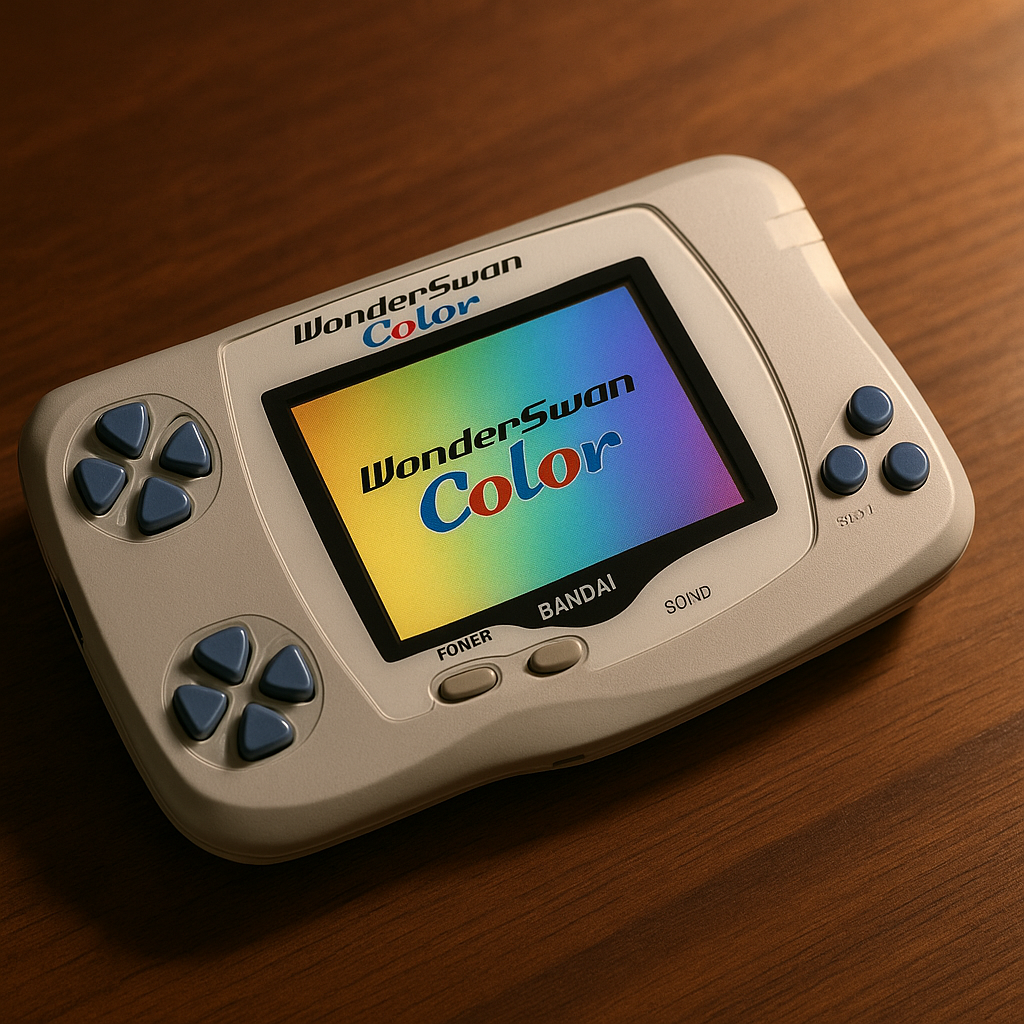
Less than a year after launch, the WonderSwan Color appeared, housed in an almost identical case but covered with tinted translucent plastics. The screen moved to 241 simultaneously displayable colors, from a palette of 4,096 shades: a visual leap praised by the specialized press. This rapid transition demonstrated Bandai’s determination not to leave the color monopoly to Nintendo, whose Game Boy Color was released almost simultaneously.
Technical Specifications
| Feature | WonderSwan | WonderSwan Color |
|---|---|---|
| CPU | 16 bits (WSC) | 16 bits (WSC) |
| Frequency | 3.072 MHz | 3.072 MHz |
| RAM | 64 KB | 64 KB |
| Screen | Mono LCD (200×144) | Color LCD (200×144) |
| Media | Proprietary cartridges | Proprietary cartridges |
| Power | 1 × AA (battery life ~40 h) | 1 × AA (battery life ~30 h) |
| Release date | 1999 (Japan) | 2000 (Japan) |
Game Library and Partnerships
The strength of the WonderSwan lies in its Japanese exclusives. Renowned Square Enix designer Tetsuya Nomura launches prototypes never seen elsewhere, while Namco offers versions of Ridge Racer adapted to the small screen. You also encounter direct Bandai licenses: Digimon, One Piece, and even a compilation of retro mini-games. The timeline of Japanese consoles helps to place the impact of these titles in the great video game saga.
Competition and Positioning
Against the Game Boy Color, the Neo Geo Pocket Color, and even Sharp’s WonderBook (a canceled project), Bandai plays the originality card more than power. The device is sold mainly in Japan — its export is considered too risky by the parent company. The aggressive price and outstanding battery life appeal to those who want to play without interruption. Conversely, the smaller game library and the absence of major international licenses hinder its adoption in the West.
Evolution to the WonderSwan Color
This shift to color is not merely cosmetic. Developers gain expressiveness, exploiting layer effects and colored sprites more finely. In practice, the palette of 4,096 shades paves the way for livelier interfaces and more varied environments. The WonderSwan Color then becomes the preferred tool for titles like Gunvarrel or Arcadia, 2D action games that would have lacked punch on the monochrome screen.
Legacy and Posterity
Despite limited success within Japanese borders, the WonderSwan leaves a lasting memory among collectors and retro-gaming enthusiasts. Its modular architecture has inspired some modern homebrews, while Bandai reused design elements for its other ranges. WonderSwan Color prototypes are now highly sought after, an indicator of the passion this little gem has sparked.
FAQ
What is the major difference between the WonderSwan and its Color version?
The graphics shift from monochrome to a screen capable of displaying up to 241 simultaneous colors, without changing the CPU or RAM.
Why was the console never marketed in the West?
Bandai judged the investment too risky given Nintendo’s dominance and the need for precise translations for each exclusive game.
What are the must-have flagship titles?
Gunvarrel, Bouken Jidai Katsugeki Goemon, and the original Digimon episodes remain references to appreciate the device.
Can new cartridges still be found?
Very few, but the import market and specialized forums regularly offer them, sometimes at a high price.
Is the WonderSwan Color backward compatible?
Yes, it reads all cartridges from the original model without any problem.
