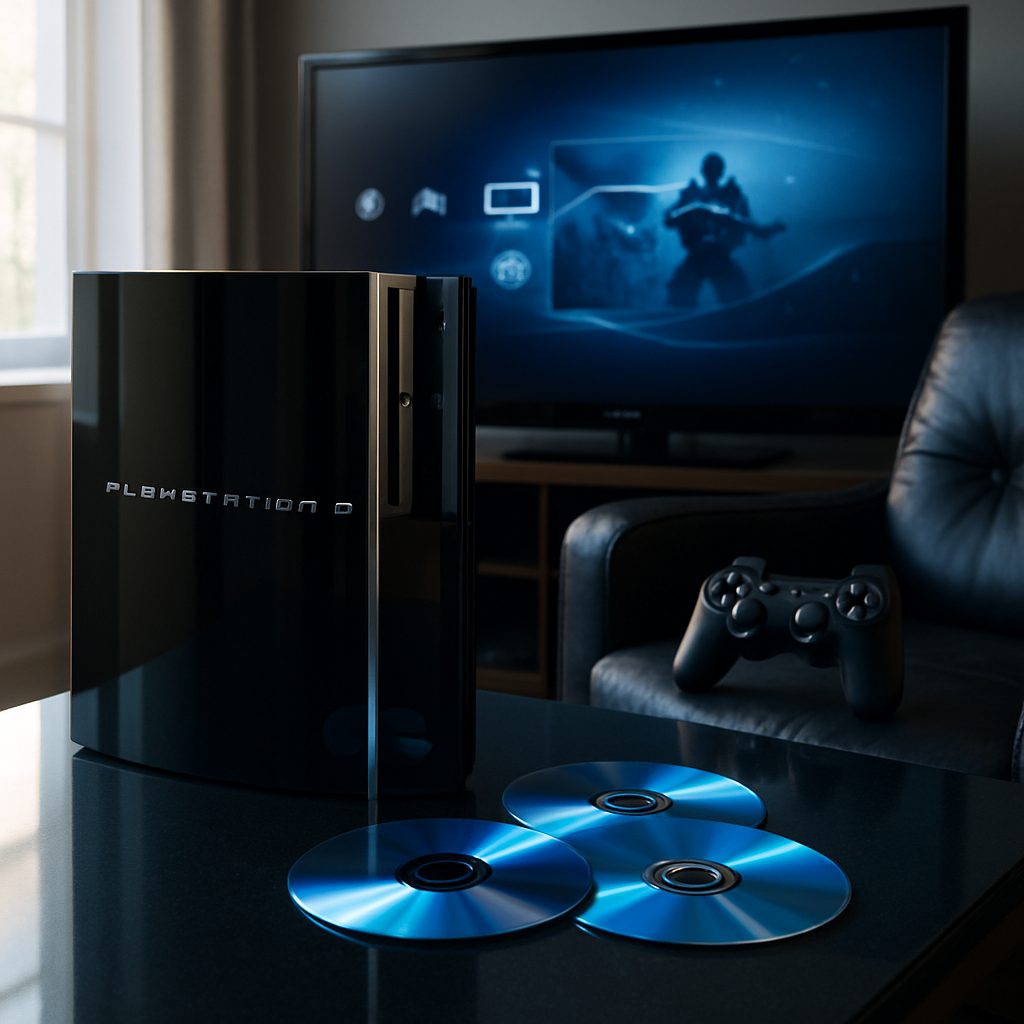
In 2006, Sony unveiled the PlayStation 3, an ambitious machine that rethinks video gaming like never before. The Cell architecture, the integrated Blu-ray player, and the launch of the PlayStation Network (PSN) represent breakthroughs embodying the brand’s boldness. Understanding these innovations requires diving into the technical choices and challenges of the time, amid fierce competition and promises of unprecedented interactive experiences.
🔥 Cell: a hybrid processor (PowerPC + eight SPU cores) designed for parallel computing and real-time 3D.
💿 Blu-ray: massive storage (25 to 50 GB per disc) offering high-definition graphics and extensive multimedia content.
🌐 PlayStation Network: a free platform since 2006, pioneering online console services, introducing downloads, interactive storytelling, and networked gaming.
⚔️ Competition: Xbox 360 and Core 2 Duo generation computers redefine performance, forcing Sony to push the limits of hardware and ecosystem.
Sommaire
Genesis and Strategic Positioning
In mid-2005, Sony announced the PS3 under the banner of performance and versatility. Aware of evolving uses, the company aimed to combine video gaming, high-definition cinema, and online experiences. True to its tradition, it bet on a proprietary architecture – the famous Cell – while adopting Blu-ray, an unexpected supporter of the format amid the optical media format war.
Competition: Xbox 360 and High-End PCs
At the time, Microsoft’s Xbox 360, launched at the end of 2005, already offered multiplayer and HD graphics. Meanwhile, PCs equipped with Core 2 Duo processors and dedicated graphics cards competed with consoles to provide sharper images and free access to online services. Sony therefore had to face two fronts: maintain the appeal of console gaming while justifying a premium selling price.
The Cell Processor: Promise and Complexity
Architecture and Operation
Born from the Sony–Toshiba–IBM partnership, the Cell combines a Power Processing Element (PPE) core and eight Synergistic Processing Units (SPU). Each SPU excels in vector computation, ideal for simulating physics and animations. On paper, this structure guarantees cutting-edge power for imagery and virtual world rendering. In practice, exploiting all these cores requires advanced programming: developers must rethink their engines, optimize every pipeline, and juggle the SPUs’ local memory.
Advantages and Constraints
- Raw performance: capable of exceeding 200 GFLOPS, the Cell outperforms traditional CPUs.
- Complex programming: task distribution between PPE and SPU long hindered studios, generating longer development times.
- Evolution by iteration: Sony progressively reduced the number of accessible SPUs to improve reliability and compatibility, thus stabilizing the platform.
The Choice of Blu-ray: A Bet on the Future of Multimedia
Before the PS3, Sony was already leading the optical media battle with HD DVD in the video market. Blu-ray, designed to carry up to 50 GB of data, allows for more detailed textures, cinema-quality cutscenes, and complex interactive services. Integrating a Blu-ray player was a major selling point, transforming the console into a full-fledged home cinema player.
Impact on Game Production
« With Blu-ray, it is no longer necessary to juggle multiple discs: we imagine gigantic open worlds, multiple voice-overs, and cinematic bonuses included right from the start. »
Publishers take advantage of this space to multiply languages, add trailers, offer making-of documentaries, and even exclusive short films. The explosion of content enriches the player experience but also increases the size of updates and downloads.
Technical Specifications

| Component | Details |
|---|---|
| Processor | Cell Broadband Engine (1 × PPE + 7 usable SPUs @ 3.2 GHz) |
| GPU | RSX “Reality Synthesizer” @ 550 MHz |
| Memory | 256 MB XDR DRAM (“main”) + 256 MB GDDR3 (RSX), high bandwidth |
| Storage | Blu-ray discs (25/50 GB), internal HDD 20–320 GB |
| Connectivity | Ethernet 100 Mb/s, Wi-Fi, Bluetooth, USB 2.0 ports |
| Optical System | Blu-ray / DVD / CD drive |
Launch and Early Developments of the PlayStation Network
From November 2006, the PSN was launched without subscription fees, offering a different model from Xbox Live Gold. Sony offered downloads of demos, indie games, and paid or free video content. Gradually, the addition of features such as trophies, voice chat, and automatic updates transformed the PSN into a social and community space.
The rise of the PSN was however accompanied by challenges: overloaded servers, cumbersome updates, and security issues. In 2011, a major attack led to the temporary shutdown of the service, pushing Sony to rethink data protection and raise cybersecurity standards.
Comparison with Contemporary Computers
In 2006–2008, a well-equipped PC (Core 2 Duo E6600, GeForce 8800 GT, 2 GB RAM) competed with the PS3 on certain titles, especially multi-platform ones. The PC retained an advantage in resolution and refresh rate, while the PS3 relied on optimization via Cell to achieve specific visual effects (smoothness, dynamic lighting). The choice between console and PC then depended on priorities: plug & play simplicity or overclocking and modding possibilities.
To delve deeper into the history and évolution des consoles de jeux vidéo, one can look at the major milestones from the 1970s to the recent upheavals of streaming and cloud gaming.
Perspectives and Legacy
- Exclusive production: licenses like Uncharted or Resistance fully exploit the Cell to create cinematic universes.
- Blu-ray ecosystem: the PS3 helped democratize the format, abruptly stopping the rise of HD DVD.
- Online infrastructures: the PSN laid the foundations for enriched services (PlayStation Plus, video streaming, indie games).
FAQ
Why did Sony design the Cell processor instead of a traditional CPU?
The Cell aims to offer unprecedented parallel computing power. By combining a general-purpose core (PPE) with multiple vector cores (SPU), Sony seeks to accelerate 3D rendering, physics, and video decoding. Traditional CPUs simply could not compete in terms of vector computing throughput at an equivalent budget.
What was the impact of Blu-ray on the popularity of the PS3?
Integrating a Blu-ray player transformed the PS3 into a true multimedia center. Players enjoyed not only richer games but also high-definition movies, providing an attractive selling point compared to costly standalone players.
What were the main limitations of the PSN at its launch?
Initially, the PSN suffered from undersized servers and an immature infrastructure. Downloads could be interrupted, and content offerings were limited. It was only after several updates and security enhancements that the network gained stability and a greater variety of offerings.
How did the PS3 compare to gaming PCs of the same generation?
A PC equipped with a Core 2 Duo and a mid-range graphics card matched it in raw performance and resolution. However, the PS3, optimized for the Cell and RSX, offered plug & play coherence and studio exclusives that made the difference for many players.
