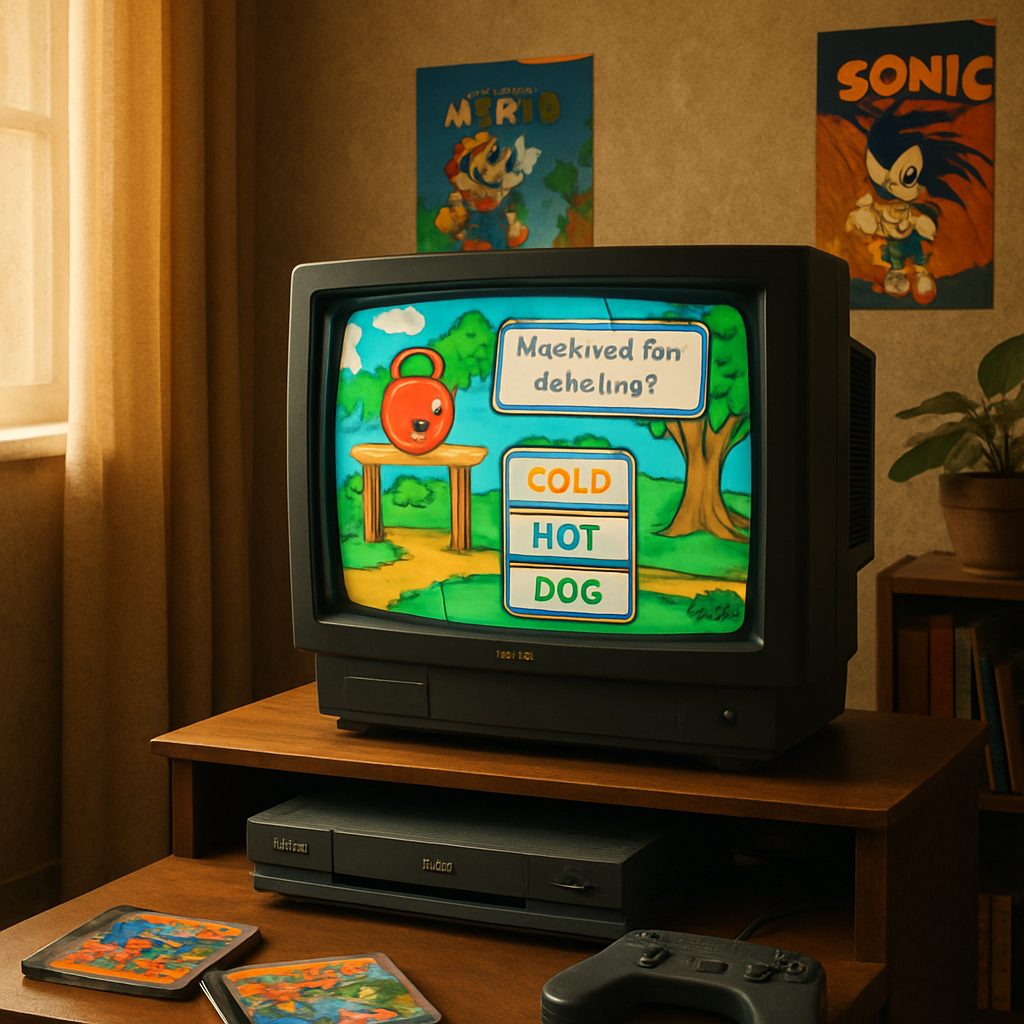
In 1991, Philips unveiled the CD-i, a hybrid multimedia player where learning blends with entertainment. More than just a console, this system is based on the principle of the interactive CD-ROM, aiming to open a new educational horizon. Facing traditional computers and consoles, Philips bet on a playful and formative approach, supported by remarkable partnerships and a bold architecture.
Sommaire
In brief
🔍 Hybrid platform: the CD-i combines video, audio, and interactivity thanks to a CD-ROM drive and a 16/32-bit processor.
🎓 Educational goal: Philips targets schools and homes, offering about ten titles certified by teaching specialists.
🕹️ Varied catalog: from historical simulation to language exercises, the CD-i features more than 200 references, including prestigious licenses.
⚔️ Multiple competition: facing the Sega Mega-CD, Commodore CDTV, or MS-DOS PCs, the machine struggles to impose its atypical positioning.
Genesis and concept of the Philips CD-i
Origins and educational ambition
In the early 90s, Philips focused its efforts on the laserdisc and laser telephony. The idea was born from the combination of digital video with user-controlled interactions. The initial ambition was not to directly compete with Sega or Nintendo, but to transform the living room into an educational space. Within their research & development laboratories in the Netherlands, engineers designed a device capable of exploring the origins of languages, diving into natural history, or teaching chemistry through smooth and didactic animations.
In reality, the CD-i relied on Philips’ expertise in the field of compact disc players. The brand envisioned large-scale distribution in schools, where the ergonomics and robustness of the casing mattered as much as the quality of the content. Demonstrations to teachers quickly highlighted the appeal of interactive pedagogy: still images, videos, dynamic quizzes, and mini-games followed one another without downtime.
Technical architecture of the system
The motherboard housed a 16/32-bit processor from the Motorola family, while the RAM hovered around 1 MB, expandable to 2 MB thanks to an additional module. The CD-ROM drive read through polycarbonate layers at 1× or 2× speeds, offering a storage capacity of 650 MB. On the video side, the machine exploited a palette of 16.7 million colors, with a standard resolution of 384×280 pixels.
Technical specifications
| Component | Specifications |
|---|---|
| CPU | Motorola 68070 16/32-bit at 15.5 MHz |
| RAM | 1 MB (expandable to 2 MB) |
| Media | CD-ROM 650 MB |
| Video | 16.7 million colors – 384×280 px |
| Audio | 4 digital channels |
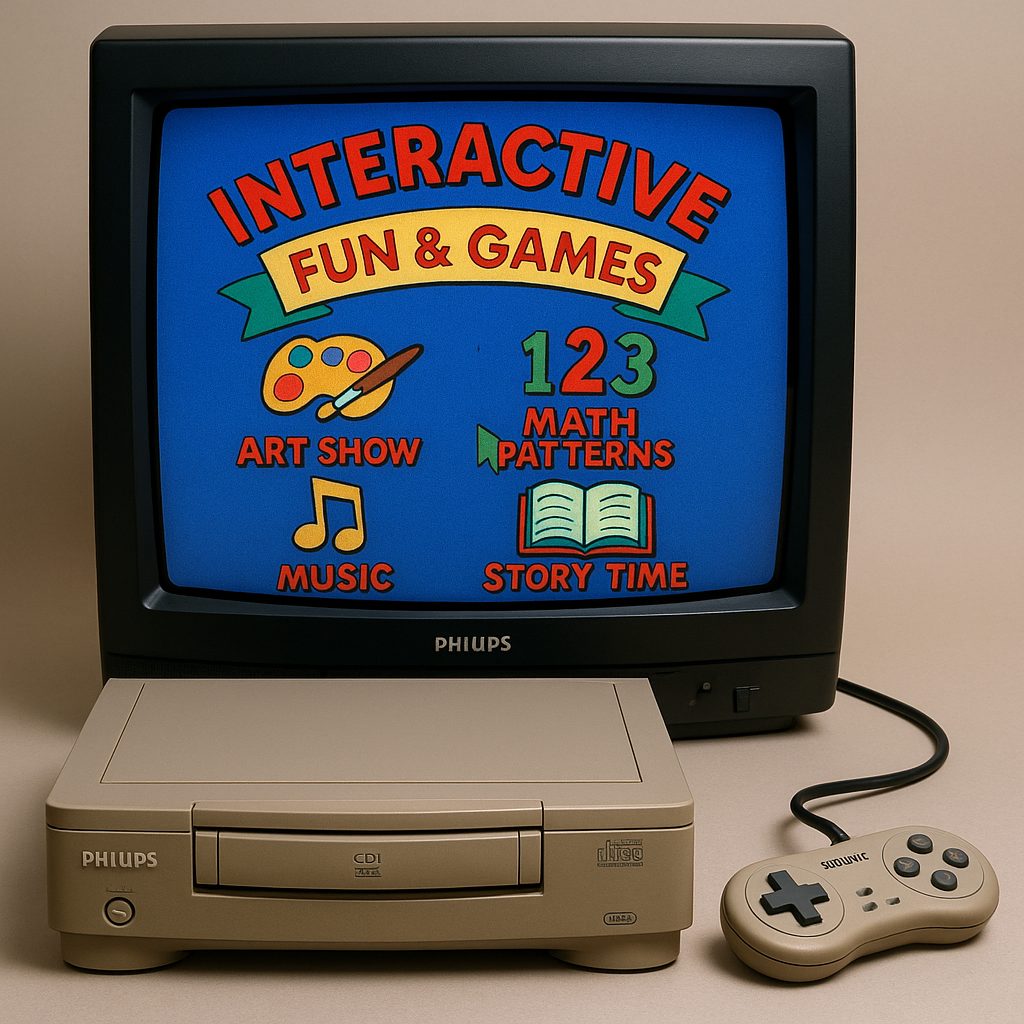
The Educational Games Catalog
Formats and Original Productions
The titles developed for CD-i are organized around two pillars: pure education and interactive adventure. Among the most notable, “World Library: The Story of Newton” offers an animated dive into the life of the physicist, while “Interactive Physics” presents itself as a virtual laboratory to experiment with mechanical laws and forces. The video pre-rendering technique allows chaining live-action sequences and 2D graphics, creating an immersion that few consoles at the time could rival.
Specialized CD-ROM publishers have succeeded one another to bring their expertise: Philips Media publishes several collections, Silicon Graphics signs the “Travel Diaries” series, and American Laser Games handles more playful titles, where the mouse replaces the classic controller. This diversity reflects Philips’ desire to embrace all uses, from family entertainment to the high-tech classroom.
Partnerships and Licenses
Rather than developing exclusively in-house, Philips forms agreements with independent studios and cultural institutions. Museums like the Rijksmuseum lend their archives for virtual exhibitions, while European language schools design oral and written exercises. These alliances give rise to themed boxes: Mediterranean archaeology, interactive anatomy, literary translation workshops.
- Disney Interactive: animated tales and voice quizzes
- National Geographic: exploration of fauna and flora
- University of Amsterdam: Dutch and English language modules
Competition and Positioning
Against Classic Consoles
In the consumer market, Philips does not just face the Super Nintendo or the Sega Mega Drive: the arrival of the Sega Mega-CD and the TurboGrafx-CD creates a CD-ROM segment for consoles where video and audio playback become a major selling point. Yet, Philips’ strategy remains distant: where Sega emphasizes arcade graphics, Philips bets on the richness of multimedia content and the modularity of uses.
To complement this perspective, a overview of the evolution of consoles sheds light on successive breaks – from cartridge to CD, then to streaming. From this perspective, the CD-i appears as an advanced experiment, before the rise of interactive DVDs and online platforms.
Comparison with Computers of the Era
In households, the Amiga 500 and the Atari ST remained favorites of graphics enthusiasts and musical demonstrations, while the MS-DOS PC dominated businesses. Floppy disks limited to 880 KB suggested that the CD-ROM would represent the next step, but not everyone played along. The Commodore CDTV, an early cousin of the CD-i, suffered from confused marketing and a high price.
| Platform | CPU | Media |
|---|---|---|
| Amiga 500 | Motorola 68000 at 7 MHz | 880 KB Floppy Disk |
| Atari ST | Motorola 68000 at 8 MHz | 720 KB Floppy Disk |
| PC MS-DOS | 386SX at 16 MHz | 1.44 MB Floppy Disk |
| CDTV | Motorola 68000 at 7.14 MHz | 650 MB CD-ROM |
Retrospective and Legacy
Successes and Limitations of the Project
Although the CD-i never established itself among hardcore gamers, it found its audience among schools and some curious families. The production costs of interactive discs remained high, content updates were complex, and competition increasingly fierce. In 1996, Philips gradually abandoned the “console” aspect to focus on developing CD-ROMs intended for PCs and multimedia kiosks.
“The CD-i will not be the revolutionary console many hoped for, but it paves the way for educational interactivity, which desktop computers would only truly embrace ten years later.”
The Influence on Modern Interactive Publishing
In the background, the CD-i foreshadows the principles of e-learning and digital storytelling. Navigation methods via menus, clickable chapters, and on-demand videos are now widespread on the web and in mobile applications. Philips’ laboratories laid the foundations for increasingly smooth visual interactivity, later adopted by DVD-ROMs and then by online platforms like Khan Academy or Coursera.
In short, even if the CD-i remains for many a somewhat kitschy childhood memory, its legacy endures at the heart of digital educational pathways. A fad or a true innovation, it mainly taught that gaming and pedagogy can coexist, opening the way to new interactive formats.
