In the early 90s, two giants engaged in a merciless battle to dominate the home console market. On one side, Nintendo, comfortably established after the resounding success of the NES. On the other, Sega, shaking up the established order with aggressive communication and impactful innovations. Explore here the driving forces behind this confrontation that shaped the modern video game industry.
🎮 Historic rivalry: Sega and Nintendo embodied the 16-bit war, boosting both technological innovation and studio creativity.
📊 Key figures: the Mega Drive attracted nearly 30 million users, while the Super Nintendo reached 49 million sales.
🛠️ Technical specs: 16-bit CPU, RAM ranging between 64 KB and 128 KB, cartridge media versus cartridges/expansion chips.
⭐ Legendary catalog: Sonic, Mario, Zelda, or Streets of Rage have left their mark on the collective imagination – each universe competing in originality.
Sommaire
Context and stakes
The late 80s redefined the contours of home video gaming. The triumph of the NES restored credibility to a sector drained by the 1983 crisis. Nintendo then benefited from a reassuring image and unmatched control over its production lines. For Sega, ambitions were clear: to capture the teenage audience that Nintendo deemed too “family-oriented.” This transgressive profile had already led to the success of the Master System, but the Japanese company aimed higher.
In this context, other competitors — Amiga, Atari ST, even compatible PCs — were emerging, ready to capture a niche. Yet, the fiercest battle was fought between two rivals with sharp marketing and colossal budgets.
Nintendo: the quiet strength
Strategy and brand image
Nintendo evolved like a wise king on its throne. The company maintained a meticulously crafted communication, favoring quality and reliability. The Super Nintendo, released in 1990 in Japan and 1991 in Europe, relied on a “premium” positioning: refined packaging, official licenses, and strict control of third-party publishers.
Nintendo’s partnerships with studios like Rare or Square brought an epic breath to the catalog. This jewel of the game library notably offered Super Mario World or The Legend of Zelda: A Link to the Past, true technological and artistic showcases of the 16-bit era.
Major technical innovations
The Super Nintendo featured a Ricoh 5A22 processor at 3.58 MHz, complemented by a graphics chipset capable of displaying 256 colors simultaneously from a palette of 32,768. Its sound chip, designed by Sony, set a high bar for chiptune music, placing the technical standard above the Mega Drive.
However, Nintendo did not succumb to the add-on craze. Compared to standard cartridges, only a few expansion chips (Super FX, SA-1) were developed, often reserved for ambitious titles like Star Fox.
Sega: the bold challenger
“Rebel” Marketing
The “Genesis Does” campaign (or “Sega Rocks”) left no room for softness. Sega positioned itself as the console for young adults, far from family constraints. The image of Sonic, a mascot with a cool attitude, strongly contrasted with the polished world offered by its competitor.
Television and magazine advertisements praising the display speed or the “rock” aspect of the Mega Drive left a strong impression and consolidated a very engaged fan community.
Technical feats and add-ons
The Mega Drive, equipped with a Motorola 68000 CPU at 7.61 MHz and a Zilog Z80 processor handling sound, took advantage of its higher frequency to offer faster animations. The graphics palette, limited to 64 simultaneous colors, was however compensated by a more dynamic rendering and sprite screens rich in detail.
Sega did not hesitate to multiply extensions: Mega CD for CD sound and FMV, 32X for a first foray into 32-bit. Although the critical and commercial reception was mixed, these attempts demonstrated Sega’s willingness to push the limits of its console.
Technical comparison: Specifications
| Element | Super Nintendo | Sega Mega Drive |
|---|---|---|
| Main CPU | Ricoh 5A22 @ 3.58 MHz | Motorola 68000 @ 7.61 MHz |
| RAM | 128 KB | 64 KB |
| Simultaneous colors | 256 / 32,768 | 64 / 512 |
| Sound | 8 stereo channels (Sony SPC700) | 10 FM + PSG channels |
| Media | Cartridges (+ Super FX chips) | Cartridges (+ Mega CD, 32X) |
The computer rivals
In this battle, personal computers like the Amiga 500 or the Atari ST tried to seduce with graphical and sound capabilities often superior to 16-bit machines. However, their keyboards and mice remained less intuitive than a pad, limiting adoption by the general public. The PC, for its part, suffered from complex hardware fragmentation, despite the appearance of iconic VGA and Sound Blaster games.
In the end, it was the ease of use and the coherence of the software–hardware offering that prevailed, leaving these rivals on the sidelines of the living room.
Cultural impact and legacy
The console wars of the 1990s not only marked the rise of video games: they generated a fan culture, tournaments, and specialized magazines. The image of the two mascots, Mario and Sonic, became universal, giving rise to unlikely crossovers and fueling an ongoing dialogue between two passionate communities.
At the turn of the 2000s, the fusion of the two universes—seen in titles like Mario & Sonic at the Olympic Games—illuminates the symbiotic dimension of this rivalry: mutual emulation pushed each side to excel.
Subjective conclusion
While Sega played the provocateur, Nintendo responded with finesse. Neither can claim to have “won” absolutely: their duel mainly propelled the industry to new heights, laying the foundations for the 32/64-bit era and beyond. This fierce struggle remains a living legend, proof that in marketing as in technology, emulation is the best fuel for innovation.
FAQ
Which console sold the most?
The Super Nintendo leads with nearly 49 million units sold, compared to about 30 million for the Mega Drive.
What are the iconic games of this rivalry?
On Nintendo’s side, we remember Super Mario World and The Legend of Zelda: A Link to the Past. For Sega, Sonic the Hedgehog and Streets of Rage perfectly embody the bold choices of the manufacturer.
Why also mention computers?
Amiga, Atari ST, and PC occasionally threatened the supremacy of consoles by offering advanced graphic and sound performance, but their complexity of use confined them to a niche.
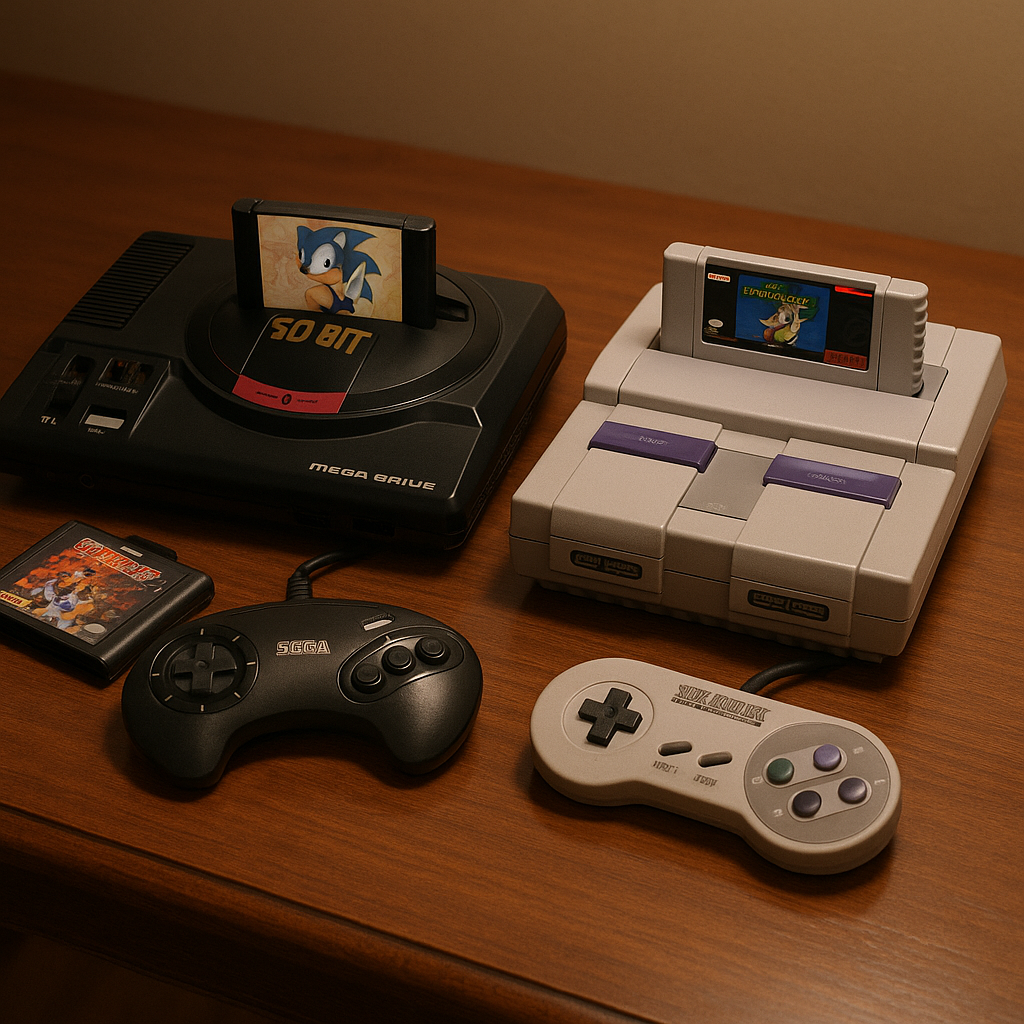
To deepen the overall evolution of home machines, you can consult the history of video game consoles and grasp the major milestones that followed this pivotal decade.
