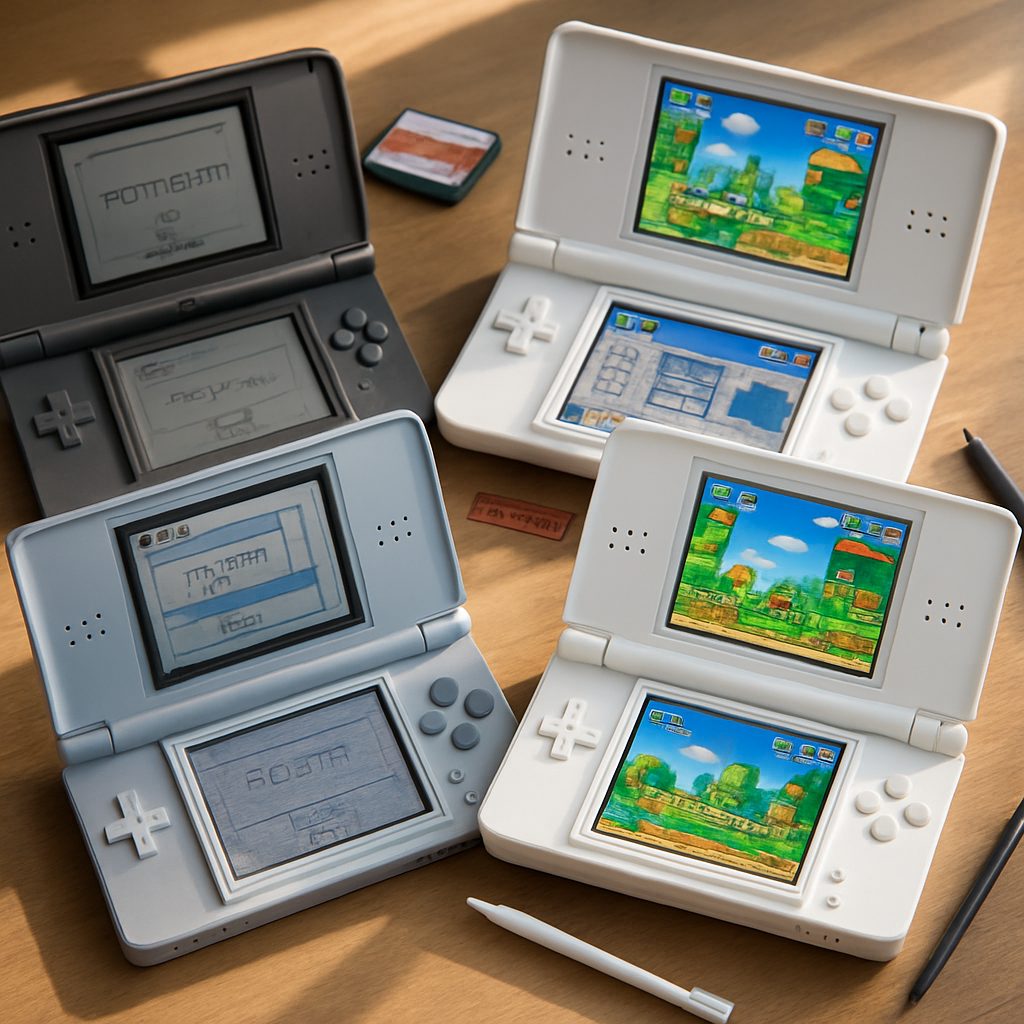
When Nintendo unveiled its handheld console in 2004, it perhaps did not imagine the magnitude of the upheaval that the Nintendo DS would cause. By betting on an unprecedented format combining dual screens and a touchscreen interface, the company redefined portable usage and established a new standard, before improving its model with the DS Lite. Through this deep dive, we review the technical ingenuity, competitive context, and the commercial success that made the DS the best-selling console of all time.
Sommaire
In brief
🌻 Dual screen and stylus inaugurated a radical way of playing, offering a unique device where the upper screen displays the action while the touchscreen becomes the game board.
⏳ The DS Lite corrected some ergonomic points (brightness, design finesse), consolidating the installed base and attracting a wider audience, notably casual players.
🚀 With more than 154 million units sold, the DS surpasses the Game Boy and rises to the top of handheld consoles, widening the gap against the PSP and early smartphones.
⚙️ Under the hood, an ARM processor, multitasking management, and NAND cartridge support ensured the continuity of the portable line while opening new gaming applications.
The origins and announcement of the Nintendo DS
A break with portable tradition
After a decade dominated by the Game Boy Color and Game Boy Advance, one might have thought Nintendo would simply extend the monochrome or sleek formula. In truth, the Kyoto firm sensed a desire for a radical refresh: the mobile market was moving away from the simple directional pad and A/B buttons. The goal was clear: to re-enchant gameplay by introducing a new physical dimension.
The Nitro project
Behind the scenes, the development team, led by Satoru Iwata, was working on a prototype codenamed “Nitro.” Every day, they tested the touchscreen reliability, hinge durability, and battery life. Halfway between a PDA and a console, this device was meant to retain the accessibility simplicity of a Game Boy while bringing a range of interactions previously reserved for playful research labs.
Dual screen and touchscreen interface
An unprecedented concept on a handheld console
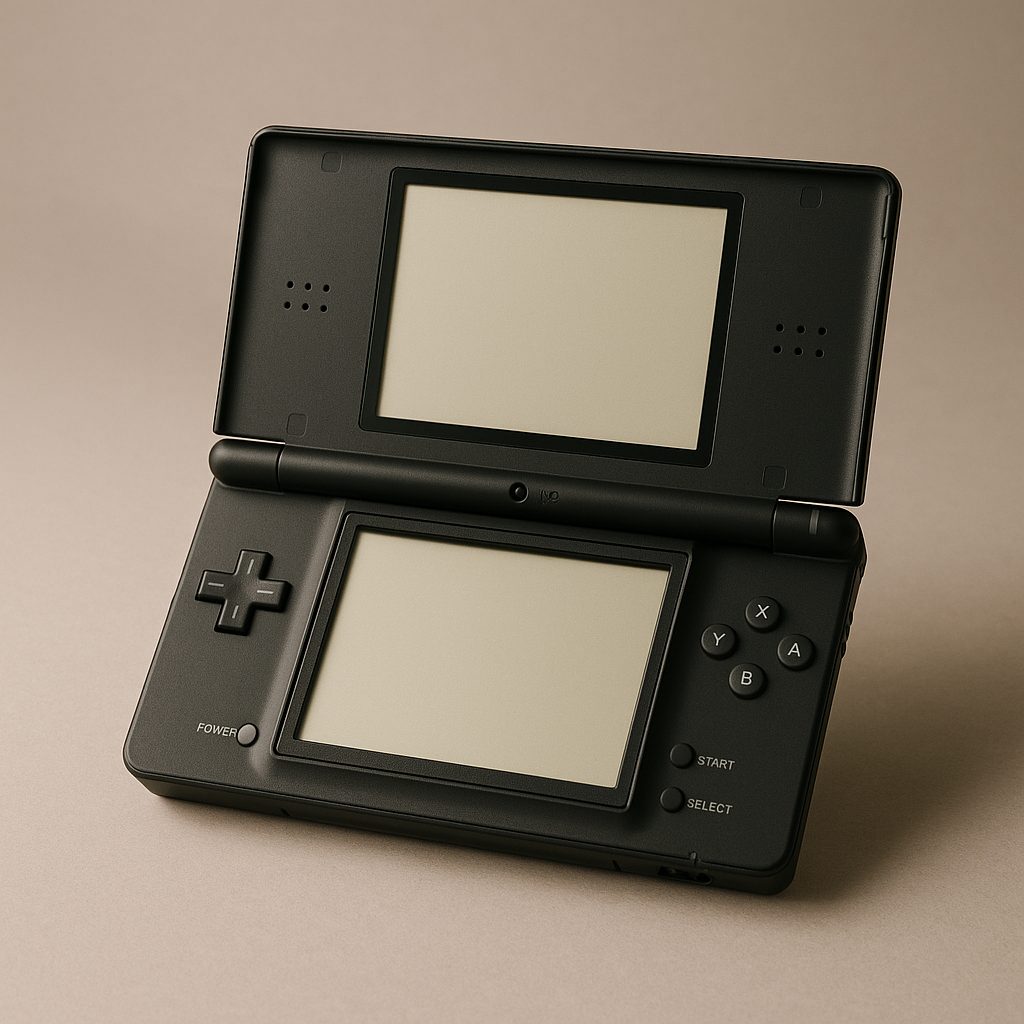
Playing with two screens had until then not left the arcade or industrial domain; Nintendo made it portable. The upper screen, non-touch, serves as the main window on the action, while the lower screen, covered with a resistive layer, is controlled by stylus or finger. This separation allows, for example, drawing trajectories, mapping, or interacting with menus without hiding the game screen. The device could thus be compared to a sketchbook connected to a miniature projector.
Examples of uses and gaming innovations
In practice, the DS generated original gameplay mechanics: strategic sketches in Advance Wars, tactile puzzles in The Legend of Zelda: Phantom Hourglass, or on-the-fly written dialogue in Hotel Dusk. Each title exploited the dual screen to streamline information, organize inventories, or offer dynamic cutscenes. The experience, sometimes amusing at first glance, revealed a disconcerting precision for a handheld console.
Technical Sheet
Main Features
| Power | Dual-core ARM9 ARM7 processor |
|---|---|
| RAM | 4 MB of RAM (Nintendo DS) |
| Storage | Proprietary ROM cartridges, internal NAND memory |
| Screens | 2 × 3 inches (256×192 pixels resolution), one touchscreen |
| Connectivity | Wi-Fi 802.11 b/g (Nintendo DS), extension for DS Lite |
| Battery | 7 to 10 hours of gameplay (Nintendo DS), up to 15 hours (DS Lite) |
| Dimensions | 148×84.7×28.9 mm (DS), 133×73.9×21.5 mm (DS Lite) |
Competition and Market Context
The Rivals of the Time: PSP, Emerging Smartphones
In the first months following its launch, the DS faced the PlayStation Portable (PSP) from Sony, which focused on raw power and a single high-resolution screen. While the PSP targeted an audience eager for “console” graphics, the DS aimed at a broader segment, including fans of original experiences and families. At the same time, some PDAs attempted to integrate Java games, but lack of hardware optimization and poor ergonomic design blocked their path.
The rise of the first smartphones also began to erode the attention of casual gamers, even though the DS maintained a clear advantage in touch responsiveness and battery life. This screen war confirmed Nintendo’s interest in innovation over raw power, a refined positioning that can be seen more broadly in the evolution of video game consoles, offering an essential overview to understand the DS in its historical context.
Heritage and Internal Comparisons
Like the Game Boy Color, the Nintendo DS inherited an unmatched longevity while bringing a fresh gaming renewal. One can even see it as the direct descendant of the Nintendo Entertainment System, which, in the 1980s, made a major impact after the American crash — a similar pattern to the DS following the relative failure of the Virtual Boy.
Commercial Success and Sales Record
A Meteoric Rise
Sales acceleration began as early as the 2004 holidays, driven by flagship titles like Mario Kart DS and New Super Mario Bros. Store shelves swallowed several hundred thousand units each quarter. Nintendo knew that a strong catalog guaranteed purchase peaks, but the scale of the phenomenon exceeded forecasts, sometimes forcing retailers to monthly allocations.
Key Figures and Legacy
In total, the DS and DS Lite reached 154.02 million units sold worldwide, surpassing the PS2 and leaving the Game Boy Advance far behind. This record is not just due to nostalgia: new segments, notably education (Brain Training) and casual gaming (Nintendogs), attracted diverse profiles. In the background, this triumph paved the way for the Nintendo 3DS, relying on established trust and a community ready to follow the company in its next revolution.
FAQ
What are the differences between the Nintendo DS and DS Lite?
The DS Lite features a more compact chassis, a more powerful adjustable backlight, and better ergonomics. Both screens maintain the same resolution, but the DS Lite offers a more comfortable and lightweight experience.
Why was the dual-screen design maintained?
It is a Nintendo signature that allowed for diversifying gameplay mechanics without overloading the main screen. This configuration generated exclusive titles and strengthened the console’s identity.
Which games made the best use of the touch screen?
Among the most notable: Meteorites, The Legend of Zelda: Spirit Tracks, and Professor Layton, where the stylus replaces the directional pad or serves as an observation tool.
Can you still play on a DS today?
Absolutely, the DS remains operational and many retailers offer used cartridges. Communities have formed around retro gaming to keep the DS game library alive.
