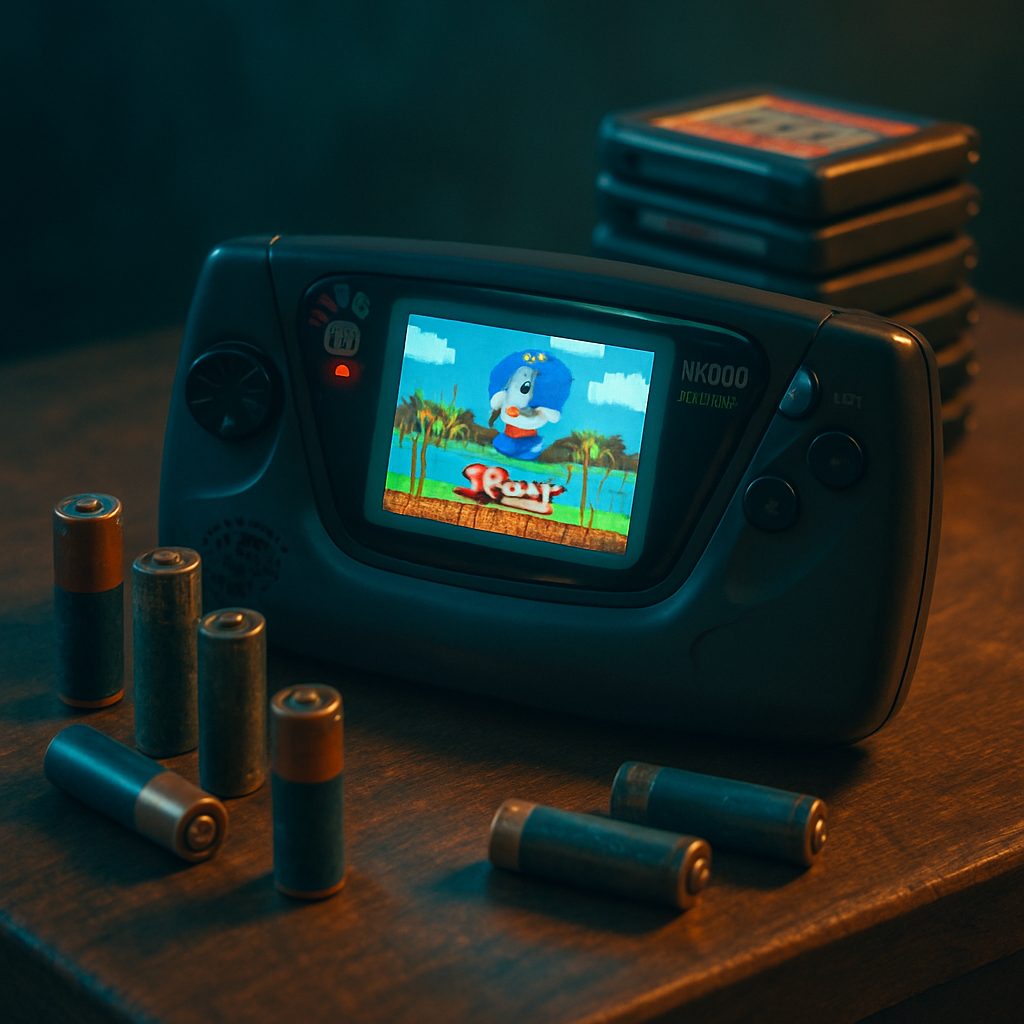
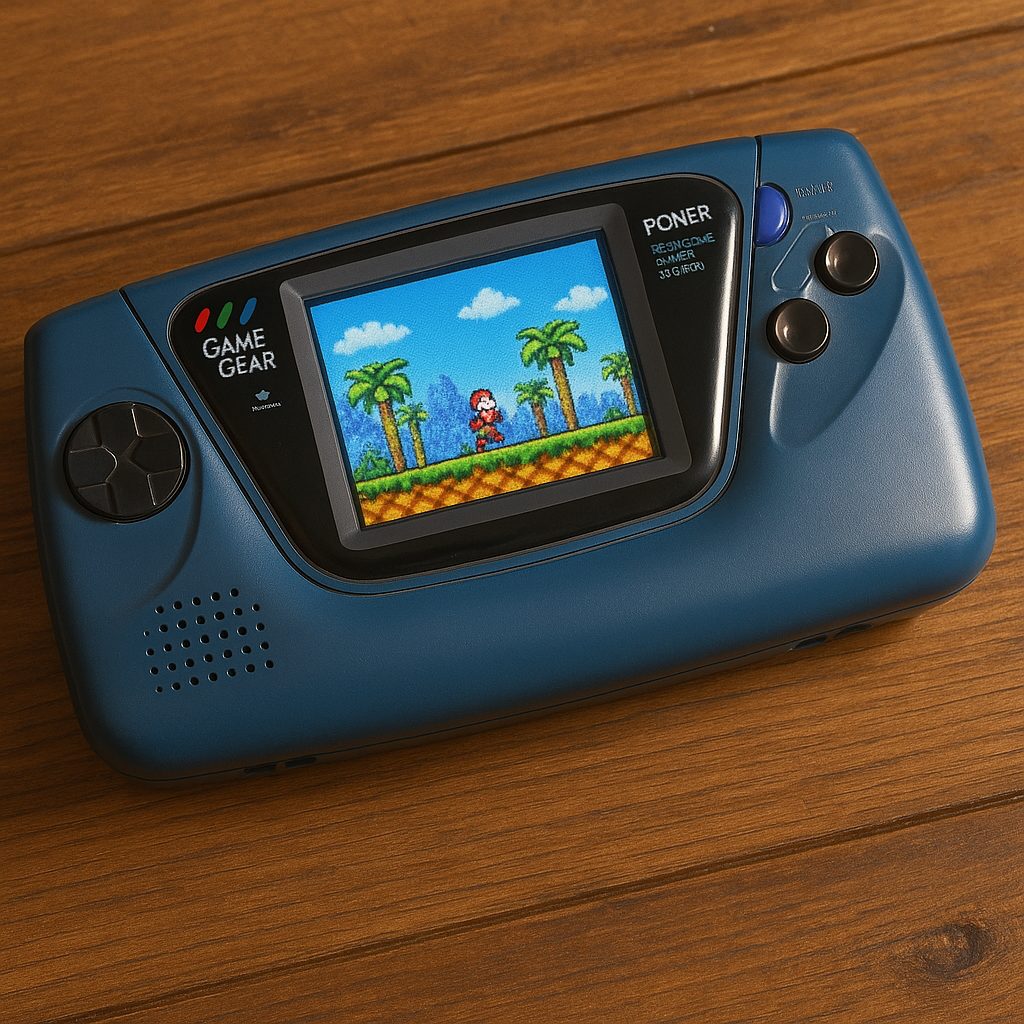
When Sega unveiled its Game Gear in 1990, the 8-bit portable market was shaken up: finally a machine capable of displaying color graphics, far from the monochrome green of the Game Boy. Behind this technological gamble lies a bold design, an energetic appetite, and a quest for performance that made it both a curiosity success and sometimes a criticized object. Exploration of the history, technical background, and legacy of a console that, despite its battery needs, marked several generations of players.
⚡ Color performance: the Game Gear offers a 3.2-inch backlit screen with 4096 colors, a first for an 8-bit portable.
🔋 Variable battery life: up to 5 hours of use on Solo Game Gear, but quickly dropping depending on the intensity of the graphics.
🎮 Rich game library: more than 300 titles, including clever ports of Master System classics, compared to 500 Game Boy Color games.
🕹️ Historical impact: pioneer of color, it directly influenced the evolution of portable consoles in the history of video game consoles.
Sommaire
Genesis and industrial context
A gamble against Nintendo
At the turn of the 1990s, Sega was refining its Master System and eyeing the overwhelming success of the Game Boy. The goal was ambitious: to offer full color on the go, an exclusivity at the time. The R&D team started from the architecture of the home console, adjusted the frequencies, and added a backlit LCD screen. The result weighs nearly 400 grams, much heavier than the competitor, but finally displays a multicolored world in the palm of your hand.
Ambitions and marketing
Sega targeted the Game Gear towards a younger audience, fans of vibrant graphics. Advertising campaigns presented it as the choice of demanding players, ready to trade battery life for unprecedented visual rendering. In the United States and Europe, it was sometimes sold at a discount in packs including controllers, batteries, and cartridges, to offset the shorter playtime compared to the Game Boy.
Technical characteristics and detailed sheet
The Game Gear draws its architecture from the Master System, but with adjustments that meet portable constraints. Between optimized frequencies and components chosen for their small size, the console quickly reveals its strengths… and its limits.
| CPU | Zilog Z80 at 3.58 MHz |
|---|---|
| RAM | 8 KB (+16 KB VRAM) |
| Media | Proprietary cartridges (up to 8 Mbit) |
| Screen | 3.2″ transmissive LCD 160×144 px, 4096 colors (32 simultaneous palette) |
| Battery life | 3 to 5 hours (6 AA batteries) |
| Dimensions | 167 × 86 × 28 mm |
| Weight | ~400 g (without batteries) |
Battery Life and Consumption: The Achilles’ Heel
Despite the touted energy efficiency at launch, the Game Gear proves to be a power hog. The backlit screen, audio chip, and the Z80 CPU running at full speed form a demanding trio. Practically, six AA batteries only guarantee three to five hours of gameplay, depending on brightness and sound intensity. After two hours, battery levels drop significantly, with slower reaction times and collapsing contrast.
In response, third-party accessories equipped with rechargeable NiMH batteries or external battery packs emerge. They partially alleviate the inconvenience but further weigh down the console. This compromise between mobility and electrical power reflects Sega’s philosophy: to offer a unique experience, even if it requires an adaptation effort from the user.
Color Screen and Comparison with the Competition
The presence of a backlit 4096-color screen places the Game Gear well above other monochrome handhelds. The Atari Lynx follows with a similar display, but at the cost of even higher power consumption and a bulky form factor. NEC offers its TurboExpress, faithful to the PC Engine, but the investment ($300 at launch) hinders its adoption.
As for the Game Boy Color, launched in 1998, it certainly offers fewer simultaneous shades (56 colors on screen), but gains in compactness and battery life. It positions itself as the natural successor to the Game Boy and often ends up winning over players disappointed by the Game Gear’s power appetite.
On the portable front, the PC Engine GT remains a quality competitor, but its limited distribution makes it rare outside Japan. In short, Sega achieves a technical feat, without winning the battle of battery life nor that of a widely distributed catalog.
The Game Library: A Bridge Between Home and On-the-Go
To expand its offering, Sega adapts many Master System titles and offers some exclusives designed for mobility. There are portable versions of Sonic the Hedgehog, Columns, Shinobi, and even more niche titles like GG Aleste. The small cartridge size (sometimes up to 1 Mbit) requires rethinking levels and mechanics, but several adaptations showcase ingenuity.
More than 300 games were released, covering arcade, platform, and puzzle genres. Third-party publishers also play along: Tetris, Mortal Kombat, Street Fighter II… all experiences that strengthen the console’s reputation. However, the lack of adjustable backlighting and sometimes low contrast on a cold screen limit the experience in some overly bright environments.
Computing and 8-bit Portable Competitors
In the early 1990s, several hybrid devices attempted to break through. The Sharp Mobilon offered a semblance of a console and PDA, while Sega itself explored the market with the Mega Jet, a Game Gear adaptation for use in the Airbus A310. These machines rarely reached the general public but demonstrate the growing interest in portable computing.
In the PC sector, some compact computers like the Commodore SX-64 or the Amstrad PCW targeted mobile users, but without gaming ambitions. The Game Gear, by directly targeting players, clearly differentiates itself: its streamlined interface and integrated controllers meet a need for immediate grasp, far from cumbersome keyboards.
Legacy and Influence on Subsequent Handhelds
When Sega ceased production of the Game Gear in 1997, it left behind the idea that a color screen is viable in a portable device. Nintendo, already planning its Game Boy Color, incorporated this lesson to offer a more balanced compromise. Later, the Sony PSP in turn adopted the color palette, while optimizing power consumption thanks to UMD technology.
Modern handhelds, from the Nintendo Switch Lite to gaming smartphones, continue this quest for performance and battery life. Without the Game Gear, which dared to combine vivid colors and portability, the history of handheld consoles would be missing an essential chapter.
Quick Technical Sheet
- CPU: Zilog Z80 3.58 MHz
- Memory: 8 KB + 16 KB VRAM
- Media: 64 Kbit to 8 Mbit cartridges
- Screen: 3.2″ transmissive LCD, 4096 colors
- Battery life: 3–5 h (6× AA)
- Weight: ~400 g without batteries
