
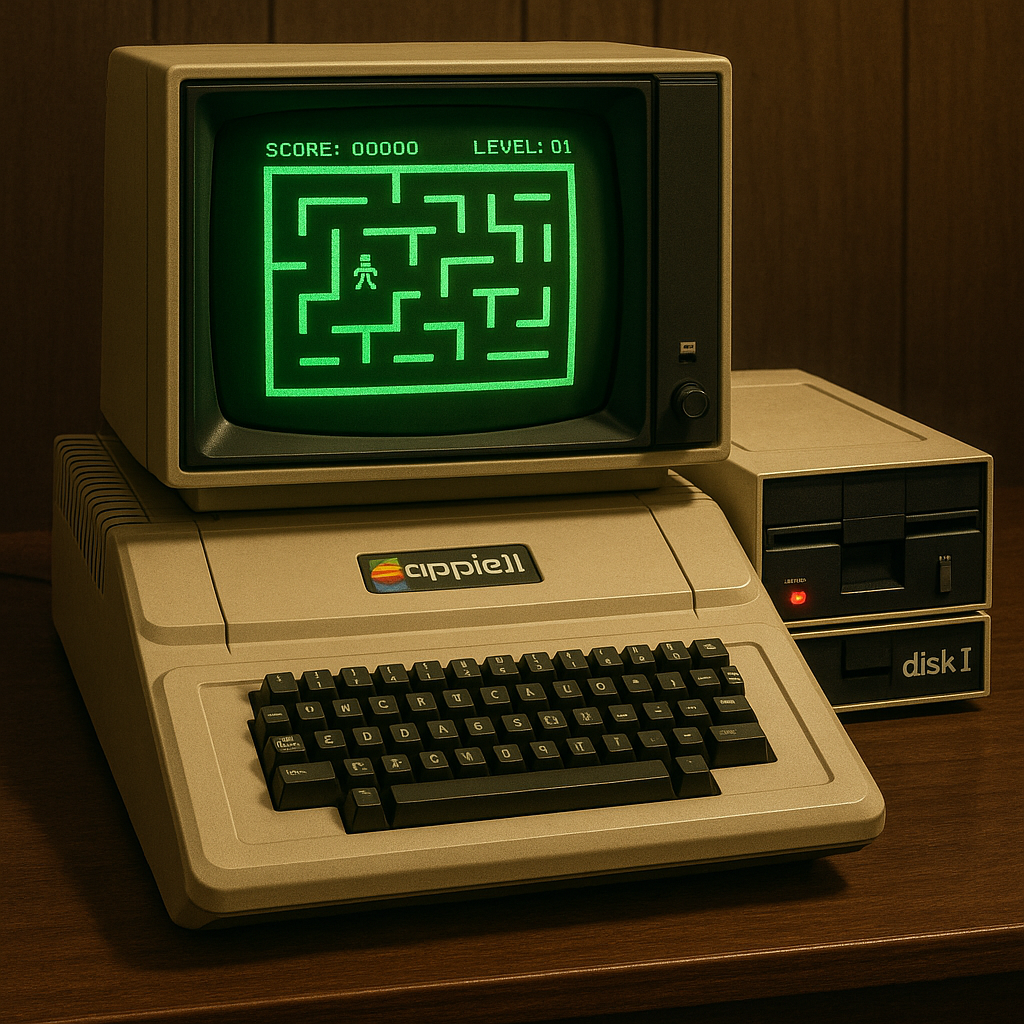
In 1977, the Apple II looked like no other personal computer: colorful casing, 8-bit processor, and—above all—a brilliant ambition: to offer users much more than just calculation, but a true gateway to playful worlds. Thanks to the arrival of the Disk II drive, developers were finally able to design ambitious titles, freed from the constraints of the cassette. This article examines this revolution, from design to its lasting impact on the video game industry.
Sommaire
In brief
🎞️ Thanks to the Disk II drive, the Apple II turned the page on cassettes to offer bigger and faster games.
💾 The use of the 5.25″ floppy disk helped standardize media, laying the foundations for gaming on microcomputers.
🚀 Foundational titles like “Oregon Trail” and “Prince of Persia” took off, inspiring a whole generation of creators.
🌐 This legacy is still found today, marking the timeline of gaming computers.
The genesis of the Apple II
A project born in a garage
Steve Wozniak and Steve Jobs, starting from an almost artisanal desire, designed the Apple II with accessibility and reliability in mind. Where hobbyists tinkered in basements, they wanted a finished product, ready to use, with casing, integrated keyboard, and industrial components. This approach set a milestone: the personal computer would no longer be the preserve of specialists, but an everyday consumer object.
Notable technical innovations
The Apple II relied on a MOS 6502 processor clocked at 1 MHz, 4 KB of RAM expandable up to 48 KB, and color video outputs. But it was the introduction of the parallel expansion bus that opened the way for external peripherals, including the famous Disk II drive designed by Wozniak himself.
The emergence of disk-based games
From cassette to floppy disk
Before the Disk II, most games circulated on audio cassettes: slow loading, frequent errors, and limited capacity. With the 5.25″ floppy disk, the Apple II offered up to 140 KB per side, direct file access, and multiplied reliability. In practice, some titles loaded in a few seconds, where magnetic tape required several minutes of waiting. This speed encouraged developers to imagine larger worlds and smoother animations.
Iconic titles and distribution
Titles like Oregon Trail, created by Don Rawitsch et al., fully benefited from this medium: interactive maps, enriched texts, and integrated saves. Prince of Persia on Apple II was acclaimed for its smoothness, an achievement made possible by fast data handling. The success of these games fostered the expansion of a network of specialized stores and the creation of magazines dedicated to the disk-based gaming universe.
Impact on the Video Game Industry
Standardization of the Medium
The Disk II served as a model for many competing systems: from the Atari XL 800 to Japanese MSX machines, all adopted the floppy disk as the reference medium. This standardization not only facilitated the portability of games but also the international distribution of flagship titles. By making the floppy disk a standard, Apple helped build the foundation of the microcomputer gaming market.
Legacy and Modern Influence
The influence of the Apple II can still be seen today in the design of many emulators and in collectors’ enthusiasm for the 8-bit era. From the retro scene to the phenomenon of re-releases, the spirit of innovation that this computer instilled is found in every pixelated adventure. Later, the transition to the Apple IIGS only extended this quest for graphical and sound performance.
FAQ
Why did the floppy disk replace the cassette on the Apple II?
The floppy disk offered almost instant access to data, greater capacity, and significantly better reliability. Developers were thus able to create more ambitious and longer games.
What was the price of the Disk II system at its release?
In 1978, the Disk II drive was sold for around $295, a considerable investment at the time, but justified by the quality and durability of the device.
How did the Apple II inspire subsequent gaming computers?
The modular architecture and the “open peripheral” approach encouraged other manufacturers to offer their own floppy disk drives. This ecosystem fostered the rapid growth of microcomputer gaming.
