
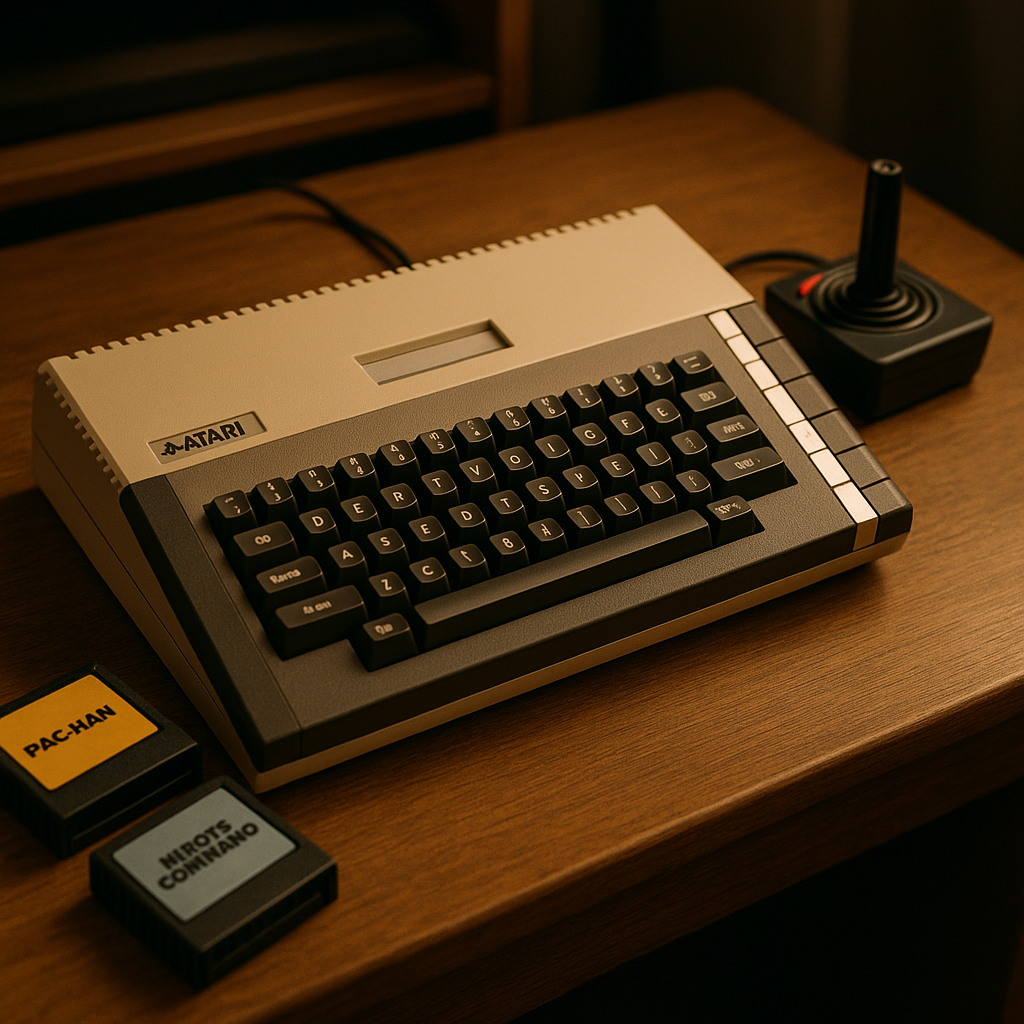
Launched at the dawn of the 1980s, the Atari XL 800 stands as the spearhead of Atari’s third generation of 8-bit computers. Its elegant, almost Scandinavian case houses an architecture optimized for both gaming and amateur programming. Beyond its beautiful facade, it is a robust machine, capable of competing with the best microcomputers of its time. Let’s explore together the technical workings of this model and the little-known video game gems that forged its legend.
🚀 Atari XL 800 inaugurates Atari’s 3rd generation of 8-bit computers, with a MOS 6502C at 1.8 MHz and up to 64 KB of RAM.
🎨 Its GTIA chip displays a palette of 256 colors and manages more sprites, supported by a refined pokey sound.
🕹️ Among its game library, rare titles like Dark Chambers or Escape from the Planet of the Robot Monsters offer a unique experience.
🔗 Its influence is measured in the evolution of microcomputers and the timeline of gaming computers.
Sommaire
Context and Genesis of the Atari XL 800
At the end of the 1970s, Atari had already tasted its first successes with the 400/800 series. The XL 800, introduced in 1983, was launched in a context of fierce competition against the Commodore 64 and Sinclair ZX Spectrum. The goal was clear: to offer a more powerful, more ergonomic machine better suited to the expectations of both gamers and budding creatives.
Evolution of the 8-bit Range
The transition from the 800 model to the XL 800 was based on several hardware improvements: compact case, standardized joystick port, more responsive keyboard. Atari wanted to make an impression and provide a more welcoming environment for coding in BASIC or assembly.
Market Positioning
In terms of pricing, the XL 800 was positioned mid-range, just below the 1200XL. But its increased availability and reasonable price helped multiply sales, notably thanks to an expanded distribution network.
Architecture and Technical Innovations
Processor and Memory
The heart of the XL 800 relies on a MOS 6502C clocked at 1.8 MHz, coupled with 64 KB of RAM, expandable via an extension port. This processor, already proven on the previous range, finds here a broader field of expression, especially for handling game routines.
Graphics and Sound
The GTIA chip, an evolution of the CTIA, manages a palette of 256 colors and offers more sprites, paving the way for richer backgrounds and smoother animations. On the audio side, the pokey chip rises above the fray thanks to clearer sound channels, managing frequencies and limited stereo effects.
Quick Comparison
| Feature | Atari XL 800 | Commodore 64 |
|---|---|---|
| Processor | MOS 6502C 1.8 MHz | 6510 1 MHz |
| RAM | 64 KB | 64 KB |
| Colors | 256 | 16 |
| Sprites | 8 | 8 |
| Sound | Pokey | SID |
Unknown Cult Games on Atari XL 800
While some cartridges have traveled the world, other titles have remained in the shadows. Yet, they reveal the power and creativity the machine was capable of.
Dark Chambers
Before Doom, there was Dark Chambers. This wireframe 3D maze, both unsettling and captivating, immerses the player in a gothic atmosphere. Each room gradually reveals itself, and the sound management – eerie chimes or sinister growls – enhances the immersion.
M.U.L.E.
Originally designed for the Atari 800, M.U.L.E. arrives on the XL 800 with refined graphics and more balanced gameplay. A mix of economic strategy and cooperative/competitive play, it pits players against resource extraction and interplanetary trade.
Escape from the Planet of the Robot Monsters
Under its cartoonish appearance, this title offers a two-player run’n’gun, filled with improbable bosses and labyrinthine levels. Its offbeat humor and fast pace make it a curiosity to (re)discover.
Cyborg
This vertical shoot’em up hooks players with its fast gameplay and creative power-ups. The waves of enemies are numerous, and every pixel counts when chasing the high score.
Legacy and Influence
Although the XL series did not survive the 16-bit revolutions, its spirit has crossed generations. Enthusiasts continue to program new games, fueling a thriving homebrew scene. To gauge the impact of the XL 800 within the evolution of computing, it is fascinating to consult a timeline of gaming computers that places these machines within a long tradition, from simple microcomputers to modern PC gaming platforms.
FAQ
What are the differences between the Atari XL 800 and its predecessors?
The XL 800 improves ergonomics (keyboard, casing), increases RAM to 64 KB, and adopts a GTIA chip for richer graphics.
How can one find the lesser-known games today?
Original cartridges can be found on collector websites, but the homebrew scene also offers disk images to emulate.
Does the Atari XL 800 still inspire developers?
Yes: 8-bit coder contests and retro clubs perpetuate the spirit of experimentation characteristic of that era.
